Why NASA's Swift Telescope Is Falling and Where It Could Land
Why NASA's Swift Telescope Is Falling and Where It Could Land
Main visual for Why NASA's Swift Telescope Is Falling and Where It Could Land
🇺🇸 Swift Is Coming Down
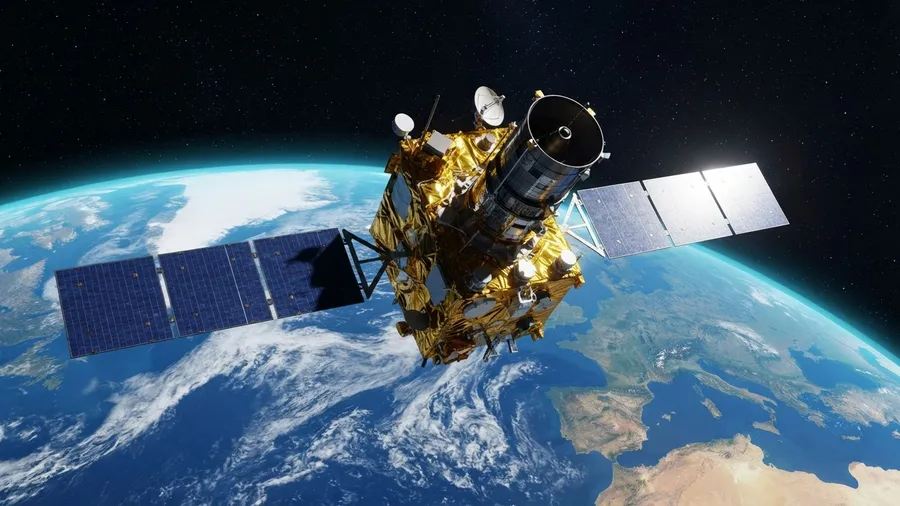
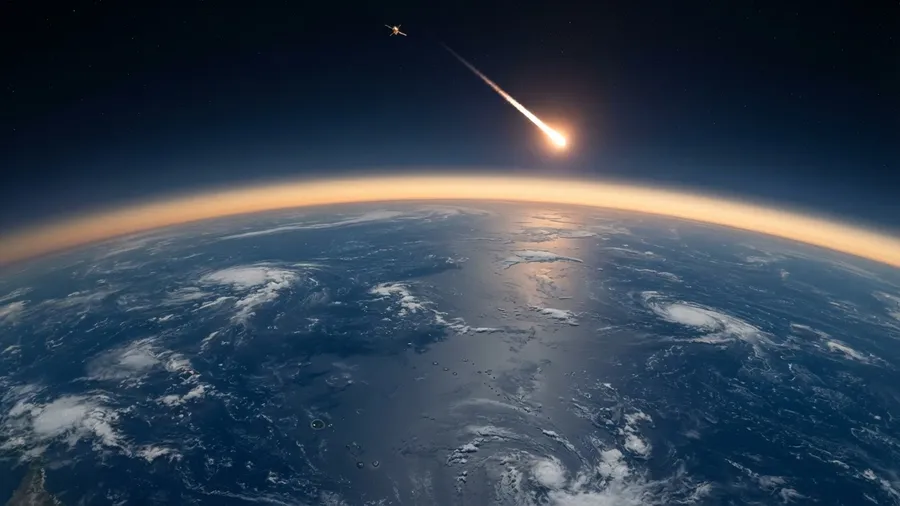
Swift is falling. Not today, and nobody can name the day, but the telescope that has chased gamma ray bursts since 2004 is losing altitude and NASA has stopped pretending otherwise. In early 2026 the team halted most science observations so the spacecraft could hold a pose that cuts drag. I kept rereading that part. A healthy observatory, still working, told to sit still like a fish hiding behind a rock. NASA has said reentry becomes likely later in 2026 if nothing changes. Where the pieces land, I honestly can't tell you. Neither can anyone else yet, and the people tracking it say so openly.
🇪🇸 Una pose para frenar la caída
Imagina un observatorio sano, con instrumentos que funcionan, al que le piden quedarse quieto. Eso pasó con Swift a comienzos de 2026. El equipo detuvo casi toda la ciencia para que la nave adoptara una orientación que reduce el roce con el aire. Es un telescopio de unos 1,500 kilos que lleva más de veinte años mirando explosiones de rayos gamma. Ahora baja, poco a poco. NASA dice que la reentrada se vuelve probable más adelante en 2026 si nada cambia. Fecha exacta, no la hay. Lugar exacto, tampoco. Y eso, si lo piensas, es raro para algo que se rastrea todos los días.

Detail view related to Why NASA's Swift Telescope Is Falling and Where It Could Land
🇺🇸 An Orbit Without an Engine
Swift launched in November 2004 into an orbit around 600 kilometers up, tilted 20.6 degrees to the equator. Its job was simple to describe and hard to do. Catch gamma ray bursts, those flashes from dying stars and colliding neutron stars, and swing around in about a minute to look at the afterglow in X rays and ultraviolet light. It has logged well over a thousand of them. But there's a catch. Swift carries no engine for lifting its own orbit. Nobody planned on that, because in 2004 the expectation was a long, quiet life and an eventual fall decades later. The Sun had other plans.
🇪🇸 Un telescopio que nunca pudo subirse solo
Swift no tiene motor para elevar su órbita. Ese es el detalle que lo cambia todo. Lo lanzaron en noviembre de 2004 a unos 600 kilómetros de altura, y desde allí vigila el cielo en busca de estallidos de rayos gamma, esos destellos que vienen de estrellas que mueren o de estrellas de neutrones que chocan. Cuando detecta uno, gira en cerca de un minuto y mira el resplandor en rayos X y luz ultravioleta. Más de mil estallidos después, el plan original suponía una caída lejana y ordenada. El Sol, con su ciclo de máxima actividad cerca de 2024, aceleró todo.

Scientific diagram illustrating key concepts of Why NASA's Swift Telescope Is Falling and Where It Could Land
🇺🇸 How Thin Air Pulls Down a Satellite
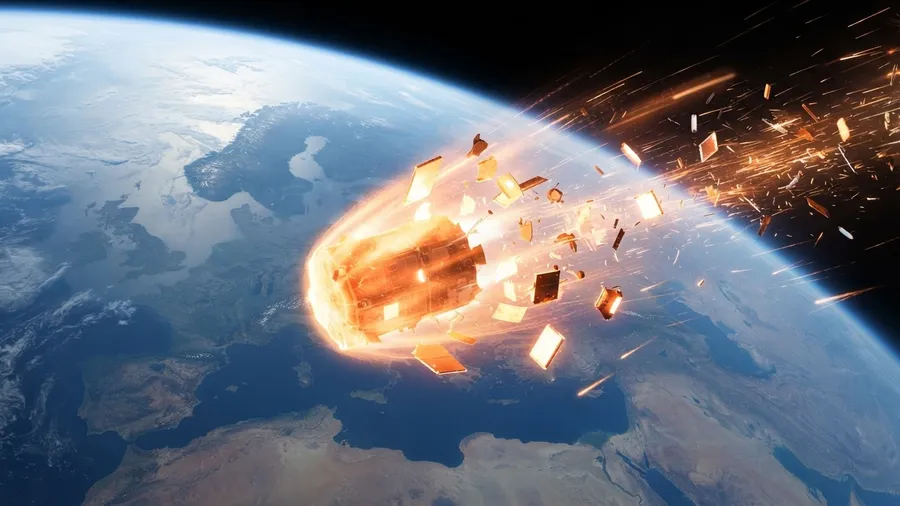
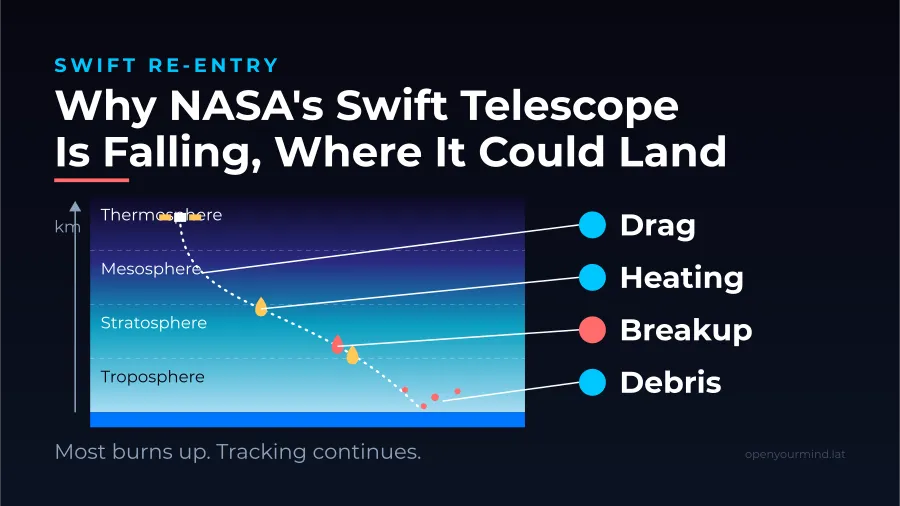
At that height there's still air. Barely. A few molecules per cubic centimeter, but Swift moves at roughly 7.5 kilometers per second, so each one hits like a tiny brake. Every collision steals a bit of energy, the orbit shrinks, and the telescope drops into slightly denser air that brakes it harder. It feeds itself. Then the Sun enters. When solar activity rises, it heats the upper atmosphere and the whole layer puffs outward, so the air at a given altitude gets thicker than last year. Predicting that density months ahead is, frankly, messy. Models disagree. Near the end, around 80 kilometers, heat tears the spacecraft apart and only dense parts like steel or titanium might reach the ground.
🇪🇸 El aire que casi no existe y aun así frena
A esa altura todavía hay atmósfera, aunque sea poquísima. Swift viaja a unos 7.5 kilómetros por segundo, así que cada molécula que golpea funciona como un freno diminuto. Se pierde energía, la órbita se achica, el satélite entra en aire un poco más denso y frena más. Es un círculo que se alimenta solo. El Sol empeora las cosas, porque cuando se activa calienta la atmósfera alta y la hincha hacia arriba. Calcular esa densidad con meses de anticipación es complicado, y los modelos no siempre coinciden. Hacia los 80 kilómetros el calor destroza la nave. Sobreviven sobre todo piezas densas, de acero o titanio.
The process described in Why NASA's Swift Telescope Is Falling and Where It Could Land
🇺🇸 Who Feels It on the Ground
Astronomers feel it first. When Swift spots a burst, it sends coordinates within seconds so telescopes across the planet can swing toward the same patch of sky. Lose Swift and those follow up observations get slower and less precise. Other missions can partly fill the gap, but not entirely. For everyone else, the risk is small. A figure I saw put the chance of someone being hurt around 1 in 9,400, and I'd treat that as a rough number. Because of the 20.6 degree tilt, debris could come down anywhere between roughly 20 degrees north and south latitude. That covers the Caribbean, including my own island. NASA has hired a private company, Katalyst Space Technologies, to try a rescue.
🇪🇸 Quién lo siente aquí abajo
Primero lo sienten los astrónomos. Swift detecta un estallido y manda las coordenadas en segundos, para que telescopios de todo el mundo apunten al mismo rincón del cielo. Sin Swift, ese seguimiento se vuelve más lento y menos preciso. Otras misiones ayudan, pero no cubren todo. Para el resto de la gente el riesgo es bajo. Vi una cifra de uno en 9,400 de que alguien resulte herido, y yo la tomaría como un estimado grueso. Por la inclinación de 20.6 grados, los restos podrían caer en cualquier punto entre los 20 grados de latitud norte y sur. Eso incluye el Caribe y también República Dominicana. NASA contrató a Katalyst Space Technologies para intentar un rescate.
Data visualization for Why NASA's Swift Telescope Is Falling and Where It Could Land
🇺🇸 What Nobody Can Answer Yet
Will Swift still be high enough when the Katalyst mission launches, which is targeted for around June 2026. Nobody knows how fast solar activity will thicken the air before then. Can a robotic spacecraft grab a satellite with no docking fixtures. Swift was never built to be serviced, and that has not been tested in orbit. Which stretch of that 20 degree band will the debris cross. Probably not knowable until days before.
🇪🇸 Lo que todavía nadie sabe
Nadie sabe si Swift seguirá lo bastante alto cuando despegue la misión de Katalyst, prevista para cerca de junio de 2026. Tampoco se sabe si una nave robótica puede agarrar un satélite sin puntos de acoplamiento. Swift no fue diseñado para recibir servicio, y eso no se ha probado en órbita. Y la franja exacta de la banda de 20 grados que cruzarían los restos probablemente se conozca solo días antes.
Real world context for Why NASA's Swift Telescope Is Falling and Where It Could Land
🔗 Related Articles | Artículos Relacionados
Nuestro canal transmite datos curiosos de ciencia, IA, espacio y tecnología las 24 horas. | Our channel streams science facts, AI, space and technology around the clock.
▶ Ver transmisión | Watch liveOPEN YOUR MIND
Source: Source
Join the conversation