A $10 Optical Sensor Brings Lab-Grade Testing to Wearables
A $10 Optical Sensor Brings Lab-Grade Testing to Wearables
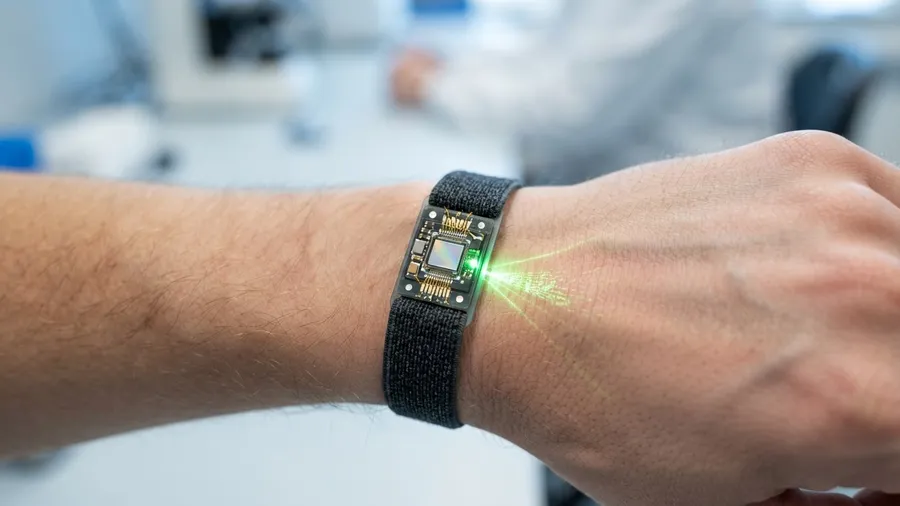
The $10 optical sensor chip sits on a slim smartwatch band, scanning light across the wrist.
🇺🇸 Ten Dollars, Lab Results
Cambridge researchers built an optical sensor that costs about ten dollars to make. Then they pointed it at things. Foods, plastics, medicines. It named every sample correctly, a hundred percent across their tests. I kept rereading that number, because perfect scores usually mean the test was small or too easy, and I cannot tell yet which one applies here. Still, the device is tiny. It is small enough to sit inside a wearable, which is the part that caught me. Instruments that do this kind of identification normally fill a bench and cost thousands. The team also showed signals for blood glucose and alcohol, picked up without drawing any blood.
🇪🇸 Diez dólares y resultados de laboratorio
Un equipo de Cambridge fabricó un sensor óptico que cuesta unos diez dólares. Lo probaron con alimentos, plásticos y medicinas, y acertó todas las muestras. Cien por ciento. Ese número me hizo desconfiar un poco, porque una nota perfecta suele significar que la prueba fue corta o fácil. El detalle que más me sorprende es el tamaño, ya que cabe dentro de un reloj o una pulsera. Un equipo de laboratorio que hace algo parecido ocupa una mesa entera y vale miles de dólares. Además, los investigadores mostraron señales de glucosa en sangre y de alcohol, todo sin sacar una sola gota.

A close-up of the sensor's spectral filters and photodetector pixels on a silicon die.
🇺🇸 The Fingerprint Idea Is Old
Shine light on something and some colors get absorbed while others bounce back. Every molecule does this a little differently, so the pattern works like a fingerprint. Chemists have used that trick for decades, with spectrometers that split light using prisms or gratings and need space to do it. Smartwatches already borrow a simpler version. They flash green light into your wrist to count heartbeats. That uses one or two colors, which is plenty for a pulse and nowhere near enough to separate glucose from everything else in skin. Several big companies have chased painless glucose sensing for years. None of them has delivered it.
🇪🇸 Una idea vieja con un problema de tamaño
La base científica no es nueva. Cuando la luz toca una sustancia, ciertos colores se absorben y otros rebotan, y cada molécula deja su propio patrón. Los químicos llevan décadas usando eso. El problema siempre fue el aparato, porque los espectrómetros tradicionales separan la luz con prismas o rejillas y necesitan espacio y piezas delicadas. Los relojes inteligentes ya usan una versión muy simple, una luz verde que mide el pulso. Con uno o dos colores alcanza para contar latidos. No alcanza para distinguir la glucosa del resto de la piel. Varias empresas grandes lo han intentado durante años sin lograrlo.

Key parts of the $10 Cambridge sensor, from light source to photodetector chip.
🇺🇸 Many Weak Eyes Instead of One Good One
Here is how I understand the mechanism, and I may have parts of it wrong. Instead of one bulky component that sorts light into colors, the chip uses many tiny detectors. Each one responds to light slightly differently. No single reading looks like a clean spectrum. It looks like a smear. Software then takes all those smeared readings together and works backward, either rebuilding the spectrum or matching the pattern against known samples. That would explain the perfect identification scores. How the team tuned the detectors to be different enough from each other was over my head, and I will not pretend otherwise.
🇪🇸 Muchos ojos débiles en lugar de uno bueno
Así entiendo yo el mecanismo, aunque puede que me falte algo. En vez de una pieza grande que separa la luz por colores, el chip lleva muchos detectores diminutos. Cada uno reacciona distinto a la misma luz. Ninguna lectura sola parece un espectro limpio, parece una mancha. Después el software junta todas esas lecturas borrosas y trabaja al revés, reconstruyendo el espectro o comparándolo con patrones que ya conoce. Eso explicaría por qué identificó todo sin errores. La parte técnica de cómo lograron que los detectores fueran tan diferentes entre sí se me escapa, y prefiero decirlo claro.

A fingertip rests on the sensor as its beam reads blood glucose through the skin.
🇺🇸 What Changes for Actual People
Nothing changes next month. Let me say that first. A sensor that works in a controlled test still has to survive sweat, sunlight, and a wrist that never stops moving. But price matters here more than anything. At ten dollars, the same chip could sit in a recycling plant sorting plastics, or in a pharmacy checking whether a pill matches its label. Back home in the Dominican Republic, plenty of families with diabetes budget every month for glucometer strips and still prick a finger several times a day. A cheap wearable that tracked glucose without blood would change that routine. If it works.
🇪🇸 Lo que cambiaría para la gente de verdad
El mes que viene no cambia nada. Eso va primero. Un sensor que funciona en una prueba controlada todavía tiene que aguantar sudor, sol y una muñeca que no para quieta. Pero el precio pesa más que cualquier otra cosa. A diez dólares, el mismo chip podría estar en una planta de reciclaje clasificando plásticos, o en una farmacia comprobando que una pastilla sea lo que dice la caja. En República Dominicana hay muchas familias con diabetes que separan dinero cada mes para las tiras del glucómetro y aun así se pinchan el dedo varias veces al día. Una pulsera barata que midiera glucosa sin sangre cambiaría esa rutina.

A lab spectrometer next to the $10 wearable sensor shows the size and cost gap.
🇺🇸 Still Unanswered
Nobody has shown how the glucose reading holds up through sweat, body hair, and a moving wrist. As far as I can tell, there is no comparison against finger prick values in milligrams per deciliter over several weeks. And the hundred percent score covers a limited set of foods, plastics, and medicines. How it handles a mixture, or a fake pill with a nearly identical recipe, is not known.
🇪🇸 Lo que falta por responder
Nadie ha mostrado cómo se comporta la lectura de glucosa con sudor, vello y una muñeca en movimiento. Hasta donde yo sé, no existe una comparación con el pinchazo en el dedo, en miligramos por decilitro, durante varias semanas. Y el cien por ciento se refiere a un grupo limitado de alimentos, plásticos y medicinas. No se sabe qué pasa con una mezcla, ni con una pastilla falsa de receta casi idéntica.

The wearable sensor fits everyday life, shown on a kitchen counter near fresh food.
🔗 Related Articles | Artículos Relacionados
Nuestro canal transmite datos curiosos de ciencia, IA, espacio y tecnología las 24 horas. | Our channel streams science facts, AI, space and technology around the clock.
▶ Ver transmisión | Watch liveOPEN YOUR MIND
Source: Source
Join the conversation