Dead Man's Fingers The Creepy Zombie Fungus Growing Near You
Dead Man's Fingers The Creepy Zombie Fungus Growing Near You

Main visual for Dead Man's Fingers The Creepy Zombie Fungus Growing Near You
🇺🇸 Black Fingers Out of the Ground
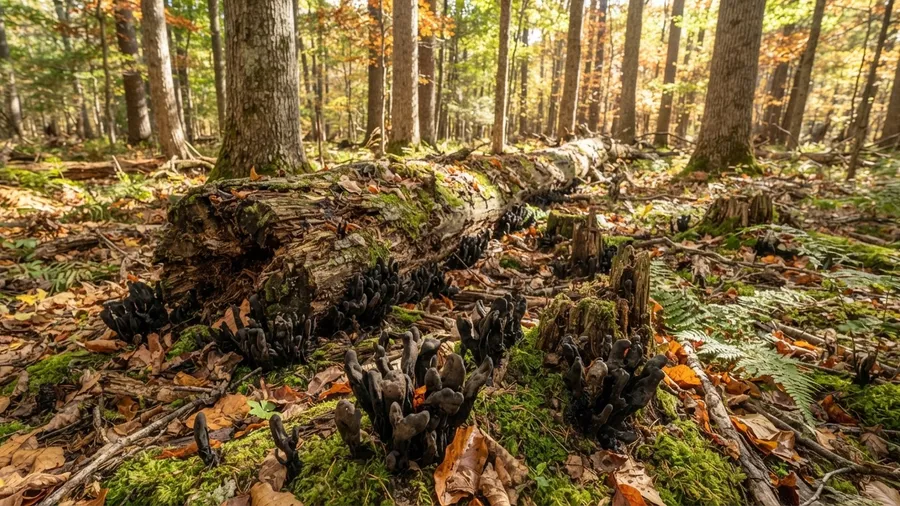
Nothing was discovered here, and I want to say that up front. Somebody photographed a fungus called dead man's fingers, Popular Science ran nine pictures, and the internet did its usual shiver. The fungus is Xylaria polymorpha. It pushes up black, club shaped lumps from buried or rotting wood, usually in clusters, and they really do look like fingers reaching out of a grave. You can find them in woods across the United States. Some are the size of a thumb. Some are bigger than a hand. I kept rereading how common they are, because most people walk right past them.
🇪🇸 Dedos negros bajo los árboles
Aquí nadie descubrió nada nuevo. Lo que pasó es más simple. Una galería de fotos mostró un hongo que crece en bosques de todo Estados Unidos, y la gente se asustó con razón, porque parece una mano saliendo de la tierra. Se llama Xylaria polymorpha. Los dedos son negros, con forma de maza, y casi siempre brotan en grupo junto a troncos podridos o raíces enterradas. Algunos duran meses en el mismo lugar, así que no es raro verlos en el mismo tocón más de una vez. Yo mismo debí haberlos visto cien veces sin saber qué eran.

Detail view related to Dead Man's Fingers The Creepy Zombie Fungus Growing Near You
🇺🇸 Not Really a Zombie
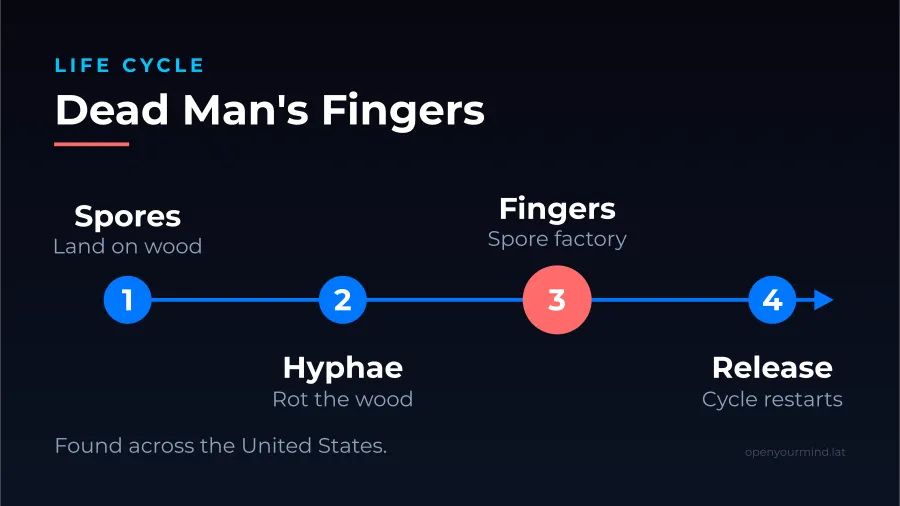
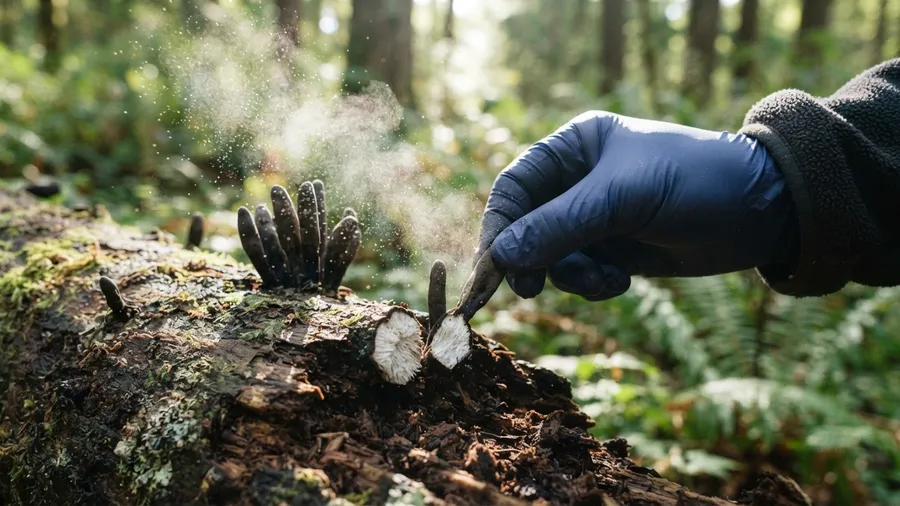
The zombie label is mostly marketing. There are real zombie fungi, like Ophiocordyceps, which infect ants and steer their behavior. Dead man's fingers does nothing like that. It is a decomposer, a fungus that feeds on dead hardwood such as beech, maple and oak. The visible part is called a stroma, a tough structure built to make spores. Young ones wear a pale, powdery coat of asexual spores. Later the coat wears off, the surface turns black and bumpy, and the inside stays white and corky. People have known this species for a very long time. The creepy part is only the shape, which is strange, if you think about it.
🇪🇸 El zombi que no controla a nadie
El apodo de zombi engaña un poco. Los hongos que sí manipulan a sus víctimas, como Ophiocordyceps con las hormigas, son otra historia. Este no controla nada. Vive de madera muerta, sobre todo de árboles de hoja ancha como el roble, el arce y la haya. Cuando es joven, tiene una capa blanquecina y polvorienta que son esporas asexuales. Con el tiempo esa capa se cae y la superficie se pone negra y rugosa. Por dentro la carne sigue blanca y dura, casi como corcho. Los micólogos lo conocen desde hace siglos. Lo único espeluznante es la forma, nada más.
Scientific diagram illustrating key concepts of Dead Man's Fingers The Creepy Zombie Fungus Growing Near You
🇺🇸 What Happens Inside the Wood
Most of the fungus is hidden. It lives as a mesh of fine threads called hyphae, running through the wood like roots through soil. The threads release enzymes into the wood, and those enzymes break down cellulose and, to some degree, lignin. The fungus then absorbs the sugars. The rot it causes tends to soften the wood, though I will admit the exact classification of that rot is over my head. When conditions suit it, the threads bundle together and push up as fingers. The surface carries tiny chambers, each holding sacs with eight spores apiece. The spores are shot out into the air, ready to land on another log.
🇪🇸 Lo que pasa dentro de la madera
Casi todo el hongo está escondido. Es una red de hilos muy finos, las hifas, que atraviesa la madera igual que las raíces atraviesan el suelo. Esos hilos sueltan enzimas hacia afuera. Las enzimas rompen la celulosa y, en parte, la lignina, y el hongo absorbe los azúcares que quedan libres. La pudrición que provoca ablanda la madera, aunque no sé explicar con precisión qué tipo de pudrición es. Cuando el clima ayuda, los hilos se juntan y suben a la superficie en forma de dedos. En la piel negra hay cámaras diminutas llenas de sacos, y cada saco guarda ocho esporas. Salen disparadas al aire.
The process described in Dead Man's Fingers The Creepy Zombie Fungus Growing Near You
🇺🇸 What It Means for Your Yard
Touching it is fine. Eating it is a bad idea, since it is tough and nobody sells it as food. The practical issue is the tree. Dead man's fingers on an old stump just means the stump is being recycled, which is its job. On the base of a living tree, though, it can signal rot in the roots or lower trunk. Xylaria polymorpha and a close relative, Xylaria mali, have both been linked to black root rot in apple orchards. A homeowner who sees fingers beside a big oak should call an arborist, not panic. Weight, lean and storm risk are the real questions.
🇪🇸 Qué significa para tu patio
Tocarlo no pasa nada. Comerlo es mala idea, porque es duro y nadie lo vende como comida. Lo que importa en la práctica es el árbol. Si los dedos salen de un tocón viejo, el hongo solo hace su trabajo de reciclar madera muerta. Pero si aparecen en la base de un árbol vivo, pueden indicar pudrición en las raíces o en el tronco bajo. Esta especie y su pariente Xylaria mali se han ligado a la pudrición negra de la raíz en huertos de manzana. Si ves los dedos junto a un roble grande, llama a un arborista. Lo que cuenta es si el árbol aguanta una tormenta.

Data visualization for Dead Man's Fingers The Creepy Zombie Fungus Growing Near You
🇺🇸 Still Unanswered
Nobody has measured how many months Xylaria polymorpha can sit inside a healthy tree before wood starts to fail. Field data on that timing is thin. Some Xylaria species make compounds called cytochalasins in lab cultures, and it is not settled whether wild fruiting bodies carry them at levels that matter to people or pets. Then there is the spore count. Researchers have not pinned down how many spores one stroma sheds in a single season.
🇪🇸 Lo que todavía no se sabe
Nadie ha medido cuántos meses puede esperar Xylaria polymorpha dentro de un árbol sano antes de que la madera empiece a fallar. Casi no hay datos de campo sobre ese plazo. Tampoco está claro si los hongos silvestres tienen citocalasinas, compuestos que otras especies de Xylaria producen en laboratorio, en cantidades que afecten a personas o mascotas. Y falta saber cuántas esporas suelta un solo dedo durante una temporada completa.
Real world context for Dead Man's Fingers The Creepy Zombie Fungus Growing Near You
🔗 Related Articles | Artículos Relacionados
Nuestro canal transmite datos curiosos de ciencia, IA, espacio y tecnología las 24 horas. | Our channel streams science facts, AI, space and technology around the clock.
▶ Ver transmisión | Watch liveOPEN YOUR MIND
Source: Source
Join the conversation