Inside Charlie Kemp's Mission to Build Helpful Home Robots
Inside Charlie Kemp's Mission to Build Helpful Home Robots
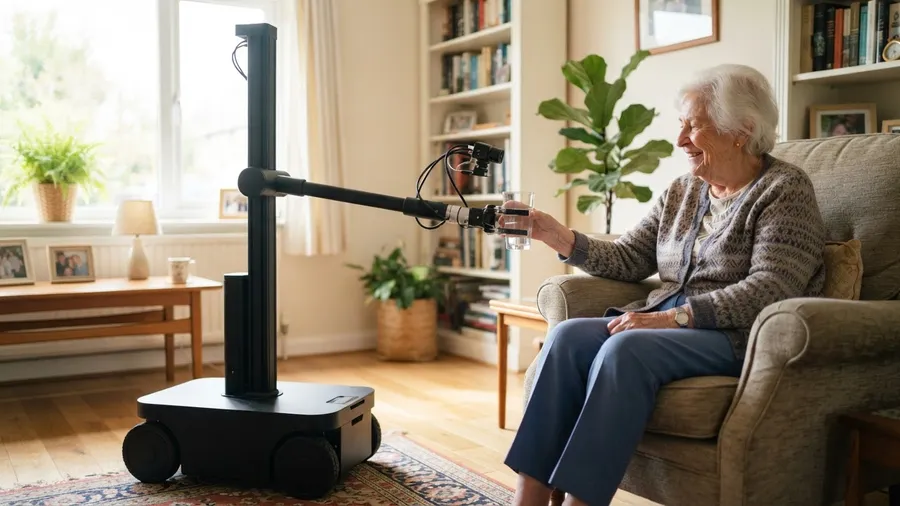
A Stretch robot hands a glass of water to a senior woman at home.
🇺🇸 From MIT Labs to a Robot Called Stretch
Charlie Kemp started in artificial intelligence at MIT. Nothing about that starting point screams home robot. Yet he ended up as cofounder and chief technology officer of Hello Robot, the company behind Stretch, a mobile robot with a thin telescoping arm. In between came years as a professor at Georgia Tech, running a lab that worked directly with people with disabilities. I kept rereading how the profile frames that part of his career. It was not a straight line from clever idea to product. It was more like a long conversation with the people who would actually live with the machine. Kemp treats that conversation as the real engineering, which is strange, if you think about it, for someone trained in AI.
🇪🇸 Del MIT a un robot llamado Stretch
Hello Robot nació en 2017, con Aaron Edsinger como cofundador, pero la historia empieza mucho antes. Kemp estudió inteligencia artificial en el MIT, y uno pensaría que de ahí saldría alguien obsesionado con algoritmos. No fue así. Pasó años como profesor en Georgia Tech trabajando codo a codo con personas con discapacidades, y esa experiencia terminó moldeando el producto. Stretch es el resultado: un robot móvil con un brazo delgado que se extiende como un telescopio. Lo que más me llamó la atención del perfil es que Kemp no habla de la tecnología primero. Habla de las personas. Para él, escucharlas es parte del diseño, no un paso previo.
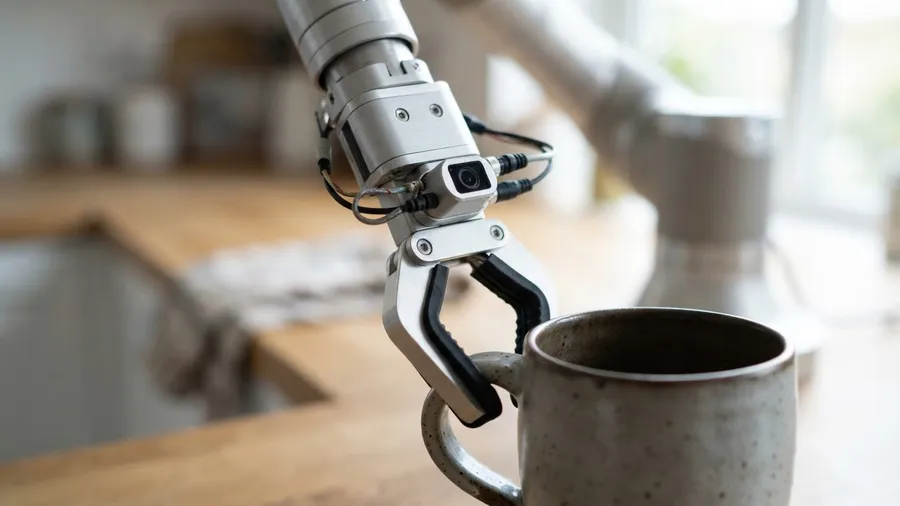
Stretch's soft gripper gently grasps a mug, showing the fine control needed for daily tasks.
🇺🇸 Why Home Robots Kept Failing
Home robots have a long history of disappointing people. The Roomba worked because it did one boring thing well. Anything that needed an arm was a different story. Research robots like the PR2 were brilliant and also enormous, with price tags in the hundreds of thousands of dollars. Industrial arms were fast and strong, which is exactly what you do not want swinging near someone in a wheelchair. Kemp lived through that era. His lab used big research platforms to learn what people with disabilities actually needed, and the lesson seems to have been blunt. The robots that taught the most were the robots nobody could afford to put in a real home.
🇪🇸 Por qué los robots de casa fallaban
Durante décadas, los robots domésticos decepcionaron. La aspiradora Roomba funcionó porque hacía una sola tarea aburrida y la hacía bien. Pero cuando hacía falta un brazo, todo se complicaba. Los robots de investigación, como el PR2, costaban cientos de miles de dólares y ocupaban media sala. Los brazos industriales eran rápidos y potentes, justo lo contrario de lo que quieres cerca de alguien con movilidad limitada. Kemp trabajó en esa etapa con esas máquinas grandes. Ahí aprendió qué necesitaba la gente de verdad. Y la lección fue incómoda: los robots que más enseñaban eran los que casi nadie podía tener en su casa.

Labeled anatomy of the Stretch robot, from its wheeled base to its head camera.
🇺🇸 What Stretch Actually Does
Stretch is built around a simple trade. Instead of a humanlike arm with many joints, it has a wheeled base, a vertical mast, and one arm that slides in and out. The arm rides up and down the mast, so the gripper can reach a floor, a table, or a shelf. It weighs roughly 23 kilograms, if I read the specs right. Light means low momentum, so a bump is far less dangerous than with a heavy arm. Fewer joints also means fewer motors and a lower price. A camera sits on the head, and the software is open for researchers to program. How the robot plans a path through a cluttered kitchen, I cannot tell you. That part is over my head.
🇪🇸 Cómo funciona Stretch por dentro
La clave de Stretch es una apuesta por la simplicidad. En vez de un brazo humanoide con muchas articulaciones, tiene una base con ruedas, un mástil vertical y un solo brazo que entra y sale como una antena. El brazo sube y baja por el mástil. Así la pinza llega al piso, a una mesa o a un estante alto. Pesa unos 23 kilos y eso importa, porque una máquina liviana golpea con poca fuerza si choca contigo. Menos articulaciones también significan menos motores y menos costo. Tiene una cámara en la cabeza y su software es abierto. No sé explicarte cómo planea rutas en una cocina llena de cosas.
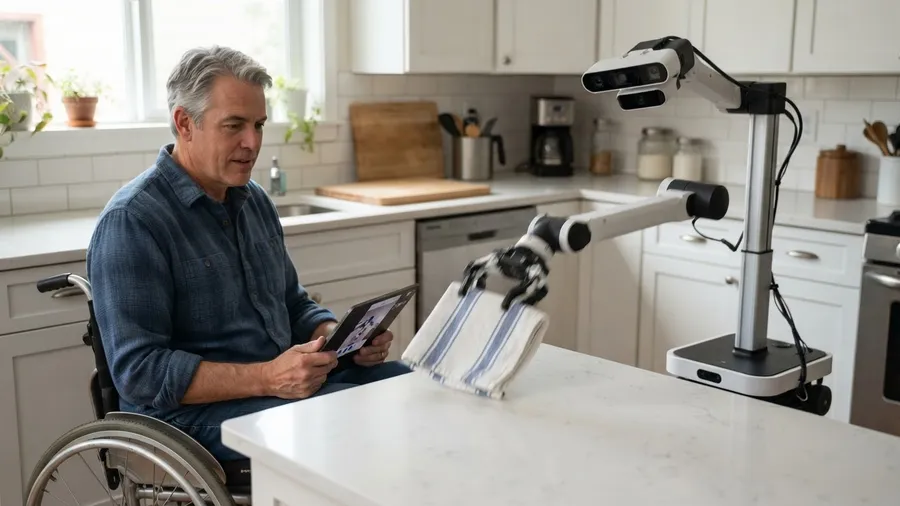
A Stretch robot helps with household chores while a man in a wheelchair guides its movements.
🇺🇸 What Changes for Real People
Think about a person who cannot move their arms well. Today, picking up a dropped phone or fetching a towel can mean waiting for another human to walk in. A robot that can do that on request changes the shape of a day. Kemp worked with Henry Evans, a man with quadriplegia who became a well known collaborator in assistive robotics. That kind of partnership is why Stretch exists in its current form. It is also still expensive, in the range of tens of thousands of dollars. Most families cannot buy one casually. So right now the change is real but narrow, felt mostly in research labs and a few homes.
🇪🇸 Qué cambia para la gente de verdad
Imagina a alguien que no puede mover bien los brazos. Si se le cae el celular o necesita una toalla, depende de que otra persona entre al cuarto. Un robot que haga eso cuando se lo pides cambia cómo se vive un día entero. Kemp colaboró con Henry Evans, un hombre con cuadriplejia que se volvió una voz conocida en la robótica de asistencia. Ese tipo de relación explica por qué Stretch tiene la forma que tiene. Eso sí, todavía es caro, con precios de decenas de miles de dólares. La mayoría de las familias no lo compra de un día para otro. Por ahora el cambio es real, pero estrecho.

Key milestones in Charlie Kemp's path from AI studies to assistive home robotics.
🇺🇸 What Nobody Has Answered Yet
Nobody has shown whether the price can fall below 10,000 dollars without losing the sensors that make Stretch safe. The payload is limited to a couple of kilograms, so it is unclear if that covers a full week of household chores. And no published study I know of follows one user for six months with no researcher in the room.
🇪🇸 Lo que todavía nadie responde
Nadie ha demostrado que el precio pueda bajar de 10,000 dólares sin perder los sensores que hacen seguro a Stretch. La carga máxima es de un par de kilos, y no está claro si alcanza para las tareas de una semana completa. Tampoco conozco un estudio publicado que siga a un usuario durante seis meses sin investigadores presentes.

A Stretch robot moves through a modern apartment, its slim frame suited to crowded living spaces.
🔗 Related Articles | Artículos Relacionados
Nuestro canal transmite datos curiosos de ciencia, IA, espacio y tecnología las 24 horas. | Our channel streams science facts, AI, space and technology around the clock.
▶ Ver transmisión | Watch liveOPEN YOUR MIND
Source: Source
Join the conversation