Could a Overlooked Neutrino Explain Why Matter Exists?
Could a Overlooked Neutrino Explain Why Matter Exists?
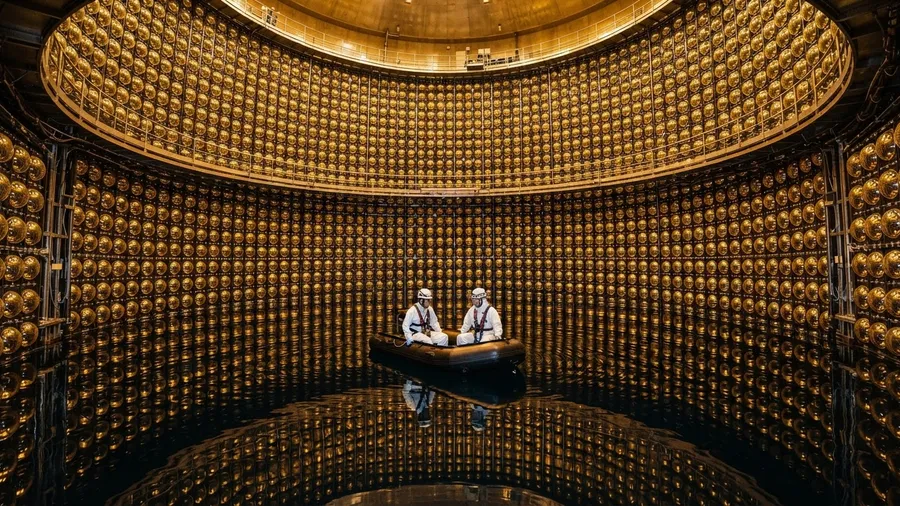
Technicians in a small boat are dwarfed by the Super-Kamiokande detector tank in Japan.
🇺🇸 A Particle Nobody Wanted to Count
Here is what actually happened. Nobody caught a new particle in a detector. A group of theorists went back to an old idea, a very heavy neutrino that barely talks to anything else, and ran the early universe forward with it. The numbers landed close to what we see. For every billion matter and antimatter pairs, one extra matter particle survived. That leftover is us, and the planets, and the coffee. I kept rereading the second half of the claim, because it is bolder. As that heavy neutrino gained mass, it may have shaken spacetime hard enough to leave ripples. Ripples we might still be able to hear. Which is strange, if you think about it, for a particle nobody has ever seen.
🇪🇸 Una partícula que nadie quiso contar
Empecemos por lo que no pasó. Nadie detectó una partícula nueva. Lo que hubo fue un grupo de teóricos que rescató una idea vieja, un neutrino muy pesado que casi no interactúa con nada, y simuló el universo temprano con él. Los resultados se parecen bastante a lo que observamos. Por cada mil millones de pares de materia y antimateria sobró una sola partícula de materia. De ese sobrante estamos hechos todos. Lo que me hizo releer el texto fue la segunda parte. Según el modelo, cuando ese neutrino adquirió masa pudo sacudir el espaciotiempo con fuerza suficiente para dejar ondas, y esas ondas quizás todavía lleguen hasta nosotros.
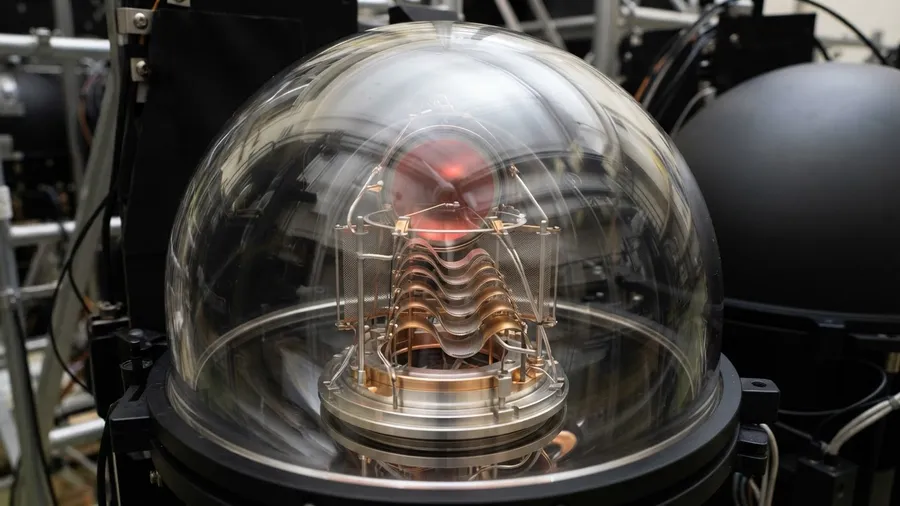
A single photomultiplier tube captures faint light signals from particle interactions.
🇺🇸 The Problem Was Already Sitting There
The puzzle is old. In 1967 Andrei Sakharov listed what a young universe would need to make more matter than antimatter, and one item was a lopsided treatment of the two. The Standard Model has some of that lopsidedness. Not nearly enough. Meanwhile neutrinos kept surprising people. They oscillate between types, which means they have mass, and that earned a Nobel in 2015. Yet the Standard Model only contains left handed neutrinos, and giving them mass cleanly is awkward. A heavier right handed partner fixes the awkwardness. Physicists have known this since the late 1970s. In 1986 Fukugita and Yanagida pointed out that the same partner could also explain the matter surplus. Then the idea sat there for decades, respectable and untested.
🇪🇸 El problema ya estaba sobre la mesa
El rompecabezas es viejo. En 1967 Andrei Sakharov escribió las condiciones que necesitaba un universo joven para producir más materia que antimateria. Una de ellas era un trato desigual entre ambas. El Modelo Estándar tiene algo de esa desigualdad, pero muy poca. Mientras tanto, los neutrinos seguían dando sorpresas. Oscilan entre sus tipos, así que tienen masa, y eso le dio un Nobel a esta área en 2015. El problema es que el Modelo Estándar solo incluye neutrinos de mano izquierda, y darles masa de forma limpia resulta incómodo. Un compañero pesado de mano derecha arregla la incomodidad. Desde 1986, con Fukugita y Yanagida, se sabía que ese mismo compañero podía explicar la materia sobrante. Y ahí se quedó, respetable pero sin probar.

The timeline shows where the overl
🇺🇸 How a Heavy Ghost Tips the Scale
Picture the hot early universe full of these heavy neutrinos. They are unstable. Each one decays into ordinary particles, and here is the trick. If the decay favors making leptons over antileptons, even by a hair, you end up with a net surplus of leptons. Then comes a process called a sphaleron, which works only while the universe is hotter than roughly a hundred billion electron volts. Sphalerons convert part of that lepton surplus into protons and neutrons. Matter wins. The ripples are the shakier link. If the heavy neutrino gets its mass from a symmetry breaking event, that event could produce a gravitational wave background. I will be honest, the details of that step are over my head.
🇪🇸 Cómo un fantasma pesado inclina la balanza
Imagina el universo recién nacido, caliente y lleno de estos neutrinos pesados. Son inestables. Cada uno se desintegra en partículas comunes, y ahí está el truco. Si la desintegración prefiere producir leptones en vez de antileptones, aunque sea por muy poco, queda un exceso neto de leptones. Después entran los esfalerones, que solo funcionan mientras el universo está más caliente que unos cien mil millones de electronvoltios. Ellos convierten parte de ese exceso en protones y neutrones. Gana la materia. El eslabón más frágil son las ondas. Si el neutrino pesado obtiene su masa en una ruptura de simetría, ese evento podría generar un fondo de ondas gravitacionales. Confieso que los detalles de ese paso me quedan grandes.
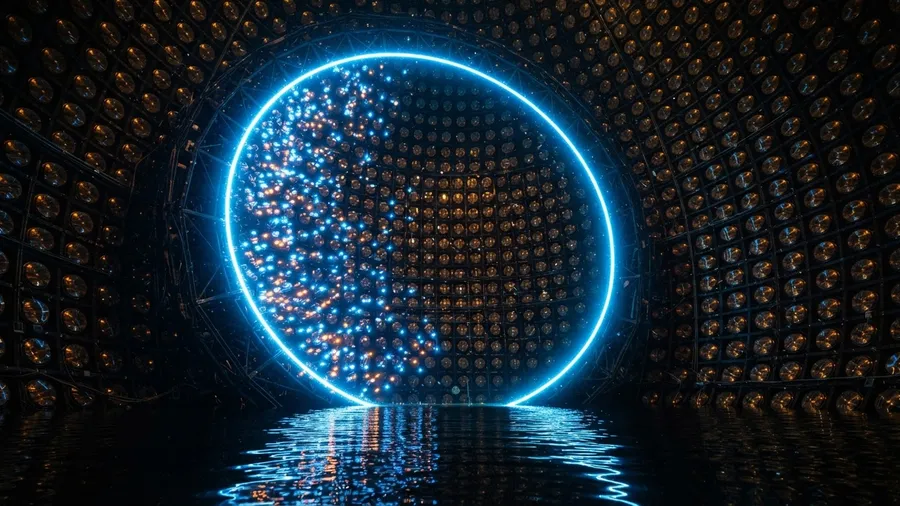
A particle passing through water produces a ring of Cherenkov light across the detector wall.
🇺🇸 What Changes Outside the Blackboard
Nothing changes in your kitchen. Let me say that plainly. What changes is where people point expensive instruments. Pulsar timing arrays already reported hints of a low frequency gravitational wave background in 2023, and the cause is still argued over. A heavy neutrino scenario gives analysts one more shape to test the data against. The LISA space observatory, planned for the mid 2030s, would listen at higher frequencies, and this idea hands it a specific target. On the ground, experiments such as KamLAND Zen and LEGEND hunt for neutrinoless double beta decay. A positive result would show that neutrinos are their own antiparticles, which would make this story far more believable. For real people, that means grant decisions, graduate theses, and years of careful waiting.
🇪🇸 Lo que cambia fuera de la pizarra
En tu cocina no cambia nada. Mejor decirlo claro. Lo que cambia es hacia dónde apuntan instrumentos carísimos. Los arreglos de púlsares ya reportaron en 2023 indicios de un fondo de ondas gravitacionales de baja frecuencia, y todavía se discute su origen. Un escenario con neutrinos pesados le da a los analistas una forma más contra la cual comparar los datos. El observatorio espacial LISA, previsto para mediados de los años 2030, escucharía frecuencias más altas, y esta idea le entrega un objetivo concreto. En tierra, experimentos como KamLAND Zen y LEGEND buscan la doble desintegración beta sin neutrinos. Un resultado positivo mostraría que el neutrino es su propia antipartícula. Para la gente real, eso se traduce en becas, tesis doctorales y años de espera paciente.
🇺🇸 Three Things Nobody Has Pinned Down
Nobody knows the heavy neutrino mass. Standard versions need roughly a billion GeV or more, far beyond any collider. Nobody knows whether neutrinoless double beta decay exists, and current experiments only exclude half lives shorter than about ten to the twenty sixth years. Nobody knows if the 2023 pulsar signal or LISA, around 2035, will show the right frequency and strength. One clean detection would help. A null result would not kill the idea.
🇪🇸 Tres cosas que nadie ha fijado todavía
Nadie conoce la masa del neutrino pesado. Las versiones estándar piden cerca de mil millones de GeV o más, mucho más allá de cualquier colisionador. Nadie sabe si existe la doble desintegración beta sin neutrinos, y los experimentos actuales solo descartan vidas medias menores a unos diez a la veintiséis años. Nadie sabe si la señal de púlsares de 2023 o LISA, hacia 2035, mostrarán la frecuencia y la intensidad correctas. Una detección clara ayudaría. Un resultado nulo no mataría la idea.
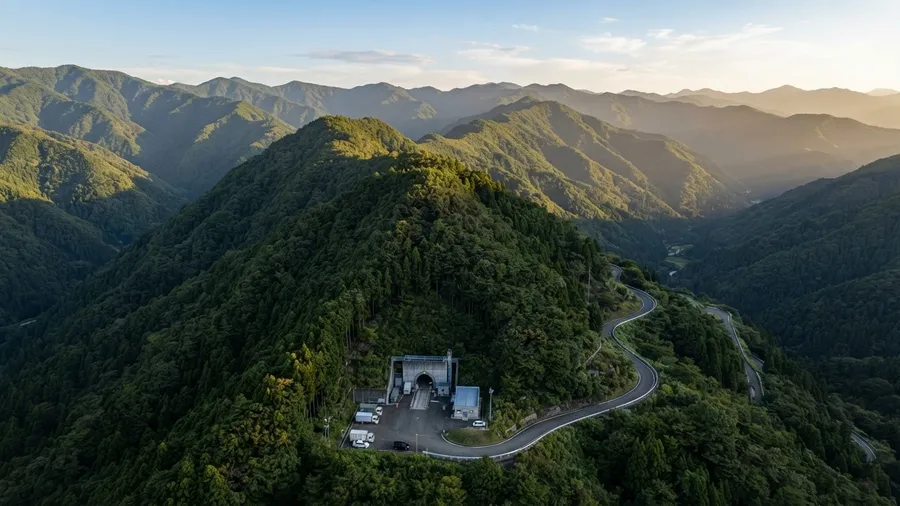
The observatory sits at the base of a forested peak in Gifu Prefecture, Japan.
🔗 Related Articles | Artículos Relacionados
Nuestro canal transmite datos curiosos de ciencia, IA, espacio y tecnología las 24 horas. | Our channel streams science facts, AI, space and technology around the clock.
▶ Ver transmisión | Watch liveOPEN YOUR MIND
Source: Source
Join the conversation