Where Solar Wind Zigzags Come From, According to Solar Orbiter
Where Solar Wind Zigzags Come From, According to Solar Orbiter

Where Solar Wind Zigzags Come From, According to Solar Orbiter
🇺🇸 A Kink, Fingerprinted
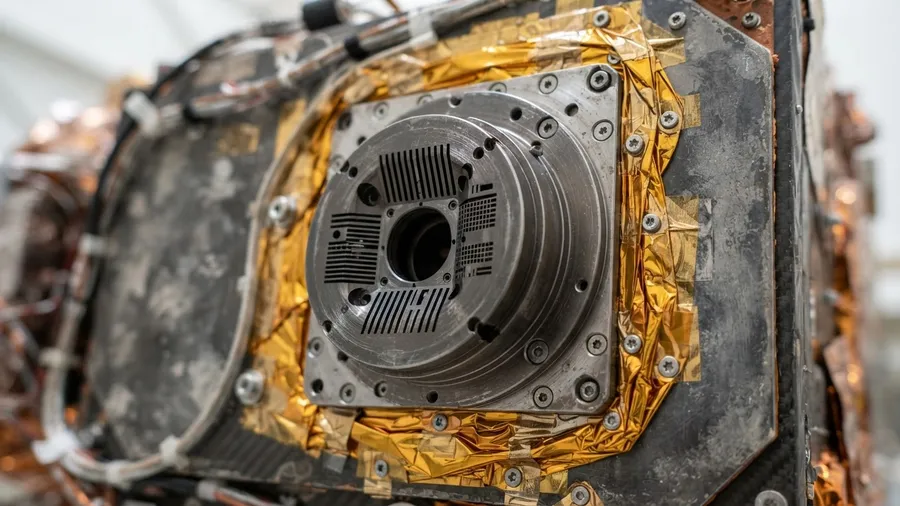
Imagine a magnetic field line drawn as a straight arrow pointing away from the Sun. Now bend it into an S, so that for a few moments the arrow points back toward the star. That is a switchback. Solar Orbiter flew through one, and its magnetometer caught the fold. Others had seen that before. The new part came from the particle instruments. The team counted helium against hydrogen and checked the charge states of heavier ions like carbon and oxygen. Those ratios work like a fingerprint, because they get locked in low in the solar atmosphere and barely change afterward. The fingerprint pointed to the Sun's surface region. It did not point to some accident far out in space.
🇪🇸 La huella dentro del zigzag
Solar Orbiter atravesó un zigzag magnético y lo midió desde adentro. Eso ya se había logrado antes. Lo nuevo fue mirar qué traía el doblez en su interior. El analizador de viento solar contó iones de helio, carbono, oxígeno y otros más pesados, y comparó sus proporciones. Esas proporciones se fijan cerca de la superficie del Sol y después casi no cambian durante el viaje. Por eso sirven como una huella digital. La huella de este switchback coincidía con material de la atmósfera baja solar. Me gusta ese detalle, porque una discusión vieja se cierra, al menos un poco, con un dato y no con una simulación.
Where Solar Wind Zigzags Come From, According to Solar Orbiter
🇺🇸 Two Camps and One Problem
Parker Solar Probe made switchbacks famous in 2018, when it found them in large numbers near the Sun. The wind looked like it had hiccups. Two camps formed almost immediately. One said the kinks are born at the surface, thrown out by magnetic reconnection. The other said they grow on the way out, as turbulence in the wind twists the field. Both stories fit the magnetic data, and that is the annoying part. A bent field line looks the same whether it was bent low or bent high. Composition is the only thing that remembers where the plasma started. Which is strange, if you think about it, because the magnetic field gets all the attention.
🇪🇸 Dos bandos y un problema
Hace unos años, la sonda Parker mostró que el viento solar cercano al Sol está lleno de estos quiebres. Desde entonces hay dos bandos. Unos dicen que nacen en la superficie, cuando líneas magnéticas abiertas y cerradas se reconectan. Otros dicen que se forman por el camino, por pura turbulencia. El problema es que la señal magnética se ve igual en los dos casos. Una línea doblada es una línea doblada. Lo único que guarda memoria del origen es la composición del plasma. Por eso la medición de Solar Orbiter pesa tanto. No se trata de ver el doblez, sino de saber de dónde vino lo que lo llena.

Scientific diagram: Where Solar Wind Zigzags Come From, According to Solar Orbiter
🇺🇸 How a Loop Could Bend the Wind
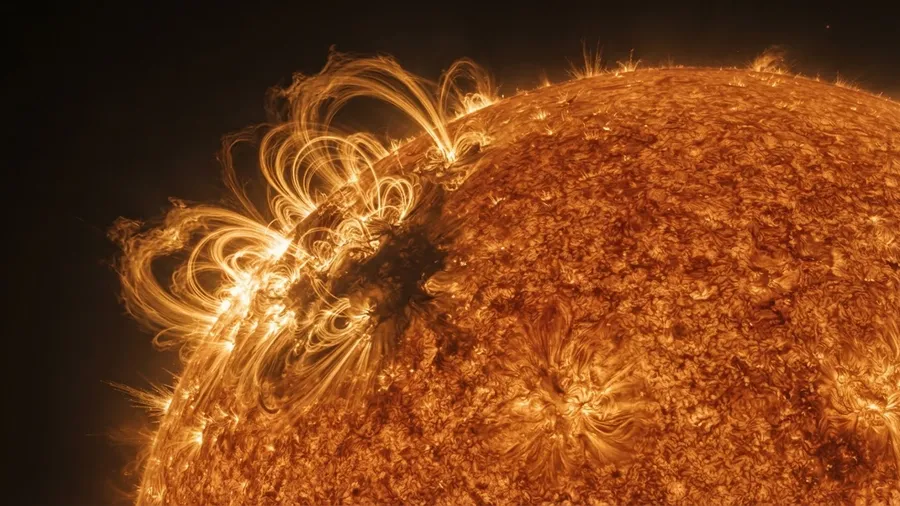
Think of the solar surface as a lawn of magnetic loops. Some field lines arch over and come back down, trapping hot plasma. Others are open and run out into space. When an open line meets a closed loop, they can swap partners. That is interchange reconnection. The open line ends up with a sudden kink, and plasma from the loop spills out along it. The kink then travels outward as a wave, carrying both the bend and the loop's material. That would explain the fingerprint, since trapped loop plasma has a different mix than ordinary fast wind. I kept rereading how the kink survives millions of kilometers without smoothing out. Honestly, I am not sure anyone has that part nailed.
🇪🇸 Cómo un arco magnético dobla el viento
El mecanismo empieza con dos tipos de campo magnético que viven uno al lado del otro. Uno es cerrado, con forma de arco, y mantiene el plasma atrapado. El otro es abierto y sale hacia el espacio. Cuando se encuentran, se reconectan y cambian de pareja. La línea abierta queda con un doblez, y el plasma del arco se escapa por ahí. Ese doblez viaja hacia afuera como una onda. Admito que esta parte me cuesta. No tengo claro cómo un doblez resiste tanta distancia sin deshacerse, y los modelos todavía discuten eso. Lo que sí encaja es la huella química, que habla de plasma salido de arcos cerrados.
Where Solar Wind Zigzags Come From, According to Solar Orbiter
🇺🇸 What Changes Down Here
Most of this changes nothing on your phone tomorrow. Let me be straight about that. But the solar wind carries a magnetic field to Earth, and the direction of that field decides how easily storm energy gets into our magnetic bubble. A field pointing the wrong way opens the door. Switchbacks flip that direction, so knowing where they come from matters for forecasting. The people who care are satellite operators, airlines flying polar routes, and utilities running long power lines at high latitudes. If the zigzags really start near the surface, wind models can begin with better starting conditions. That means forecasts improve slowly, one measurement at a time. No single crossing flips a switch.
🇪🇸 Qué cambia aquí abajo
Para la gente común, esto no cambia nada mañana. Pero las tormentas solares dañan satélites, interfieren con el GPS y pueden sobrecargar redes eléctricas en latitudes altas. Predecirlas depende de entender cómo sale el campo magnético del Sol y con qué orientación llega a la Tierra. Si los zigzags vienen de reconexiones cerca de la superficie, los modelos del viento solar pueden partir de mejores condiciones iniciales. Eso le importa a quien opera satélites, a las aerolíneas con rutas polares y a las compañías eléctricas. La mejora llega de a poquito. Un solo cruce de la nave no cambia el pronóstico del mes que viene.

Scientific diagram: Where Solar Wind Zigzags Come From, According to Solar Orbiter
🇺🇸 Still Open
Nobody knows how many switchbacks come from interchange reconnection, because this result rests on one crossing. The team needs dozens more fingerprints from Solar Orbiter's closer orbits. Nobody knows how far a kink lasts, or whether any arrive intact at Earth, 150 million kilometers away. And nobody knows what triggers the reconnection at a given instant, whether it is the churning of surface magnetic patches or something else.
🇪🇸 Lo que falta
Nadie sabe cuántos switchbacks nacen por reconexión, porque este resultado sale de un solo cruce. Hacen falta decenas de huellas más, tomadas en las órbitas cada vez más cercanas de Solar Orbiter. Tampoco se sabe cuánto dura un doblez ni si alguno llega entero a la Tierra, a 150 millones de kilómetros. Y falta entender qué dispara la reconexión en cada momento, si el movimiento de los parches magnéticos o algo distinto.
Where Solar Wind Zigzags Come From, According to Solar Orbiter
🔗 Related Articles | Artículos Relacionados
Nuestro canal transmite datos curiosos de ciencia, IA, espacio y tecnología las 24 horas. | Our channel streams science facts, AI, space and technology around the clock.
▶ Ver transmisión | Watch liveOPEN YOUR MIND
Source: Source
Join the conversation