Inside the Jet of Blazar 3C 279, Seen Like Never Before
Radio images from the blazar 3C 279 jet Event Horizon Telescope network show plasma twisting as it launches from a supermassive black hole's edge.
Inside the Jet of Blazar 3C 279, Seen Like Never Before
🇺🇸 Eight Dishes, One Blazar, Twenty Microarcseconds
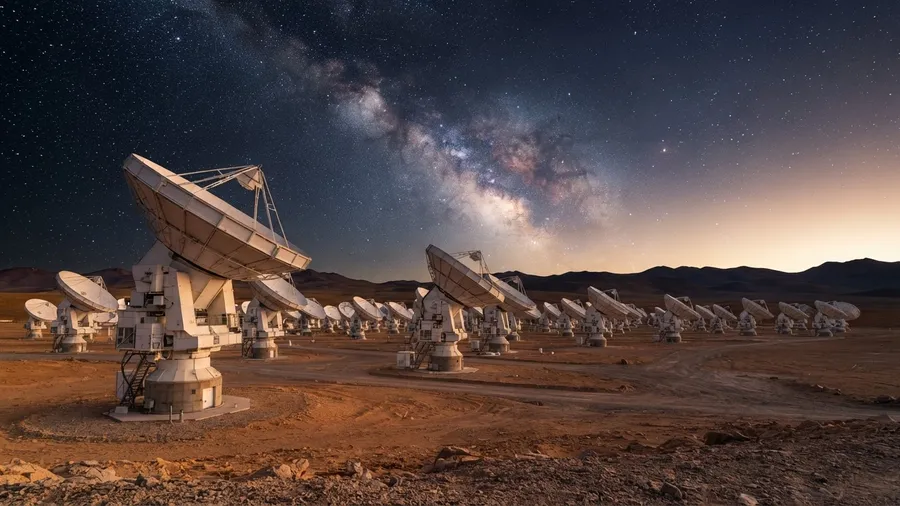
In April 2017, eight radio telescopes at six sites around the planet pointed at the same dot in the sky for several nights. The dot was 3C 279, a blazar about five billion light years away. The Event Horizon Telescope linked those dishes into one Earth sized instrument and recorded light at a wavelength of 1.3 millimeters. Years of data crunching later, the picture came out sharp to roughly 20 microarcseconds. That is fine enough to see structure well under a light year from where the jet is born. And the structure was messy. Knotted. Bent in a way nobody had drawn on a diagram. I kept rereading that part of the paper.
🇪🇸 Ocho antenas, un solo blazar
Imagínate ocho radiotelescopios repartidos entre Hawái, Chile, México, Arizona, España y el Polo Sur, todos mirando el mismo punto a la vez. Eso pasó en abril de 2017. El punto era 3C 279, un blazar a unos cinco mil millones de años luz. Juntas, las antenas funcionan como un telescopio del tamaño de la Tierra, con una nitidez de unos 20 microsegundos de arco. Con eso se ve el interior del chorro a menos de un año luz de su origen. Lo que apareció no era un chorro limpio y recto. Era torcido, con nudos, bastante desordenado. A mí me tomó un par de lecturas creérmelo.
Inside the Jet of Blazar 3C 279, Seen Like Never Before
🇺🇸 A Famous Object With a Blurry Base
Blazars are active galaxies whose jets happen to aim almost straight at us. 3C 279 is the textbook case. In 1971 radio astronomers clocked blobs in its jet that seemed to move faster than light. They do not, of course. It is a geometric trick, material chasing its own light toward the observer. In 1991 the source turned up as a bright gamma ray emitter. Later flares changed brightness within minutes, which is strange, if you think about it, because minutes means a tiny emitting region. Older radio maps could not see anything that small. They showed the jet far downstream, long after it had cooled and spread out.
🇪🇸 Décadas de sospechas, pocas imágenes
Durante décadas el problema fue la resolución. Las imágenes de radio mostraban el chorro lejos de su origen, ya enfriado y extendido. En 1971 alguien midió bultos que parecían viajar más rápido que la luz, un efecto geométrico que aparece cuando el material casi alcanza a su propia luz mientras apunta hacia nosotros. Después llegaron los rayos gamma, detectados desde el observatorio Compton, y luego explosiones de brillo que cambiaban en minutos. Minutos significa región diminuta. Pero nadie podía ver una región diminuta. Se sospechaba mucho y se veía poco. El agujero negro central pesa del orden de mil millones de soles, aunque esa cifra carga un margen de error considerable.
🇺🇸 Magnetic Thread, Spinning Engine
Gas spirals in toward the black hole and drags magnetic field lines with it. Those lines get wound up like thread on a spool. If the black hole spins, the twisted field can pull energy out of the rotation itself, an idea known as the Blandford Znajek process. That energy launches plasma outward along the spin axis at nearly the speed of light. The plasma swirls around field lines and radiates synchrotron light, which is what the EHT picks up at 1.3 millimeters. Because the jet points close to us, relativistic beaming boosts the brightness enormously. The twists in the new image might mean a helical field, or a jet wobbling as it launches. Honestly, I cannot tell you which one. The authors themselves leave more than one reading open.
🇪🇸 El motor es magnético
El motor es magnético. El gas cae en espiral y arrastra las líneas del campo, que se enrollan como hilo en un carrete. Si el agujero negro gira rápido, ese campo retorcido puede sacarle energía a la rotación. Esa energía lanza partículas a casi la velocidad de la luz por el eje de giro. Las partículas dan vueltas alrededor de las líneas magnéticas y emiten luz sincrotrón, justo la que captó el EHT. Como el chorro apunta casi hacia nosotros, el brillo se amplifica por efecto relativista. La forma torcida de la imagen podría indicar un campo helicoidal, o un chorro que cabecea mientras nace. No sé cuál de las dos gana. Los autores tampoco lo afirman con seguridad.
🇺🇸 What Changes, and for Whom
Nobody's daily life changes because of this image. Let me be straight about that. What changes is the work of a few hundred people and the students behind them. Teams that simulate jets now have a real shape to match, and a twisted one may rule out some of their tidier models. Gamma ray groups deciding where to point instruments during a flare have a better guess about where the flare lives. The code used to turn sparse telescope signals into pictures is public, so a student in Santo Domingo can download it and test it on real data. Blazars are also suspected neutrino sources, so jet physics feeds that hunt too. Slow payoff. Real one.
🇪🇸 Lo que cambia en la práctica
Para la vida diaria, nada cambia mañana. Lo que sí cambia es el trabajo de quienes modelan chorros. Ahora tienen una forma real que reproducir, y las simulaciones demasiado limpias pierden credibilidad. Los equipos de rayos gamma saben un poco mejor dónde buscar durante una explosión de brillo. Los programas que arman imágenes con pocas antenas son públicos. Un estudiante en Santiago o en Santo Domingo puede bajarlos y practicar con datos reales, sin pedirle permiso a nadie. También se sospecha que los blazares producen neutrinos, así que entender sus chorros ayuda en esa búsqueda. Es un beneficio lento, de los que se notan dentro de una década.
🇺🇸 Three Things Still Open
Whether the twist persists is open. Later EHT campaigns observed 3C 279 again, and comparing them with 2017 will show whether the bends shift over days or years. The magnetic field strength at the jet base has been inferred, never measured. The black hole spin has no firm value, so Blandford Znajek stays untested for this source.
🇪🇸 Tres cosas sin resolver
Falta saber si la forma torcida dura. Las campañas posteriores del EHT volvieron a observar 3C 279, y compararlas con 2017 dirá si las curvas cambian en días o en años. La intensidad del campo magnético en la base del chorro se ha deducido, no medido. Y el giro del agujero negro no tiene un valor firme, así que el mecanismo de Blandford y Znajek sigue sin prueba en este caso.
🔗 Related Articles | Artículos Relacionados
Nuestro canal transmite datos curiosos de ciencia, IA, espacio y tecnología las 24 horas. | Our channel streams science facts, AI, space and technology around the clock.
▶ Ver transmisión | Watch liveOPEN YOUR MIND
Source: Source
Join the conversation