Why a Man Sees His Cat's Eyes on Strangers' Faces
Palinopsia after brain surgery seeing faces can turn strangers into a familiar pet, showing how the brain builds faces from scattered visual clues
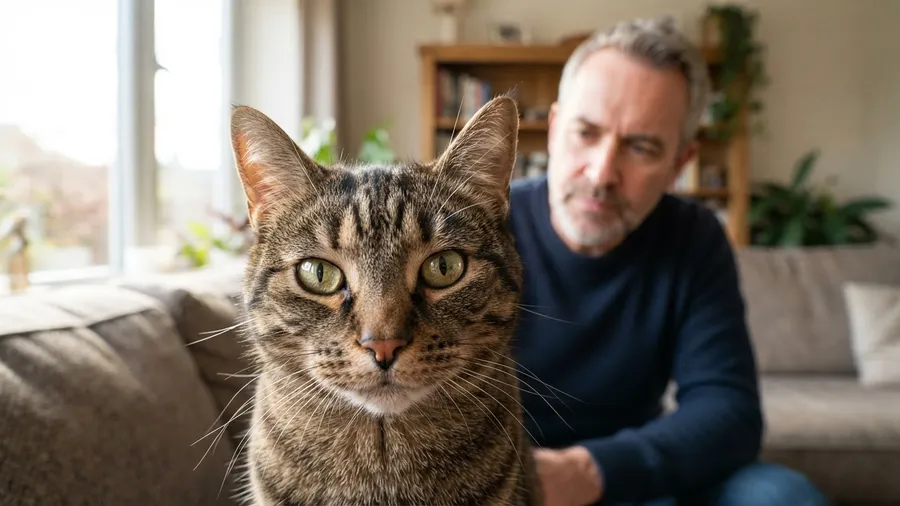
A tabby cat's luminous slit-pupil eyes draw attention while a man sits blurred behind it
🇺🇸 The eyes that did not belong
He had brain surgery, and the operation itself went as planned. Then the faces started to change. Strangers on the street, actors on a screen, anyone. Each one wore the eyes of his cat. Not just any cat, but his own, the animal he had been looking at around the house. The rest of every face stayed normal, with the same nose, the same mouth, the same hair. Only the eyes were swapped. I kept rereading that part of the report. It is such a narrow glitch, which is strange, if you think about it. Brains usually fail in broad, messy ways, not with this kind of precision.
🇪🇸 El gato que aparecía en todas las caras
Lo raro no es que viera ojos de gato. Lo raro es que solo cambiaban los ojos. Después de la cirugía cerebral, este hombre empezó a ver en desconocidos los ojos de su propio gato, el mismo que había mirado en casa una y otra vez. La nariz, la boca y el pelo seguían intactos. Todo indica que él entendía que aquello no era real, y aun así la imagen aparecía. Eso es lo que más me inquieta. Lo que leí no me deja claro cuánto duraba cada episodio, ni si ocurría con todas las caras o solo con algunas.
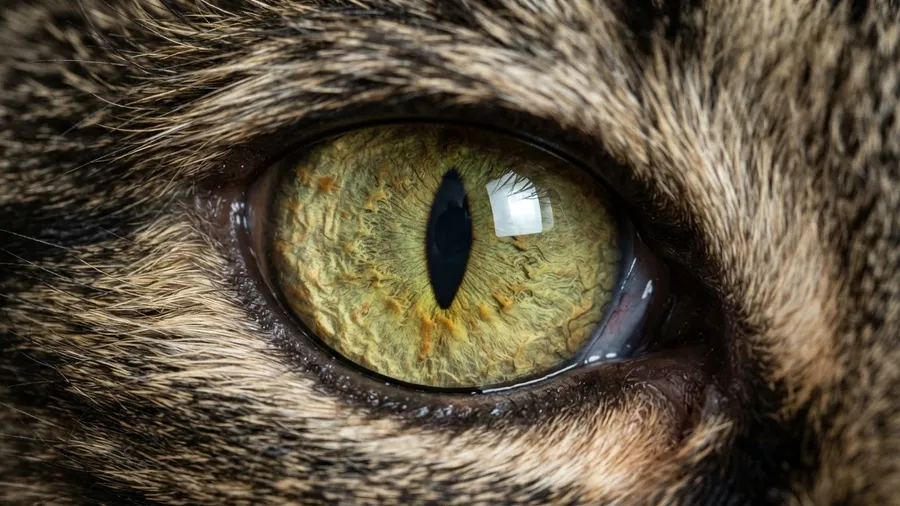
A close view of a cat's e
🇺🇸 Faces get special treatment
Faces get special treatment in the brain. A strip of tissue on the underside of the temporal lobe, the fusiform gyrus, responds strongly to them. Nearby sits the occipital face area. Along the side of the head, the superior temporal sulcus tracks things like where someone is looking. Damage in these places can cause prosopagnosia, where a person cannot recognize familiar faces. Then there is palinopsia, a family of symptoms where an image lingers or returns after the real thing is gone. It usually follows lesions at the back of the brain, seizures, or certain drugs. Usually the returning image is a whole object, though. Eyes alone is rare.
🇪🇸 Una pieza que vuelve sola
La palinopsia no es un invento reciente. Los neurólogos la describen desde hace décadas: una imagen que se queda o regresa cuando el objeto ya no está. Suele aparecer con lesiones en la parte posterior del cerebro, con convulsiones o con ciertas drogas. Lo normal es que regrese un objeto completo, una taza, una cara entera. Aquí regresó solo una pieza. Y no cualquier pieza, porque los ojos pesan muchísimo en la percepción de rostros. Los bebés los buscan primero. En monos se han encontrado neuronas que responden con fuerza a la región ocular. El cerebro, al parecer, apuesta fuerte por ellos.
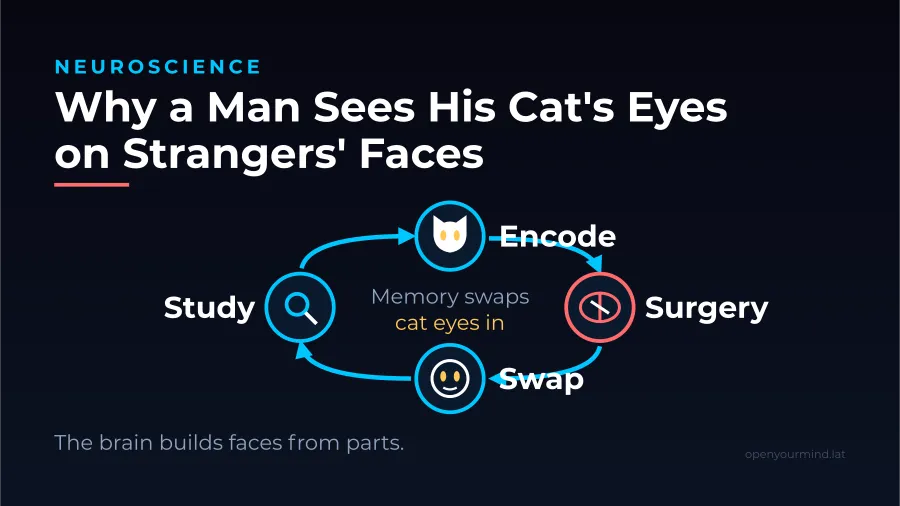
Scientific diagram: Why a Man Sees His Cat's Eyes on Strangers' Faces
🇺🇸 A trace that escapes
Start with what the brain does normally. It does not read a face like a photograph. It compares incoming signals to stored templates and fills gaps with predictions. Staring at one face for a while even shifts how the next face looks, a trick called adaptation. Now imagine a trace of recent eyes, left behind by lots of looking at the cat. Normally inhibitory circuits keep that trace quiet. If surgery disturbs those circuits near visual or temporal regions, the trace could escape and get projected onto the eye position of whatever face comes next. That is my best reading. Honestly, I cannot tell you which neurons are misfiring, and I doubt anyone can yet.
🇪🇸 La huella de los ojos
Imagina que el cerebro no lee una cara como una fotografía. La arma por partes y rellena huecos con predicciones. Cuando miras algo mucho tiempo, queda una huella, y esa huella cambia cómo se ven las caras siguientes. Eso se llama adaptación. Normalmente hay circuitos inhibidores que mantienen esa huella callada. Si la cirugía alteró esos circuitos en zonas visuales o temporales, la huella de los ojos del gato podría escaparse y pegarse justo donde el cerebro espera unos ojos. Es una hipótesis, no una prueba. Hay algo que me supera, y es por qué la huella queda tan limpia, solo ojos, sin bigotes ni orejas.
Why a Man Sees His Cat's Eyes on Strangers' Faces
🇺🇸 What changes for real people
Think about the man first. Seeing animal eyes on strangers would frighten almost anyone, and many people would assume they were losing their mind. A doctor who has never heard of palinopsia might reach for a psychiatric label. Knowing it as a visual processing fault changes that conversation. It tells the patient this is a glitch in perception, not a break from reality. Surgeons can also warn people before an operation near these regions. And for researchers studying prosopagnosia, a case where only the eyes misbehave is a rare window into how the face system splits its work. Beyond that, I would not promise much.
🇪🇸 Del miedo al diagnóstico
Para el paciente, lo primero es el miedo. Ver ojos de animal en la cara de un desconocido asusta a cualquiera, y muchos pensarían que están perdiendo la razón. Un médico que no conoce la palinopsia podría ir directo a una etiqueta psiquiátrica. Si en cambio sabe que es una falla del procesamiento visual, la conversación cambia. El paciente entiende que falló su percepción, no su contacto con la realidad. Los cirujanos también pueden avisar antes de operar cerca de esas zonas. Y para quienes estudian la prosopagnosia, un caso donde solo fallan los ojos es una ventana rara al interior del sistema de caras. Más allá de eso, yo no prometería nada.
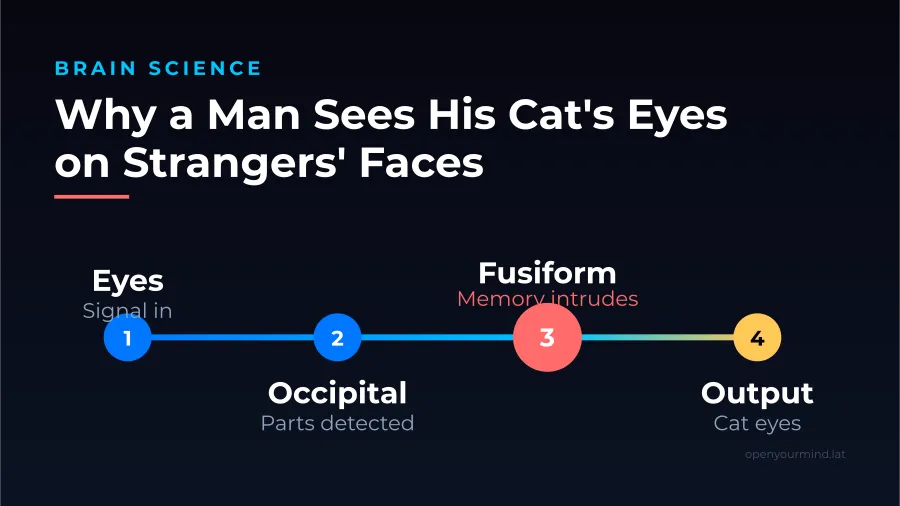
Scientific diagram: Why a Man Sees His Cat's Eyes on Strangers' Faces
🇺🇸 Still open
Nobody knows how long this kind of episode lasts after the cat leaves view, whether hours or weeks. Scans of the fusiform face area during an episode would help, and as far as I can tell they are missing. Another open point is whether human eyes or a dog's eyes would be swapped the same way after heavy exposure.
🇪🇸 Lo que falta saber
Nadie sabe cuántas semanas dura el efecto después de que el gato sale de la vista. Falta una resonancia magnética del área fusiforme durante un episodio, que yo sepa. Y queda por probar si unos ojos humanos o de perro se pegarían igual tras una exposición larga.

Why a Man Sees His Cat's Eyes on Strangers' Faces
🔗 Related Articles | Artículos Relacionados
Nuestro canal transmite datos curiosos de ciencia, IA, espacio y tecnología las 24 horas. | Our channel streams science facts, AI, space and technology around the clock.
▶ Ver transmisión | Watch liveOPEN YOUR MIND
Source: Source
Join the conversation