Why AI Agents Are Overloading Company Networks
Hidden API chatter from autonomous agents explains how agentic AI increases enterprise network traffic, often by multiples IT teams never planned for.

An enterprise data center aisle where dense fiber-optic cabling links racks of servers.
🇺🇸 The 450 Percent Problem
Here is the number that stuck with me. Tasks done by AI agents generate an estimated 450 percent more network traffic than the same tasks done by human workers. Not 45. Four hundred and fifty. I kept rereading that line, because it means a single agent doing one job can lean on the network like several people at once. Enterprise networks were already straining. AI had quickly become the biggest source of new demand, and now agentic systems are stacking more on top. Nobody hired extra staff. The work is the same work. What changed is how chatty the worker is, which is strange, if you think about it.
🇪🇸 Un número que no cuadra
Las redes de las empresas ya venían apretadas, y ahora llega esto. Según las estimaciones, una tarea hecha por un agente de IA genera un 450 por ciento más de tráfico que la misma tarea hecha por una persona. Lo leí dos veces. Un solo agente puede pesar en la red como varios empleados juntos, aunque nadie contrató a nadie. La inteligencia artificial ya era una de las mayores fuentes de demanda nueva, y los agentes se suman a esa carga. Lo raro es que el trabajo no cambió. Cambió la forma de hacerlo, y esa forma habla muchísimo más con la red.
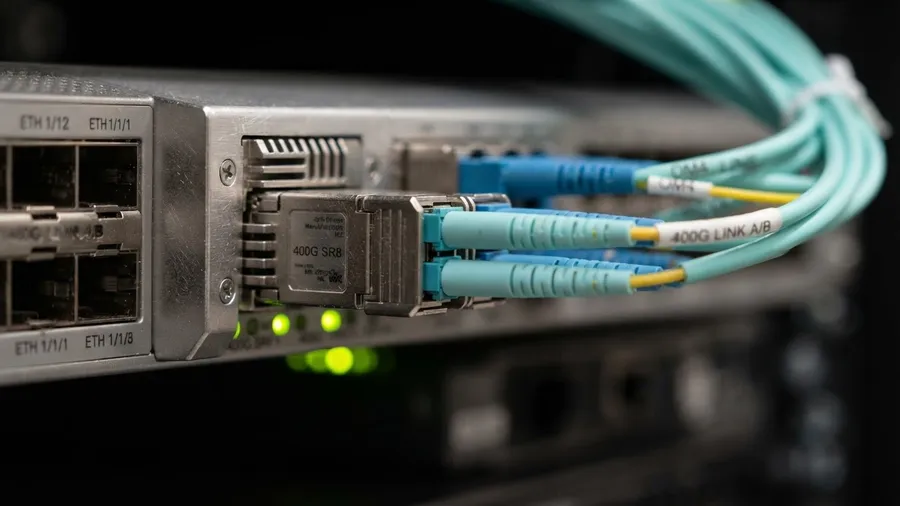
A 400G fiber transceiver and LC connectors carry the high-speed traffic that AI agents generate.
🇺🇸 Networks Built for People
Corporate networks were built around people. A person opens a page, reads for a minute, clicks, goes to a meeting. Traffic comes in bursts with long gaps between them, and capacity planners sized the pipes around that rhythm. Cloud software and video calls already stretched things. Then chatbots arrived, and companies started moving large piles of data toward models. Still, that early wave of AI had a human in the loop. One person typed a prompt and waited for one answer. The pace stayed human. Engineers could guess the busy hours, because people have lunch and go home. Software agents do neither, and that old assumption quietly breaks.
🇪🇸 La red pensada para gente
Antes de los agentes, una persona escribía una pregunta y esperaba una respuesta. Una petición, una respuesta. El ritmo seguía siendo humano. Las redes corporativas se diseñaron así, pensando en gente que abre una página, lee un rato y se va a una reunión. Había picos y había silencios, y los ingenieros sabían más o menos a qué hora se llenaba todo. La nube y las videollamadas ya habían apretado el sistema, y los chatbots movieron montones de datos hacia los modelos. Pero un agente no almuerza ni se va a casa. Esa suposición vieja, la de las horas muertas, deja de servir.
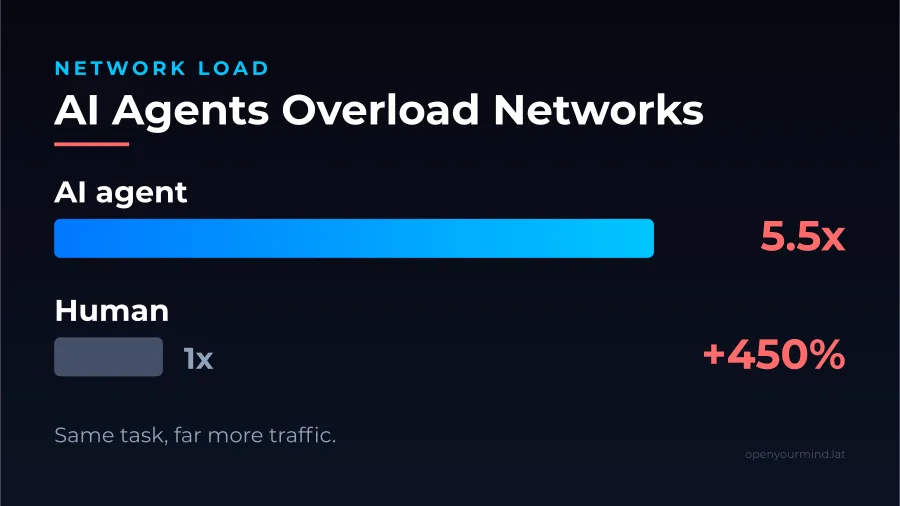
The same task generates about 5.5 times more network traffic when an AI agent performs it.
🇺🇸 One Request, Dozens of Calls
Think about what one agent does with a simple request. It splits the job into steps. Each step can mean a call to a language model, a call to a database, a call to some other software tool. Every call is a round trip over the network. Many agents also resend the whole conversation history to the model on each turn, so the payload grows as the task goes on. Then there are retries when a step fails, and checks to confirm the last step worked. Some agents launch helper agents that do the same. I cannot tell you how the 450 percent divides among those causes. I have not seen that breakdown.
🇪🇸 Cómo se multiplica el tráfico
Imagina que le pides algo sencillo a un agente. Lo parte en pasos. Cada paso puede ser una llamada a un modelo de lenguaje, otra a una base de datos, otra a una herramienta externa. Y cada llamada es un viaje de ida y vuelta por la red. Muchos agentes además reenvían el historial completo de la conversación en cada turno, así que el paquete engorda con el tiempo. Si un paso falla, reintentan. Si termina, verifican. Algunos hasta lanzan agentes ayudantes que repiten el mismo patrón. No sé qué parte del 450 por ciento viene de cada causa, y no encontré ese desglose. Quizá ni existe todavía.
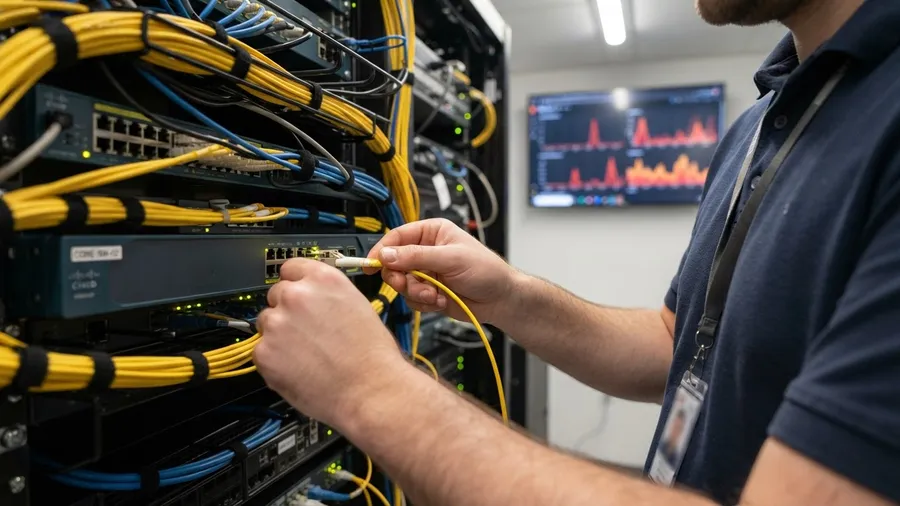
An engineer connects a fiber patch cable, the kind of hardware that carries AI agent traffic.
🇺🇸 What Changes on a Tuesday Morning
Start with the people who feel it first. An employee on a video call can start to stutter because a fleet of agents is pulling data across the same links. A support tool that answered quickly last quarter may start to lag. IT teams end up buying bandwidth they never budgeted for, and cloud bills climb when agents push data in and out of cloud services all day. Security staff inherit a stranger problem, since an agent stuck in a retry loop can look a lot like an attack. Most workers will never hear the word agent in this story. They will just notice that the network feels slower, and nobody can say why.
🇪🇸 Lo que siente la gente de la oficina
Para el empleado de a pie, esto se nota como lentitud sin explicación. Una videollamada que se corta porque una flota de agentes está sacando datos por los mismos enlaces. Una herramienta de soporte que antes respondía rápido y ahora se arrastra. Los equipos de TI terminan comprando ancho de banda que no estaba en el presupuesto, y la factura de la nube sube porque los agentes mueven datos todo el día. Seguridad tiene un dolor de cabeza distinto, porque un agente atrapado en un ciclo de reintentos se parece bastante a un ataque. Casi nadie dirá la palabra agente al quejarse. Dirá que internet anda lento.
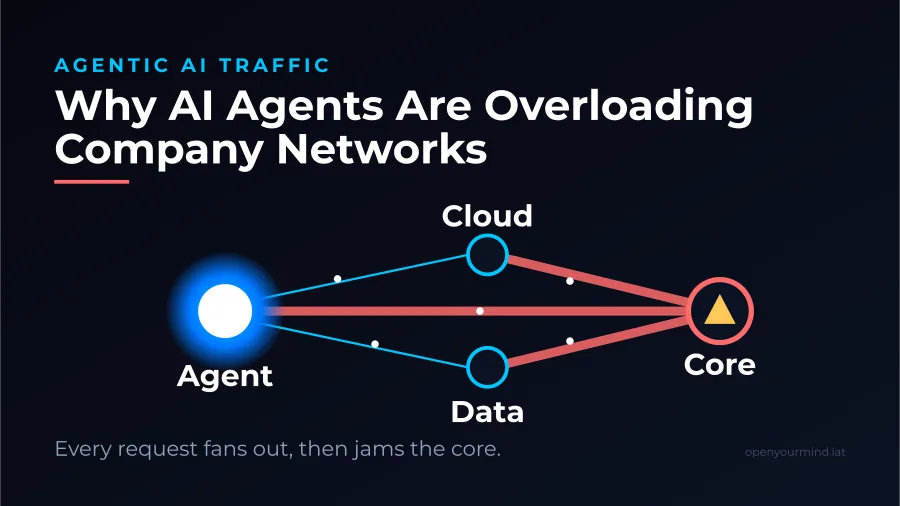
One employee request can fan out into many parallel AI agent calls across the enterprise network.
🇺🇸 What Nobody Has Measured
A few numbers are missing. Nobody has published how much of the 450 percent comes from retries and resent context versus useful work. It is unclear whether the figure holds for agents running on local models inside a company, where traffic may never leave the building. And capacity planners lack a measured peak load for a hundred agents running at once over a single branch office link. Those three measurements would tell us where to spend money first.
🇪🇸 Lo que falta por medir
Faltan datos concretos. Nadie ha publicado cuánto de ese 450 por ciento viene de reintentos y de contexto reenviado, y cuánto es trabajo útil. No se sabe si la cifra se mantiene con agentes que corren modelos locales dentro de la empresa, donde el tráfico quizá nunca sale del edificio. Y falta medir el pico real de cien agentes trabajando a la vez sobre el enlace de una sola sucursal. Con esas tres medidas se sabría dónde gastar primero.

A hyperscale campus, where cooling and power infrastructure support the networks AI agents load.
🔗 Related Articles | Artículos Relacionados
Nuestro canal transmite datos curiosos de ciencia, IA, espacio y tecnología las 24 horas. | Our channel streams science facts, AI, space and technology around the clock.
▶ Ver transmisión | Watch liveOPEN YOUR MIND
Source: Source
Join the conversation