How Scientists Confirm a Material Emits Single Photons
Zero-delay coincidence counts reveal the answer, and this guide covers how to verify single photon emitters antibunching in the lab.
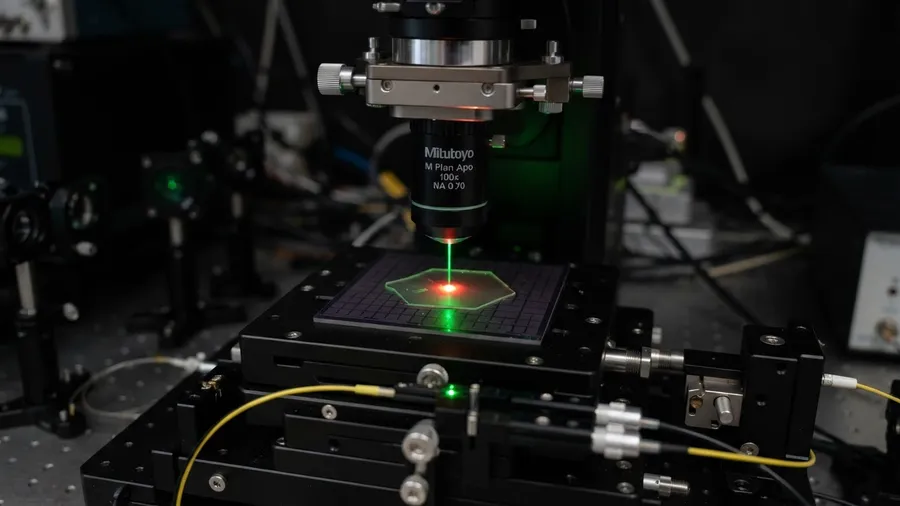
A confocal microscope excites a hexagonal boron nitride flake with a green laser to find emitters.
🇺🇸 A bright spot is not a proof
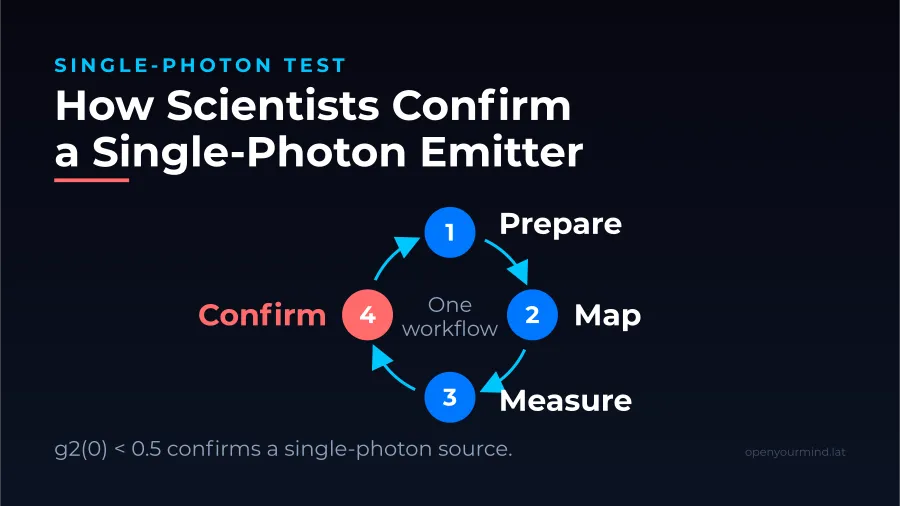
Here is the situation. A lab finds a bright spot under a microscope and calls it a single photon source. Then somebody asks how they know. For years the honest answer meant two separate experiments on two separate setups, sometimes weeks apart. The approach covered by Physics World folds both into one workflow. First you map where the light comes from. Then, without moving the sample, you test whether that exact spot ever releases two photons at once. I kept rereading that part, because it sounds almost too modest. But the gap between a bright spot and a verified emitter is where a lot of claims quietly fell apart.
🇪🇸 Una mancha brillante no prueba nada
Una mancha brillante bajo el microscopio no es todavía un emisor de fotones individuales. Parece obvio, pero muchos resultados se apoyaron justo en esa confusión. Lo normal era medir la posición en un montaje y la estadística de los fotones en otro, a veces con semanas de diferencia y con la muestra ya movida o degradada. Ahora el flujo de trabajo junta las dos cosas. Se localiza el punto, se deja la muestra quieta y se comprueba si ese mismo punto alguna vez suelta dos fotones juntos. Suena modesto, lo sé. Pero cambia quién puede afirmar qué, y con cuánta evidencia.
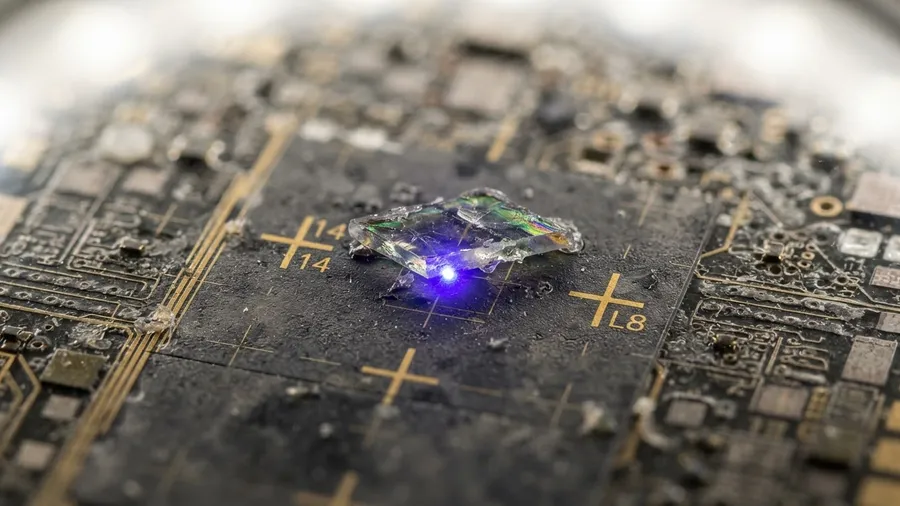
A single nanoscale emitter on the patterned substrate glows as a bright pinpoint of colour.
🇺🇸 The old test still does the work
The core test is older than most people expect. Hanbury Brown and Twiss built their intensity interferometer in the 1950s to measure starlight. In 1977 Kimble, Dagenais and Mandel used the same logic on sodium atoms and saw photons arrive apart from each other, which is antibunching. Classical light cannot do that. Candidate materials kept piling up in the decades since: quantum dots, nitrogen vacancy centres in diamond, defects in hexagonal boron nitride, single layers of tungsten diselenide. Each one produces bright spots. Few produce clean single photons on demand. Which is strange, if you think about it, given how many papers announced them anyway.
🇪🇸 Los materiales se multiplicaron más rápido que las pruebas
Los materiales candidatos se acumularon rápido. Puntos cuánticos, centros de vacante de nitrógeno en diamante, defectos en nitruro de boro hexagonal, capas atómicas de diseleniuro de tungsteno. Todos brillan. Pocos entregan fotones individuales limpios. La prueba para distinguirlos viene de lejos. En los años cincuenta Hanbury Brown y Twiss midieron correlaciones en la luz de las estrellas, y en 1977 Kimble, Dagenais y Mandel vieron antiagrupamiento en átomos de sodio. La luz clásica no se comporta así. Lo curioso es que la técnica llevaba décadas disponible y aun así tantos artículos la dejaron para después.
Scientific diagram: How Scientists Confirm a Material Emits Single Photons
🇺🇸 Two measurements on one stage
Picture a confocal microscope scanning a laser across a flake. Bright spots show up as a map, and fitting one gives its position to within tens of nanometres. Now park the focus there and send the emission through a beam splitter onto two single photon detectors. A timing card records the delay between clicks on one detector and clicks on the other. A single emitter needs time to be excited again, so coincidences at zero delay drop. If g2 at zero delay falls below 0.5, one emitter is the likely story. Background light fills that dip back in. How well each setup corrects for it, I honestly cannot tell from what I read.
🇪🇸 Dos detectores y un divisor de haz
El corazón de la medición son dos detectores y un divisor de haz. La luz del punto se reparte entre ambos, y una tarjeta de tiempos cuenta cuánto pasa entre un clic en uno y un clic en el otro. Un emisor único se queda sin fotón después de emitir uno, y tarda algunos nanosegundos en recargarse. Por eso casi no hay coincidencias a retraso cero. Si g2 a retraso cero baja de 0.5, lo más probable es que haya un solo emisor. Antes de todo eso, un microscopio confocal barrió la muestra y ubicó el punto con precisión de decenas de nanómetros. La luz de fondo rellena el hueco, y eso estropea la lectura.
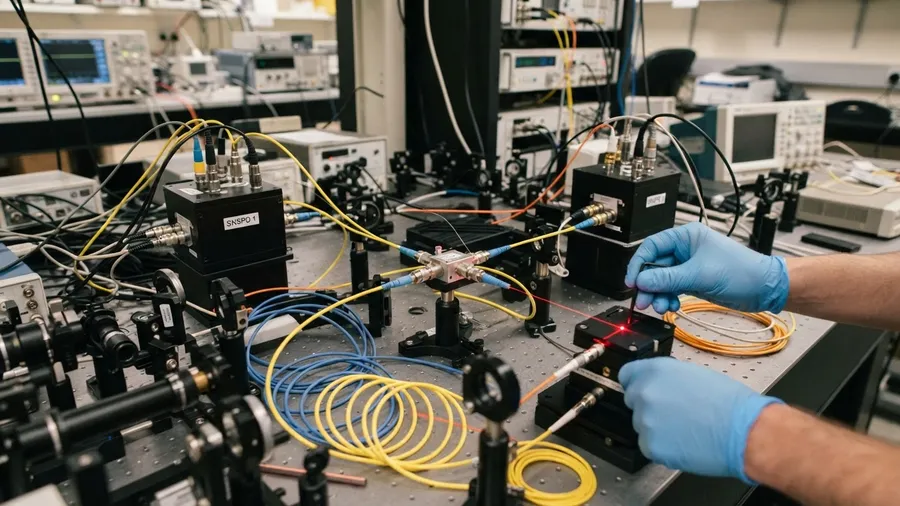
The Hanbury Brown and Twiss setup splits emitted light to two detectors to test photon arrival.
🇺🇸 What changes at the bench
Time, mostly. A postdoc who used to book one instrument, then another, then argue about whether the spot had drifted, now gets an answer in one session. That matters most for groups without a long history in quantum optics, who can screen a new material without building two labs. It also means fewer weak claims in the literature, which is the part I care about most. Quantum key distribution and other secure communication schemes need sources whose photon statistics are actually known. A device engineer picking a material for that should be able to trust the paper. Nothing here puts a quantum network in your house. It just makes the shelf of candidate materials more honest.
🇪🇸 Lo que cambia para quien mide
Para quien está en el laboratorio, el cambio es práctico. Antes había que reservar un equipo, luego otro, y discutir si el punto se había movido entre una medición y la otra. Ahora basta una sesión. Los grupos sin tradición en óptica cuántica pueden probar un material nuevo sin armar dos laboratorios. Y los ingenieros que buscan fuentes para distribución cuántica de claves podrán confiar más en lo que leen, porque la estadística de fotones se mide en el mismo punto que se localizó. No va a haber una red cuántica en tu casa por esto. Pero la lista de materiales candidatos queda más limpia, y eso ya es bastante.
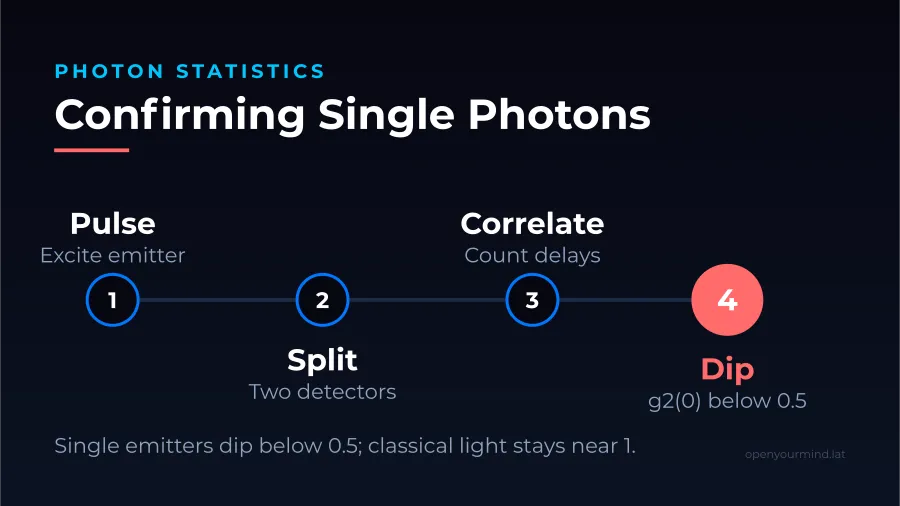
Scientific diagram: How Scientists Confirm a Material Emits Single Photons
🇺🇸 Open questions with numbers attached
Nobody knows how much background light an emitter can sit in before the dip at zero delay stops being trustworthy. Many papers accept g2 below 0.5, yet applications such as secure communication push for values nearer 0.1. Nobody has shown that one workflow holds its focus through a ten hour mapping session without drift. And it is still unclear whether emitters that blink on millisecond timescales can be verified at all.
🇪🇸 Preguntas abiertas con números
Nadie sabe cuánta luz de fondo tolera un emisor antes de que el hueco a retraso cero deje de ser confiable. Muchos artículos aceptan g2 menor que 0.5, pero la comunicación segura pide valores cercanos a 0.1. Tampoco está demostrado que un solo montaje mantenga el foco durante diez horas de mapeo sin deriva. Y sigue sin estar claro si un emisor que parpadea en escalas de milisegundos se puede verificar.
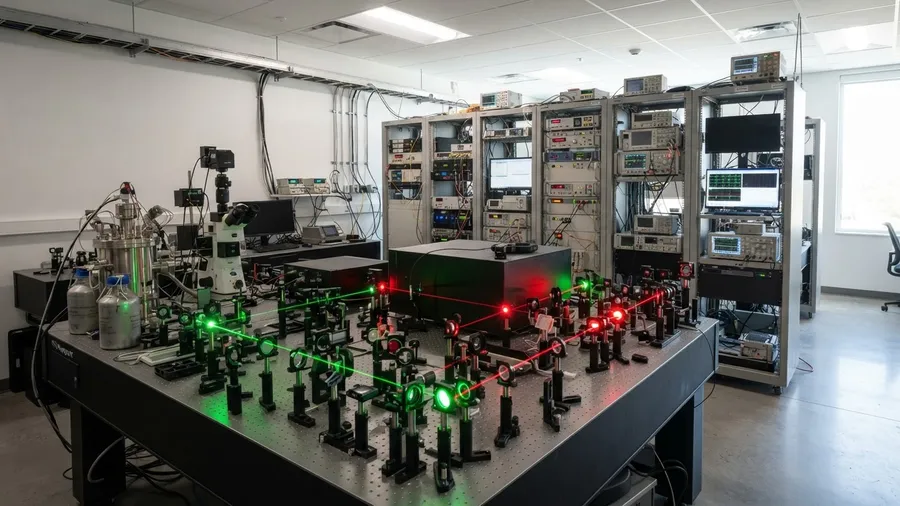
The quantum optics lab hosts
🔗 Related Articles | Artículos Relacionados
Nuestro canal transmite datos curiosos de ciencia, IA, espacio y tecnología las 24 horas. | Our channel streams science facts, AI, space and technology around the clock.
▶ Ver transmisión | Watch liveOPEN YOUR MIND
Source: Source
Join the conversation