Could Your Memories Be Stored in Chemistry, Not Just Electricity?
Protein changes inside neurons may hold long-term memories, and new evidence shows the brain can store memories chemically in surprising ways.
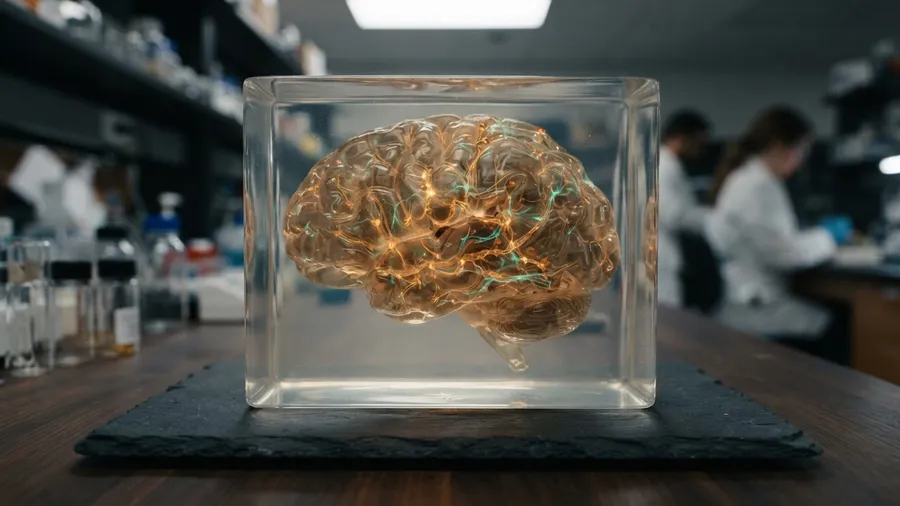
A 3D-scanned brain model glows with molecular filaments, hinting at chemistry within memory.
🇺🇸 A Theory That Puts Memory Back in the Chemistry
Here is what actually happened. A team published a proposal, not an experiment, arguing that the brain may write and read memories through chemistry. Electrical spikes still matter in their picture. But neurons also trade molecules with the material around them, and that exchange could be where the memory lives. Not just travels. Lives. I should be clear that nobody has watched a memory get stored this way in a living brain. It is a theory. Still, the implication reaches past neuroscience. If memory, emotion and thought are tangled together at the chemical level, then a faster computer does not get you closer to a mind. I kept rereading that part.
🇪🇸 Una teoría que devuelve el recuerdo a la química
Empecemos por la consecuencia que más me llamó la atención. Si la memoria, la emoción y el pensamiento están enredados a nivel químico, un computador más rápido no se acerca a tener conciencia. Eso dice el planteamiento. No viene de un experimento, sino de una propuesta teórica, así que nadie ha visto todavía cómo se guarda un recuerdo de esta manera en un cerebro vivo. La idea central es que las neuronas intercambian moléculas con el material que las rodea, y que ese intercambio podría ser el lugar donde vive el recuerdo. Piensa en el olor del sancocho de tu abuela. Llega con la emoción incluida, y eso no es casualidad.
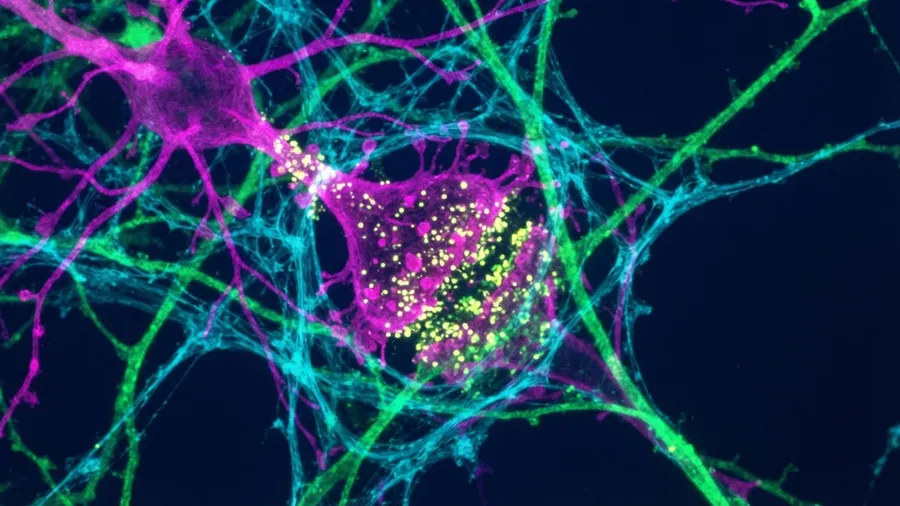
Cultured neurons with branching dendrites interact with the surrounding extracellular matrix.
🇺🇸 What We Already Believed
The textbook story goes like this. Neurons that fire together strengthen their connections, an idea from Donald Hebb in 1949, and the strengthened synapse becomes the memory. Decades of work on the hippocampus backed it up. Patient H.M. had much of his hippocampus removed and could no longer form new memories, which pointed to a place, if not a mechanism. Chemistry was never absent from that story. Dopamine, adrenaline and cortisol are known to make emotional events stick harder. Then there is the extracellular matrix, a mesh that wraps around some neurons. In rodent experiments, breaking down parts of it has loosened fear memories. Strange, if you think about it, that we treated all this as packaging.
🇪🇸 Lo que ya sabíamos
La versión clásica ya tenía química, solo que la tratábamos como decoración. Se sabía que la adrenalina, el cortisol y la dopamina hacen que un evento emocional se grabe con más fuerza. Por eso recuerdas dónde estabas el día de un susto grande y no recuerdas qué almorzaste el martes pasado. Después está la matriz extracelular, una malla que envuelve a ciertas neuronas. En ratones, deshacer partes de esa malla ha debilitado recuerdos de miedo. Todo eso convivía con la idea de Hebb, de 1949, según la cual las conexiones que se activan juntas se fortalecen. Y con el caso del paciente H.M., que sin buena parte del hipocampo ya no pudo formar recuerdos nuevos.
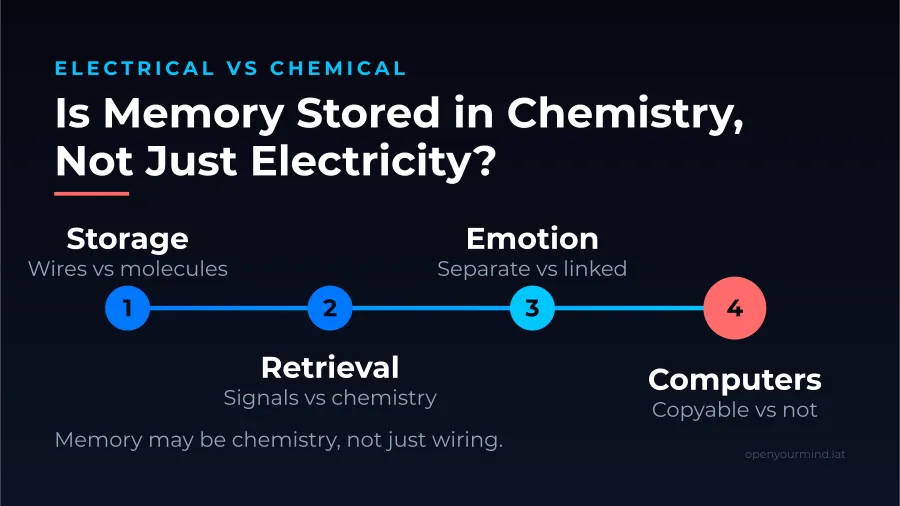
Electrical-only models compare with chemical models of memory storage in neural tissue.
🇺🇸 How the Mechanism Might Work
Take this with salt. As I read it, a neuron fires and releases more than a signal. It releases molecules into the narrow space around it. The matrix and nearby support cells respond, and the local chemical mix shifts. That altered mix changes how the next signal moves through the same spot. So the memory would be a pattern of chemistry that shapes the electricity, rather than electricity alone. Recall would happen when a cue, a smell or a word, restarts the spikes and the chemical pattern guides them back along the old route. How that pattern gets read out is the part I cannot follow. The paper is vague there too, which is honest, I suppose.
🇪🇸 Cómo funcionaría por dentro
Yo lo entiendo así, y puedo estar equivocado. La neurona no solo dispara una señal eléctrica. También suelta moléculas en el espacio diminuto que la rodea. Las células de apoyo y la matriz reaccionan, y la mezcla química de ese rincón cambia. Esa mezcla distinta modifica cómo viaja la siguiente señal por el mismo sitio. Es como un camino de tierra que se marca con la lluvia. La próxima vez que algo pasa por ahí, sigue el surco. Un olor o una palabra reactivaría los disparos, y la química los guiaría por la ruta vieja. Cómo se lee ese patrón químico, no lo tengo claro. Tampoco me quedó claro en el texto.
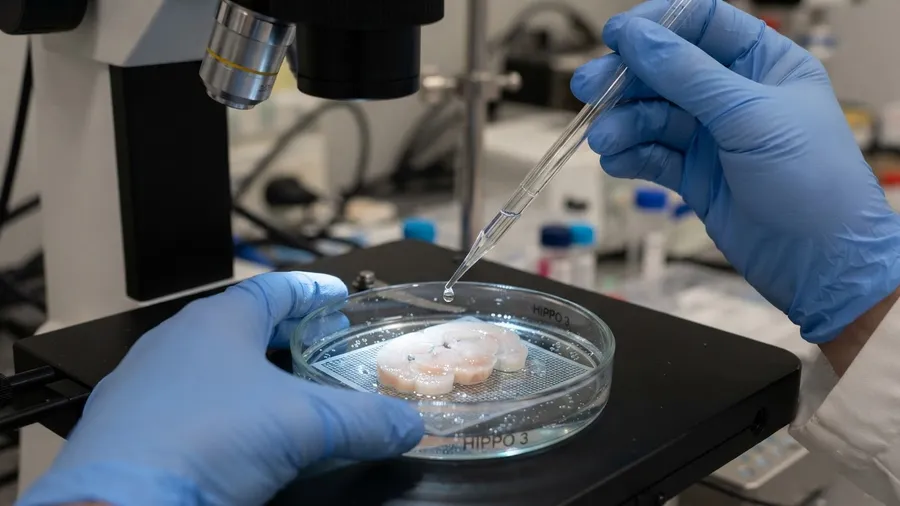
Researchers apply chemical solutions to living brain tissue slices to study molecular responses.
🇺🇸 What Changes for Real People
Nothing changes in a clinic this year. Let me say that first. But the direction of the work matters for people with memory loss. Most Alzheimer's research has centered on proteins and on synapses. If memory also lives in the chemical surroundings of neurons, then drug targets and brain scans might need to look there too. Same for trauma. Someone with PTSD does not just remember an event, they remember the fear stitched into it, and a chemical account explains that stitching better than a wiring diagram does. Then there is the computing side. Companies keep implying that scale leads to consciousness. This theory suggests the physical material may be the point, which should make us more skeptical of that hype.
🇪🇸 Qué cambia para la gente de verdad
Para una persona con pérdida de memoria, hoy no cambia nada. Mejor decirlo claro. A futuro, el enfoque podría mover el lugar donde se busca. La investigación del alzhéimer se ha concentrado en proteínas y sinapsis, pero si el recuerdo también depende del entorno químico de las neuronas, los medicamentos y los escáneres tendrían que mirar ahí. Con el trauma pasa algo parecido. Quien vive con estrés postraumático no solo recuerda el hecho, recuerda el miedo pegado al hecho. Un modelo químico explica esa unión mejor que un diagrama de cables. Y queda el debate sobre las computadoras. Si el material importa, escalar chips no garantiza una mente, y yo bajaría el volumen a tanta promesa.
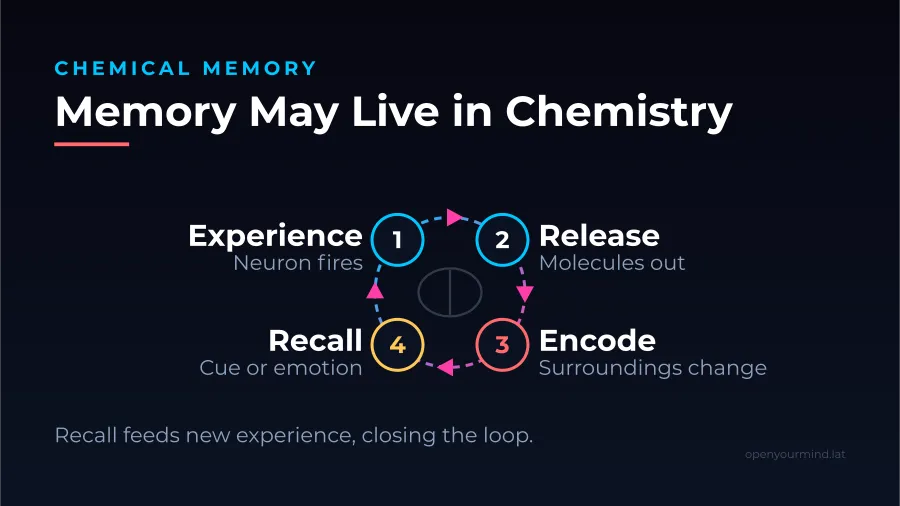
The proposed loop shows how experience reshapes molecules around neurons over time.
🇺🇸 What Nobody Knows Yet
Nobody has measured how long a chemical trace lasts after a single learning event. Minutes, days or decades would each mean something different. Nobody knows which molecules in the matrix would carry content rather than just support it. And the cleanest test is missing. Block the chemical signaling, leave the spikes alone, then check recall in mice. I have not seen that experiment reported.
🇪🇸 Lo que nadie sabe todavía
Nadie ha medido cuánto dura una huella química después de un solo episodio de aprendizaje. Minutos, días o décadas significarían cosas muy distintas. Tampoco se sabe qué moléculas de la matriz cargarían el contenido y no solo el soporte. Falta además la prueba más limpia, que sería bloquear la señal química, dejar intactos los disparos eléctricos y evaluar el recuerdo en ratones. Yo no he visto ese experimento publicado.
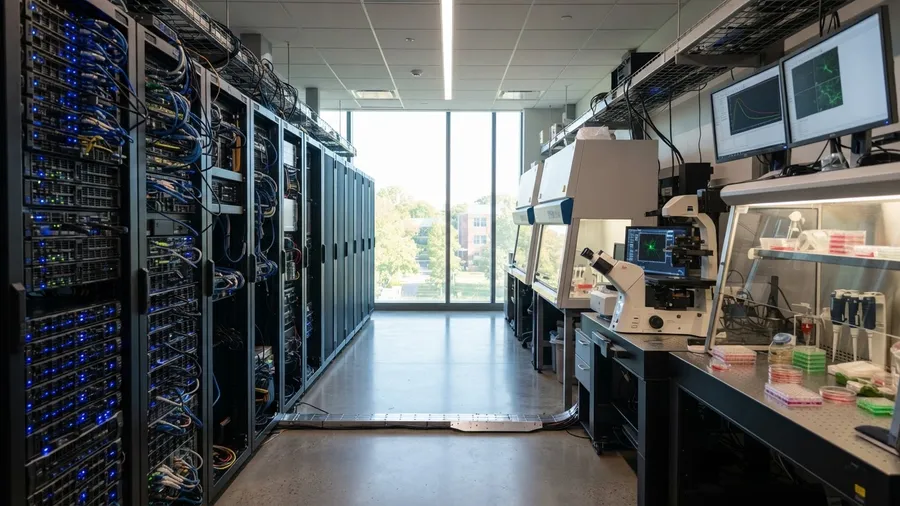
Computing racks and imaging hardware power the data analysis behind modern memory research.
🔗 Related Articles | Artículos Relacionados
Nuestro canal transmite datos curiosos de ciencia, IA, espacio y tecnología las 24 horas. | Our channel streams science facts, AI, space and technology around the clock.
▶ Ver transmisión | Watch liveOPEN YOUR MIND
Source: Source
Join the conversation