Why This Nearby Supernova Has Astronomers Racing to Observe It
Scientists tracking the nearby supernova discovered November what astronomers learn in coming months could clarify how massive stars die and explode
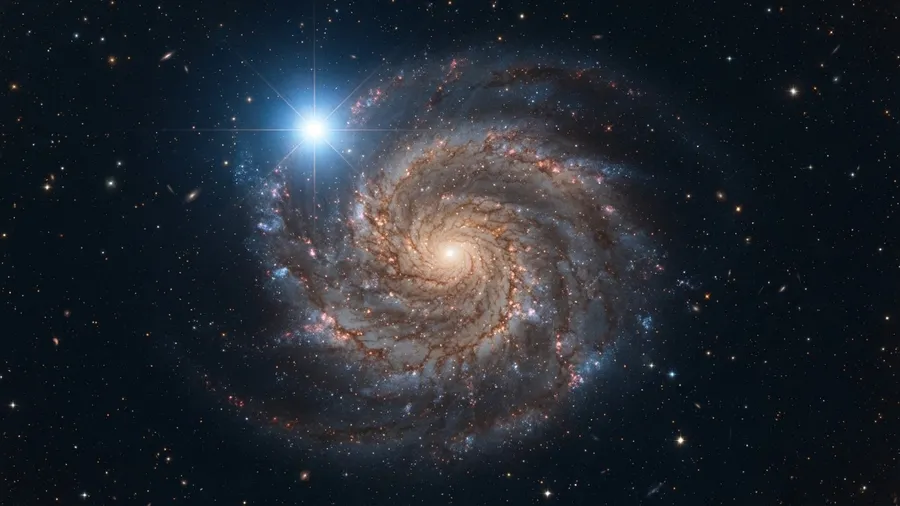
A nearby supernova blazes at the edge of a spiral arm, outshining the galaxy's surrounding stars.
🇺🇸 The Light Showed Up Fast
Early November. A survey telescope flagged a new point of light inside a nearby galaxy, and somebody checked it before breakfast, or whatever counts as breakfast where they were. That part is routine now. What is not routine is how young this explosion was when someone caught it. Hours old, maybe a day or two. The first spectra came in and people started messaging each other, because the light did not look like the textbook case. I kept rereading the early alerts. Telescope time got rearranged, observing proposals were rewritten overnight, and a few groups dropped what they were doing. I will be honest, I cannot tell you every detail of what they saw, and the papers are not out yet.
🇪🇸 La atraparon casi recién explotada
Lo raro no fue la supernova. Esas pasan todo el tiempo, en galaxias lejanas, y casi siempre las vemos tarde, cuando ya llevan días brillando. Esta la agarraron joven, con apenas horas de vida, y eso lo cambia todo. A principios de noviembre un telescopio de rastreo marcó un punto nuevo dentro de una galaxia cercana. Cercana quiere decir millones de años luz, no la vecina de la esquina, pero cercana para este oficio. Los primeros espectros no se parecían al caso típico y los grupos empezaron a escribirse entre ellos. Reorganizaron noches de observación en cuestión de horas. Yo no sé todavía qué vieron exactamente. Los artículos no han salido.
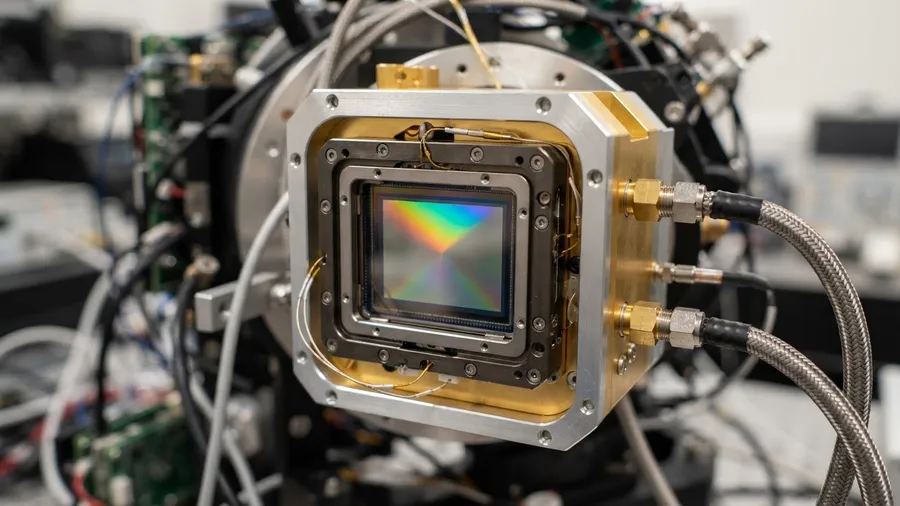
The cooled CCD camera sensor used to capture the supernova's light in fine detail.
🇺🇸 What Was Already on the Shelf
Stars above roughly eight times the mass of the Sun end this way. The core runs out of fuel, collapses, and the outer layers get blown off. We have known that outline for decades. The last really close case was SN 1987A, in a small galaxy beside ours, about 168,000 light years away. Detectors on Earth caught about two dozen neutrinos from it, which is strange, if you think about it, two dozen ghost particles confirming a whole theory. Then in 2023 a bright one went off in M101, around 21 million light years out. It suggested some stars throw off a lot of gas right before they die. Since then astronomers have wanted another nearby one, caught early.
🇪🇸 Lo que ya sabíamos
Una estrella con más de ocho veces la masa del Sol termina así, y la historia básica se conoce desde hace décadas. La última supernova realmente cercana fue la 1987A, en la Gran Nube de Magallanes, a 168.000 años luz. Unos detectores de neutrinos registraron unas veinticuatro partículas, y con eso se confirmó buena parte de la teoría del colapso. Después, en 2023, explotó una en M101, a unos 21 millones de años luz. Esa dejó una pista curiosa. Algunas estrellas parecen soltar muchísimo gas poco antes de morir. Desde entonces la comunidad quiere otra supernova cercana y atrapada temprano, porque una sola no basta para saber si eso es lo normal o una rareza.
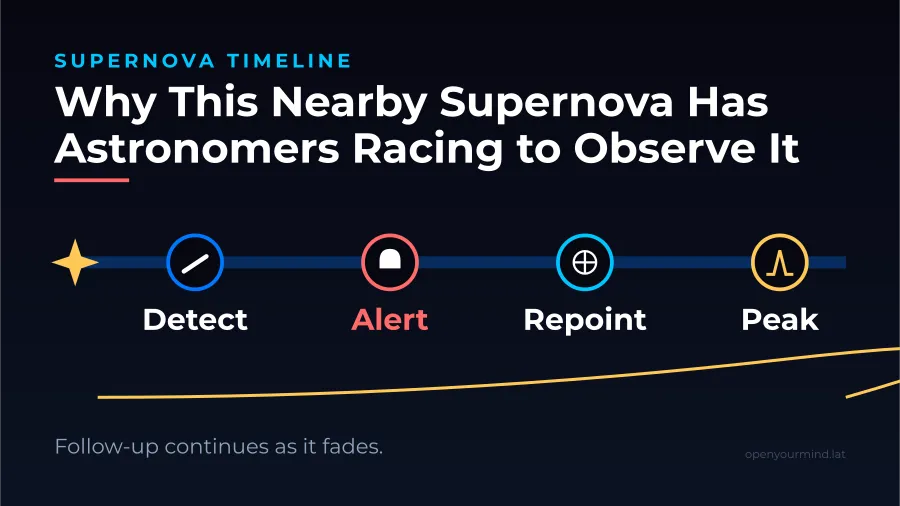
Timeline showing how the nearby supernova was detected and quickly flagged as special.
🇺🇸 How a Star Actually Blows Up
Here is the mechanism, as far as anyone has it. The core builds up iron, and iron cannot release energy by fusing. So the core collapses in a fraction of a second, squeezed down to about the width of a city. Then it bounces. A shock wave forms and stalls, which is the part that bothers theorists. Neutrinos pour out and seem to push the shock forward again, but getting that to work in simulations is hard, and I do not fully follow the math. Eventually the shock reaches the surface and the star brightens. Catch it early and you might see the breakout flash, plus the gas the star shed before dying. Later, radioactive nickel keeps the glow going for weeks.
🇪🇸 Cómo explota una estrella de verdad
Empieza con hierro. El núcleo de la estrella lo acumula, y el hierro no libera energía al fusionarse, así que nada sostiene el peso de las capas de arriba. El colapso dura menos de un segundo. Se forma una onda de choque que se atasca a mitad de camino, y esa es la parte que a los teóricos les quita el sueño. Los neutrinos parecen darle el empujón que falta, aunque las simulaciones todavía batallan para reproducirlo bien. Cuando la onda llega a la superficie hay un destello breve, y solo lo ves si llegas temprano. Después el níquel radiactivo mantiene el brillo durante semanas. Por eso la carrera. El destello dura horas.
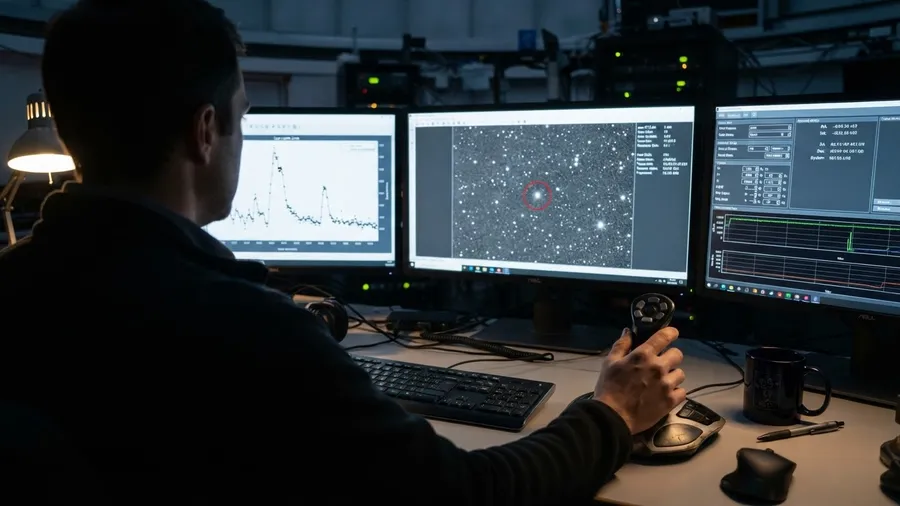
Control desk monitors tracking the supernova's light curve as observations continue.
🇺🇸 What Changes for Actual People
Nothing changes at your breakfast table. Let me say that plainly. But a few things do move. Telescopes get reassigned, including big space instruments, so other projects wait a week or two. Amateur astronomers with backyard gear fill the gaps between professional observations, and their data ends up in real papers. The neutrino community probably cannot hear this one, since it is too far, but the same follow up habits get rehearsed for the day a supernova goes off in our own galaxy. And the iron in your blood and the calcium in your bones came from explosions like this. Every well measured example sharpens our estimate of how much of each element a dying star makes.
🇪🇸 Qué cambia para la gente común
Para la gente común, la respuesta honesta es que casi nada cambia mañana. Lo que sí cambia está más lejos. Una semana de telescopio es dinero y paciencia, y otros proyectos esperan para que este se observe. Los aficionados con equipos modestos llenan los huecos entre las observaciones profesionales, y sus datos terminan en artículos de verdad. También se ensaya la cadena de alertas que se usaría si algo así pasara en la Vía Láctea, algo que ocurre más o menos una o dos veces por siglo. Y está lo del hierro de tu sangre y el calcio de tus huesos, que salieron de estrellas muertas. Cada supernova bien medida afina cuánto producen de cada elemento.
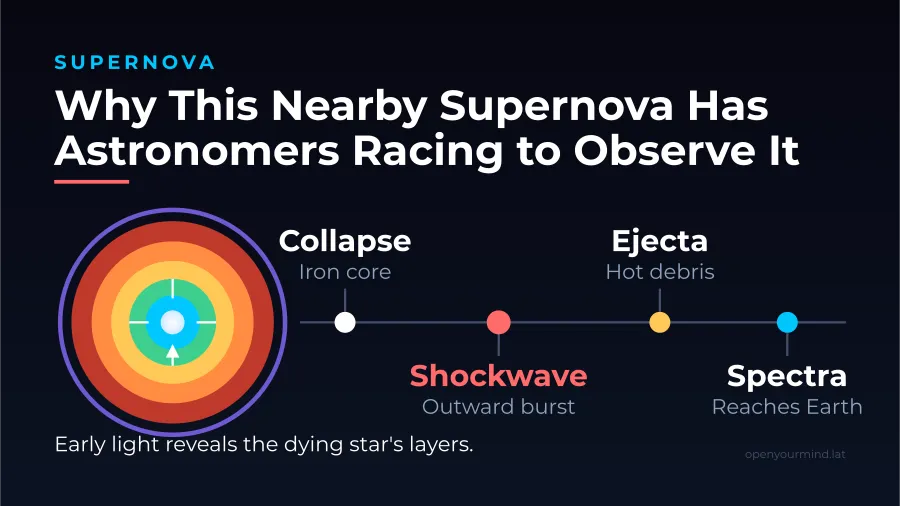
Layered shells of a massive star at the moment its iron core collapses into a supernova.
🇺🇸 What Nobody Knows Yet
Nobody knows which star exploded. Archival Hubble images might show it, but the supernova has to fade first, which takes a year or two. Nobody knows how much gas surrounded it, and radio and X ray observations over the coming months should settle that. And nobody knows what is left at the center, a neutron star or a black hole. Seeing it may need James Webb, years from now.
🇪🇸 Lo que nadie sabe todavía
Nadie sabe qué estrella explotó. Las imágenes de archivo del Hubble podrían mostrarla, pero hay que esperar uno o dos años a que la supernova se apague. Nadie sabe cuánto gas la rodeaba, y las observaciones en radio y rayos X de los próximos meses deberían decidirlo. Tampoco se sabe qué quedó en el centro, una estrella de neutrones o un agujero negro. Quizás haga falta el telescopio James Webb, dentro de varios años.
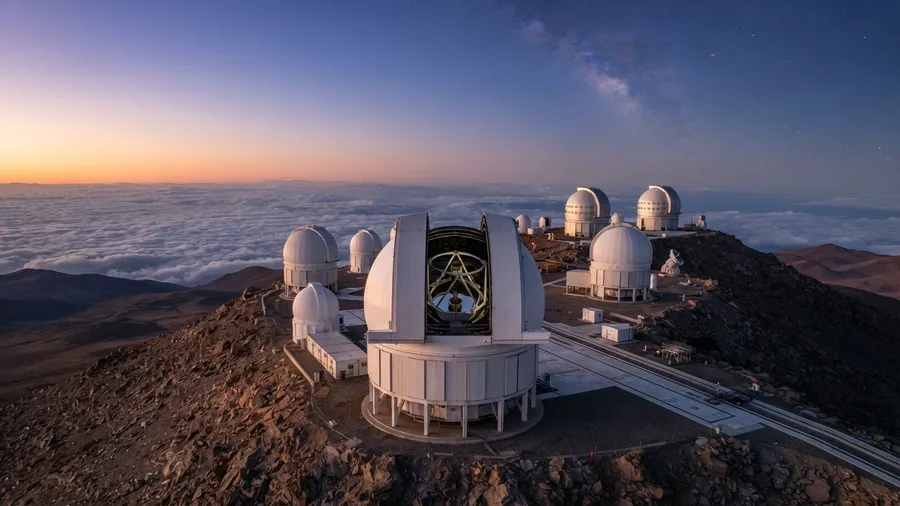
The mountaintop observatory whose telescopes were turned skyward to follow the supernova.
🔗 Related Articles | Artículos Relacionados
Nuestro canal transmite datos curiosos de ciencia, IA, espacio y tecnología las 24 horas. | Our channel streams science facts, AI, space and technology around the clock.
▶ Ver transmisión | Watch liveOPEN YOUR MIND
Source: Source
Join the conversation