Why Some Enzyme-Mimicking Molecular Cages Work Far Better
Molecular cage catalysts mimic enzymes how they work by binding reactants in tight pockets, and small shape changes can speed reactions many times over.
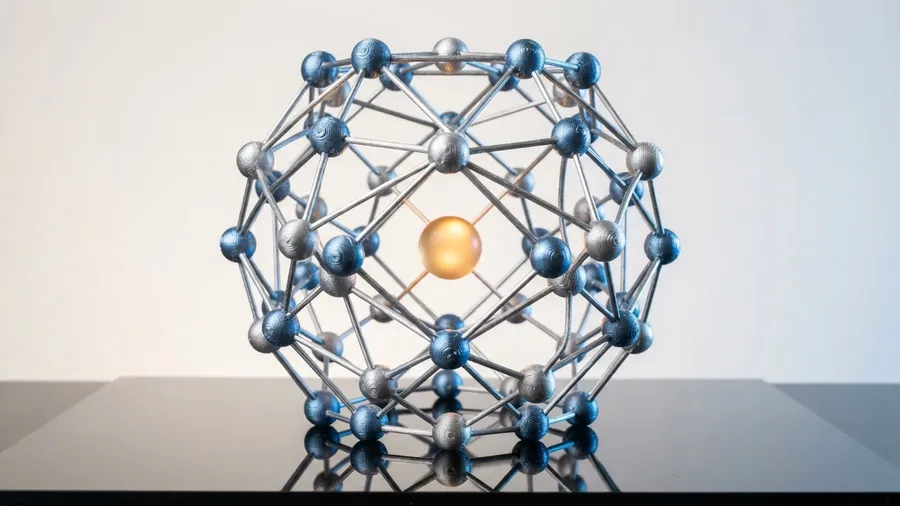
A 3D-printed molecular cage model shows how its hollow lattice of spheres and rods is built.
🇺🇸 A Gap of Ten Thousand Times
Ten thousand times. That is the gap between the best and the worst molecular cage catalysts in this study, and I kept rereading that number to make sure I had it right. These cages are tiny hollow molecules, built to swallow smaller molecules and run a reaction inside. You would expect cages with similar shapes to behave similarly. They did not. Some barely did anything. Others tore through the reaction at a pace closer to what enzymes manage. The interesting part is that the team did not stop at ranking them. They wanted to know what separated winners from losers, which is strange to want, if you think about it, since most catalyst work just chases whatever performs best.
🇪🇸 Una brecha de diez mil veces
La diferencia es enorme. El mejor catalizador resultó más de 10 000 veces más activo que el peor, y todos eran jaulas moleculares, o sea, estructuras huecas diminutas que atrapan moléculas para que reaccionen dentro. Uno pensaría que formas parecidas darían resultados parecidos. Pues no. Algunas jaulas casi no hacían nada. Otras aceleraban la reacción de una manera que recuerda a las enzimas de verdad. Lo que me atrapó es que los investigadores no se conformaron con hacer un ranking. Querían entender qué separaba a las ganadoras de las perdedoras. Eso es poco común, porque casi siempre el trabajo con catalizadores consiste en buscar el que rinda más y seguir adelante.
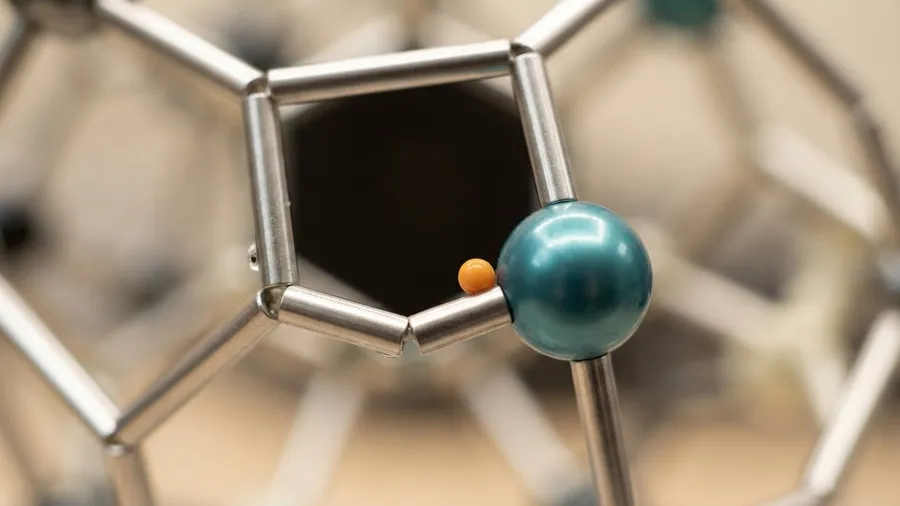
A close view of one cage window reveals the opening where reactant molecules enter.
🇺🇸 What Chemists Already Knew
Nature figured this out first. Enzymes grab a molecule, hold it in an awkward shape, and make the route to the reaction easier. The pocket matters as much as the chemistry. Chemists have copied that idea for decades with cages, capsules and bowls, and these structures do trap guests and speed things up. But the results were messy. One lab reports a modest boost, another reports something dramatic, and comparing them is close to impossible because the reactions, solvents and cages all differ. So the field had lots of examples and very little explanation. I do not know how many cage designs exist by now. Hundreds, probably. Nobody had a reliable way to predict which ones would be good.
🇪🇸 Lo que ya se sabía
Las enzimas llevan muchísimo tiempo perfeccionando este truco. Agarran una molécula, la sostienen en una forma incómoda y le facilitan el camino hacia la reacción. El bolsillo importa tanto como la química. Los químicos han imitado eso con jaulas, cápsulas y cuencos moleculares. Funcionan, sí, pero los resultados eran un desorden. Un laboratorio reporta una mejora pequeña, otro una enorme, y compararlos casi no tiene sentido porque cambian la reacción, el solvente y la jaula. Había muchos ejemplos y poca explicación. No sé cuántos diseños de jaulas existen hoy, quizás cientos. Lo que faltaba era una forma confiable de predecir cuáles serían buenas.
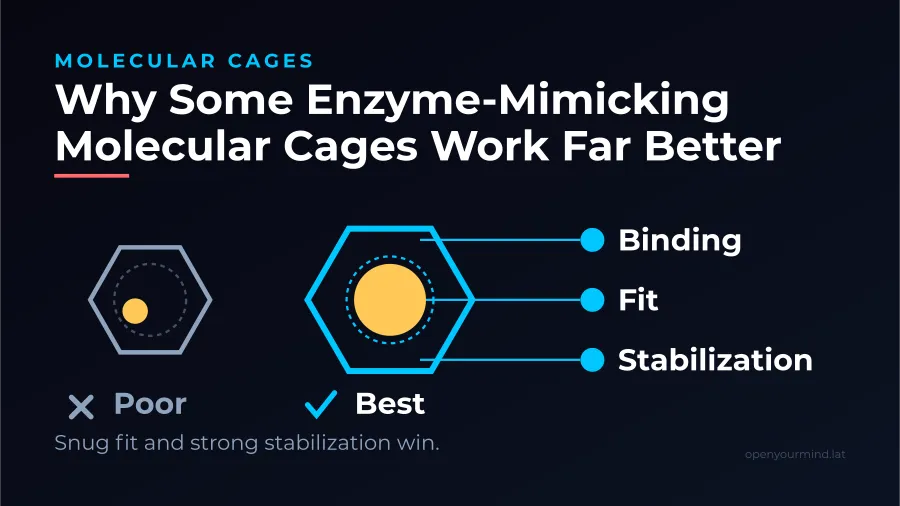
Similar-looking molecular cages differ sharply in how much they accelerate the same reaction.
🇺🇸 Inside the Little Room
Picture the cage as a small room with a door too narrow for most things. A reactant slips in and sits there, held to the walls by weak attractions. Inside, it is crowded. The reactant gets pushed toward the shape it needs, and the walls can stabilize the unstable midpoint of the reaction, the transition state. That stabilization is the big lever. Lower the energy of that midpoint a little and the rate climbs a lot. Then the product has to leave, and a cage that holds its product too tightly clogs itself. I cannot tell you which of these factors dominated here. Some details were over my head. The general picture is that good fit and clean release together set the speed.
🇪🇸 Dentro del cuartito
Imagina una jaula como un cuarto pequeño con una puerta estrecha. El reactivo entra y se queda sujeto a las paredes por atracciones débiles. Adentro hay poco espacio, así que la molécula se ve empujada hacia la forma que necesita para reaccionar. Las paredes también pueden estabilizar el punto intermedio inestable de la reacción, el estado de transición. Ahí está la palanca grande. Bajar un poco la energía de ese punto multiplica la velocidad. Luego el producto tiene que salir, y una jaula que lo sujeta demasiado fuerte se tapa a sí misma. No puedo decirte cuál de estos factores pesó más en este estudio, porque varios detalles se me escapan. Pero la idea general es que el encaje y la salida, juntos, fijan la velocidad.
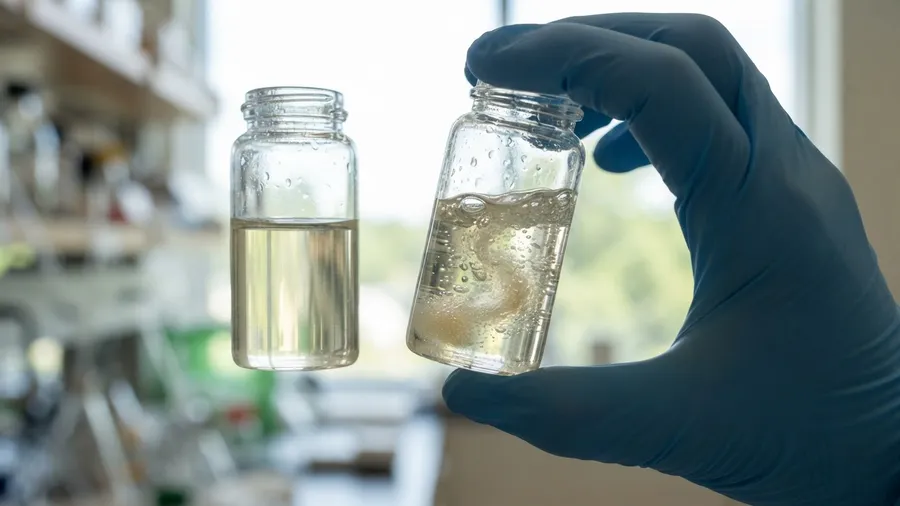
A chemist's vial shows cage catalyst powder dispersing in solution during the reaction.
🇺🇸 What Changes and What Does Not
Here is where I slow down, because hype lives in this part. Nobody will buy a product next year because of this paper. What changes is the search. If researchers can explain why one cage beats another by a factor of 10,000, they can stop screening blindly and start designing. That saves lab time, and cage synthesis is slow. The downstream hope for real people is cleaner and cheaper chemistry, like medicines or materials made with less waste and milder conditions, since a good catalyst can replace harsh heat and harsh reagents. That is a hope, not a result. As far as I can tell, the study works with a model reaction.
🇪🇸 Lo que cambia y lo que no
Para una persona común, esto no cambia nada mañana. Y desconfío de quien diga lo contrario. Lo que cambia es la búsqueda. Si los investigadores entienden por qué una jaula le gana a otra por un factor de 10 000, dejan de probar a ciegas y empiezan a diseñar. Eso ahorra tiempo en el laboratorio, donde sintetizar jaulas es lento y caro. La esperanza a largo plazo es una química más limpia y barata, con medicinas o materiales fabricados con menos desperdicio y sin tanto calor ni reactivos agresivos, porque un buen catalizador sustituye esas condiciones duras. Es una esperanza, no un resultado. Hasta donde entiendo, el estudio trabaja con una reacción modelo.
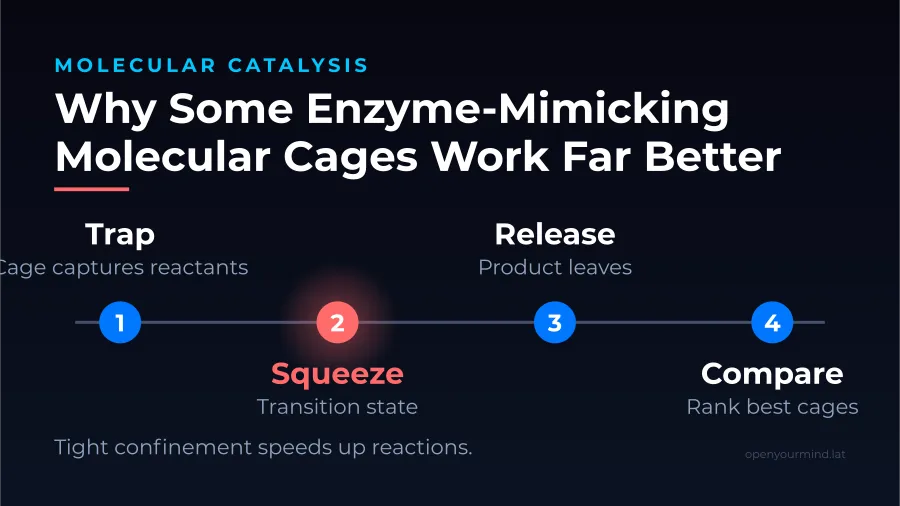
Reactants enter the cage, get trapped in its cavity, and undergo catalysis step by step.
🇺🇸 Open Questions
Researchers have not shown whether the ranking holds for a second, different reaction. The lifespan of the best cage is unmeasured, and I would want to see how many cycles it survives before breaking down, maybe a thousand. Whether the 10,000 fold gap holds in water, where real enzymes work, is also open. Three questions. Probably years of work.
🇺🇸 Preguntas abiertas
Nadie sabe si el ranking se mantiene con una segunda reacción distinta. Tampoco se ha medido cuántos ciclos aguanta la mejor jaula antes de degradarse, y un número en los miles sería convincente. Falta ver si la diferencia de 10 000 veces sobrevive en agua, donde trabajan las enzimas reales. Tres preguntas, tres experimentos, probablemente años de trabajo.
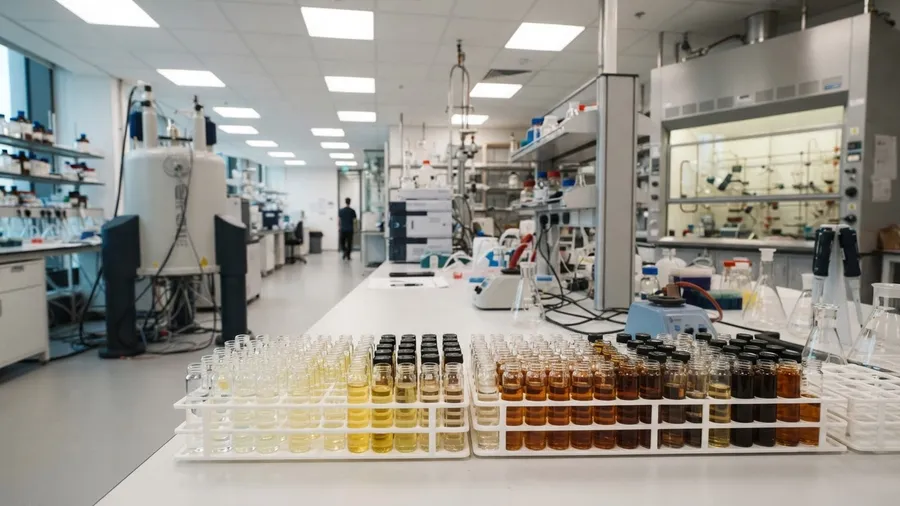
A research lab's rows of colored sample vials reflect the scale of cage catalysis testing.
🔗 Related Articles | Artículos Relacionados
Nuestro canal transmite datos curiosos de ciencia, IA, espacio y tecnología las 24 horas. | Our channel streams science facts, AI, space and technology around the clock.
▶ Ver transmisión | Watch liveOPEN YOUR MIND
Source: Source
Join the conversation