How 5 Silicon Qubits Ran at Once With 99.9% Accuracy
How 5 Silicon Qubits Ran at Once With 99.9% Accuracy
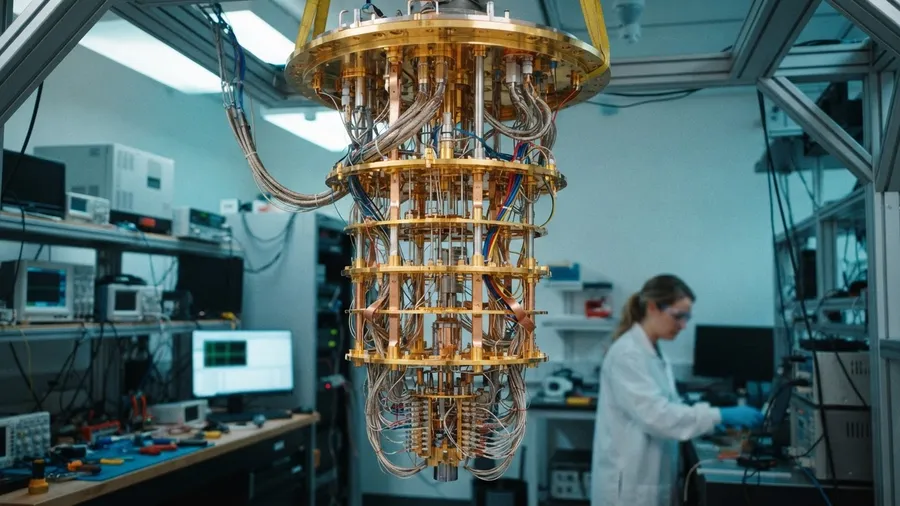
The dilution refrigerator chandelier cools the silicon qubit system to near absolute zero.
🇺🇸 Five qubits, all running at once
Five qubits built in silicon. All five running operations at the same moment. And each gate still came out right about 99.9 percent of the time. That last part is what stopped me. Plenty of labs can get a single qubit to behave beautifully when everything else is switched off. Doing it with the neighbors busy is another story, and accuracy usually sinks the moment you try. Here it held. Not perfectly, and not forever, but it held across the whole set. I kept rereading the result because the usual pattern is a slow slide downward as you add qubits. This time the line stayed flat enough to take seriously.
🇪🇸 Cinco qubits, todos a la vez
Lo que me frenó en seco fue la comparación. Un solo qubit de silicio con 99.9 por ciento de precisión ya se había visto en varios laboratorios. Lo difícil era repetirlo cuando los otros cuatro también estaban trabajando. Aquí el equipo encendió los cinco juntos y la precisión casi no se movió. Casi. Ese matiz importa, porque en este campo la costumbre es que cada qubit extra estropee un poquito a los demás. Una gota aquí, otra allá, y de pronto el chip entero es ruido. Esta vez no pasó. Me pareció extraño, la verdad, que algo tan pequeño como cinco qubits pesara tanto en la conversación sobre escalar.
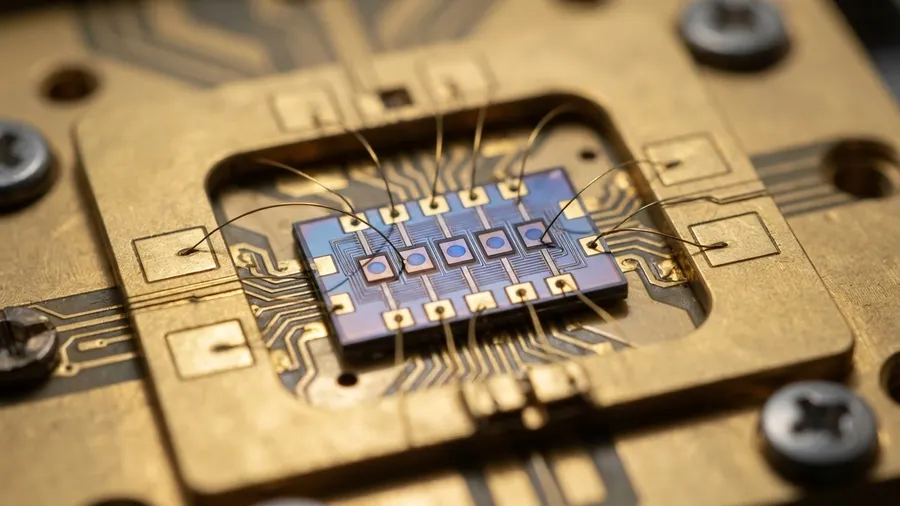
A silicon chip with five quantum dots is wire-bonded into its gold-plated sample holder.
🇺🇸 The old problem of noisy neighbors
Silicon was always the quiet bet. Superconducting circuits and trapped ions grabbed the headlines, but a spin qubit in silicon is tiny, a single electron held in a nanoscale trap, and the chip industry already knows how to make silicon at scale. The catch was crosstalk. Push on one qubit and its neighbors feel it, like tapping one wine glass on a shelf and hearing the others ring. Earlier experiments mostly measured gates one qubit at a time, which flatters the results. Fidelities above 99 percent had been reported in silicon for years. Whether they would survive a crowded chip was the open problem. I could not find a clear demonstration at this size.
🇪🇸 El problema de siempre, el ruido entre vecinos
Piensa en una repisa llena de copas de cristal. Golpeas una y las demás vibran. Eso es el crosstalk, la interferencia entre qubits vecinos, y en silicio era el obstáculo más terco. Los qubits de espín son diminutos, un solo electrón atrapado en una trampa de nanómetros, y se fabrican con técnicas parecidas a las de la industria de chips. Esa es su gran ventaja. Pero casi todos los récords de precisión se habían medido con un qubit a la vez, con el resto en silencio. Eso adorna los números. Faltaba saber qué pasaba con el chip lleno de actividad.
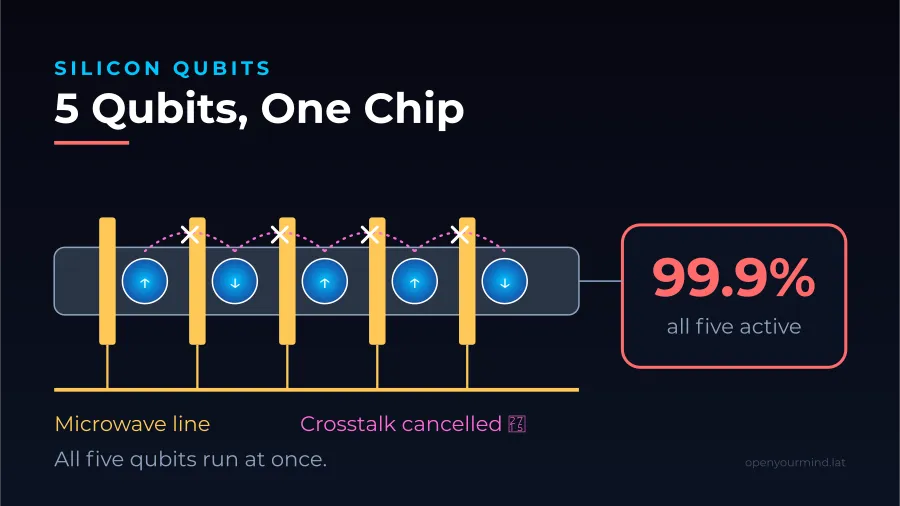
The schematic shows five silicon quantum dots, each with its own gate electrode.
🇺🇸 Tuning the pulses while everyone is awake
Each qubit here is the spin of an electron, pointing up or down, or some blend of both. To flip it you hit it with a carefully shaped pulse at just the right frequency. Trouble starts because driving one qubit nudges the resonance of the others and can partly drive them too. As I understand it, the team stopped calibrating qubits alone and tuned them while all five were active. Pulse strength, timing, frequency offsets, all adjusted in the crowd. I should say the details of their correction are partly over my head. The idea I can follow is simple enough. Measure the interference honestly, then build the pulses to cancel it.
🇪🇸 Cómo se cancela el eco
Calibrar un qubit solo es fácil, relativamente. Lo complicado es que cada pulso que mandas a uno desplaza un poco la frecuencia de resonancia de los otros. Y los otros, desprevenidos, responden a medias. Mi lectura es que el equipo dejó de ajustar cada qubit por separado y los afinó con los cinco funcionando a la vez. Así midieron la interferencia real y diseñaron los pulsos para compensarla. Debo ser honesto. No logré seguir toda la matemática de esa corrección, y no voy a fingir que sí. Lo que sí entiendo es la lógica. Primero escuchas el eco, después lo cancelas.
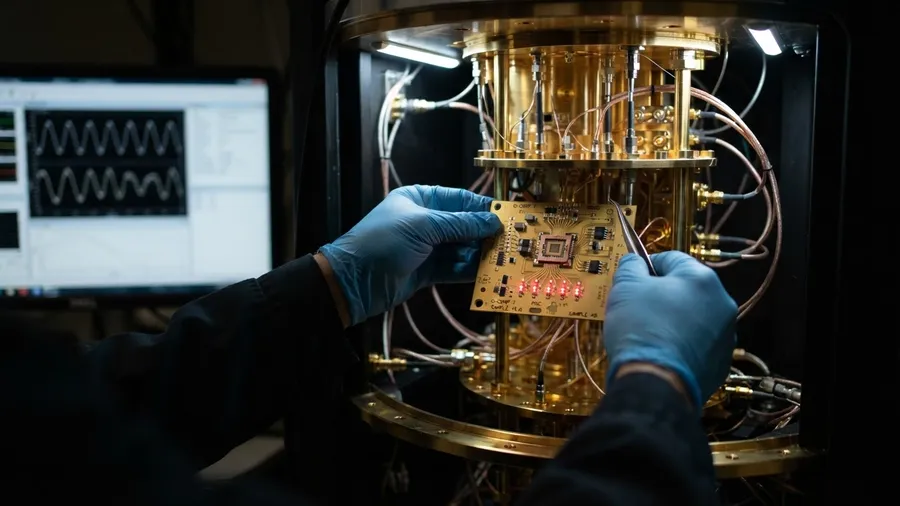
A researcher loads the chip-carrier board into the cryostat's mixing-chamber stage.
🇺🇸 What actually changes
Nobody gets a better phone out of this. Five qubits cannot do anything a laptop cannot. What changes is the engineering math. Error correction needs gates accurate enough that fixing mistakes does not create more of them, and 99.9 percent leaves real margin above the commonly cited 99 percent threshold. More margin means fewer physical qubits wasted protecting each useful one. That shrinks the chip you need. For chemists hoping to simulate catalysts or battery materials, the machine they want gets a little less absurd on paper. Years away still. But a team deciding whether to bet on silicon now has one less reason to doubt.
🇪🇸 Qué cambia para la gente de verdad
Tu teléfono no cambia. Tu laptop tampoco, porque cinco qubits no resuelven nada que ella no pueda resolver. El cambio es de aritmética. La corrección de errores exige puertas tan precisas que arreglar fallos no produzca más fallos, y con 99.9 por ciento hay colchón sobre el umbral de 99 por ciento que suele citarse. Más colchón significa menos qubits físicos gastados por cada qubit lógico útil, o sea, un chip más pequeño. Para quienes sueñan con simular baterías o catalizadores, esa máquina se vuelve menos absurda. Faltan años, eso sí. Pero apostar por el silicio se ve algo menos arriesgado hoy.
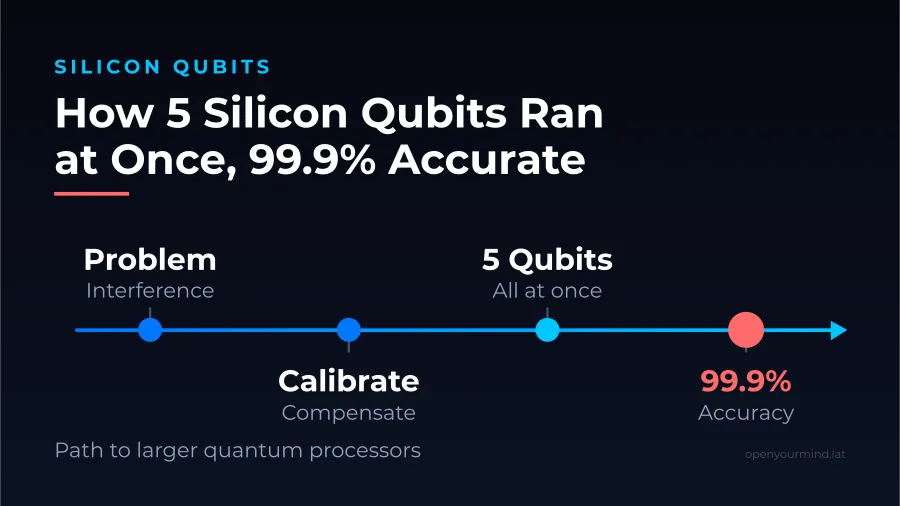
The process flow outlines how the team ran qubits simultaneously with high accuracy.
🇺🇸 What nobody has answered yet
Ten qubits comes next, and nobody knows whether 99.9 percent survives it, let alone 50. The calibration also needs a clock. If it drifts after a few hours, a large chip would spend more time retuning than computing, and I could not find that number. Then there is temperature. These chips sit in dilution refrigerators near 10 millikelvin, and whether the method works at 1 kelvin is untested as far as I can tell.
🇪🇸 Lo que sigue sin respuesta
Con diez qubits viene la siguiente prueba, y nadie sabe si el 99.9 por ciento aguanta, mucho menos con cincuenta. Tampoco está claro cuánto dura la calibración. Si se desajusta en pocas horas, un chip grande pasaría más tiempo reafinando que calculando, y no encontré ese número. Y está la temperatura. Estos chips viven cerca de 10 milikelvin, y sin pruebas no sé si el método sirve a 1 kelvin.

The quantum computing lab houses a row of cryostat units for qubit experiments.
🔗 Related Articles | Artículos Relacionados
Nuestro canal transmite datos curiosos de ciencia, IA, espacio y tecnología las 24 horas. | Our channel streams science facts, AI, space and technology around the clock.
▶ Ver transmisión | Watch liveOPEN YOUR MIND
Source: Source
Join the conversation