Artificial Muscles Let Humanoid Robots Move More Like Us
Artificial Muscles Let Humanoid Robots Move More Like Us

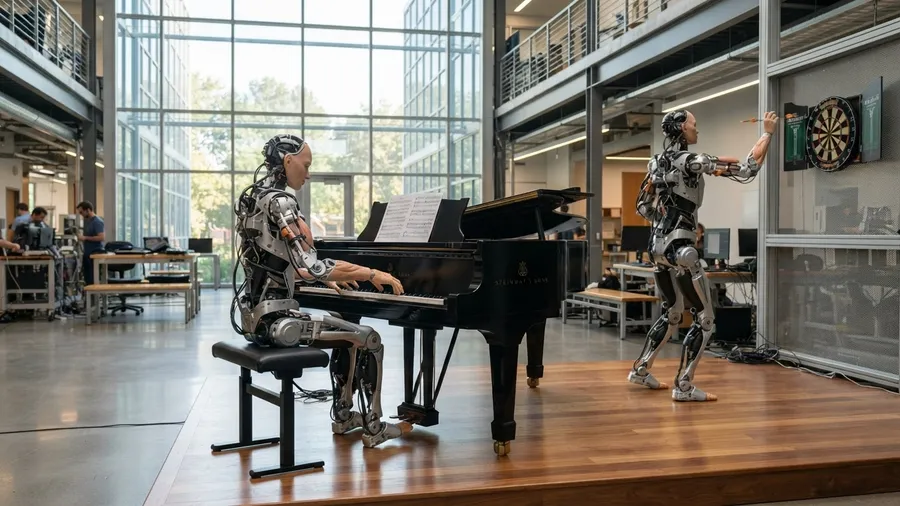
A humanoid robot's artificial-muscle hand poises over piano keys mid-chord.
🇺🇸 Eyes, fingers, and a piano
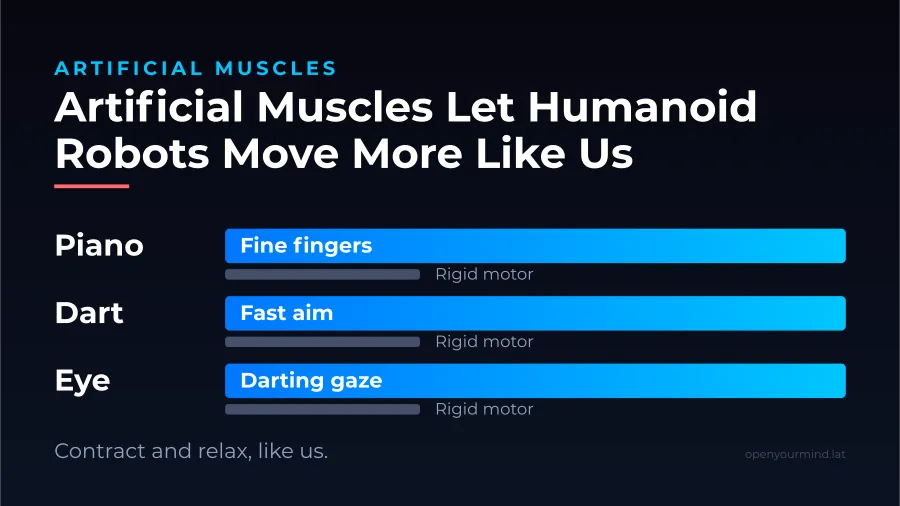
A team built artificial muscles for humanoid robots and then tested them on jobs that humans find easy and machines find miserable. One robot hand played piano. Not like a concert artist, but it hit the right keys in order. Then came the eyeballs. Detached from any head, they darted around and locked onto targets with a speed that looked uncomfortably natural. I kept rereading that part. Eyes are brutal for engineers because they need speed and tiny precision at once, and most robot motors give you one or the other. I could not track down every figure from the study, so I will not pretend to.
🇪🇸 Ojos, dedos y un piano
Los ojos fueron lo que más me llamó la atención. Unos globos oculares sueltos, sin cabeza, se movían a saltos rápidos y se fijaban en un blanco con una naturalidad rara. Antes de eso, el equipo había puesto una mano robótica a tocar piano. No suena como un concertista, pero pulsa las teclas correctas y en orden. La idea de fondo es que estos músculos artificiales sirven para tareas donde un motor normal se queda corto. Un ojo necesita velocidad y precisión al mismo tiempo, y casi ningún motor ofrece las dos. No pude confirmar todas las cifras del estudio, así que prefiero no inventarlas.
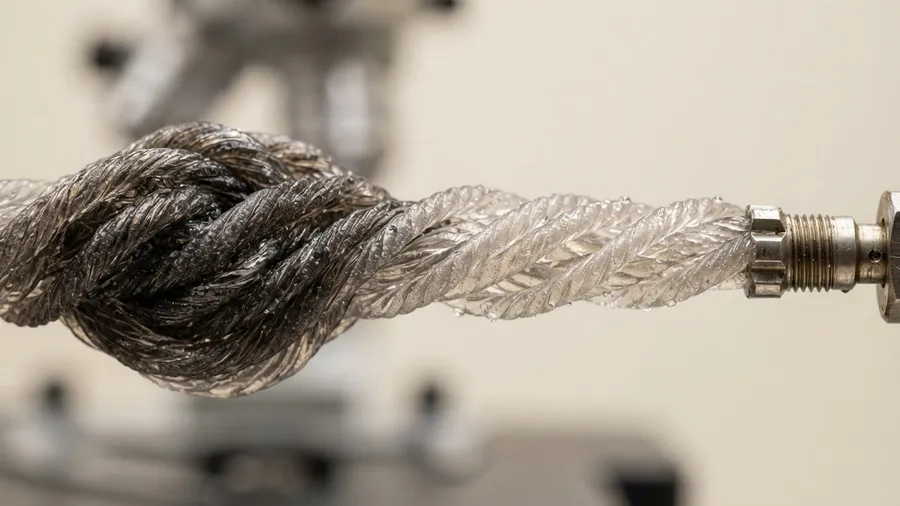
One end of this artificial muscle fiber bundle is contracted while the other relaxes.
🇺🇸 Why motors were never enough
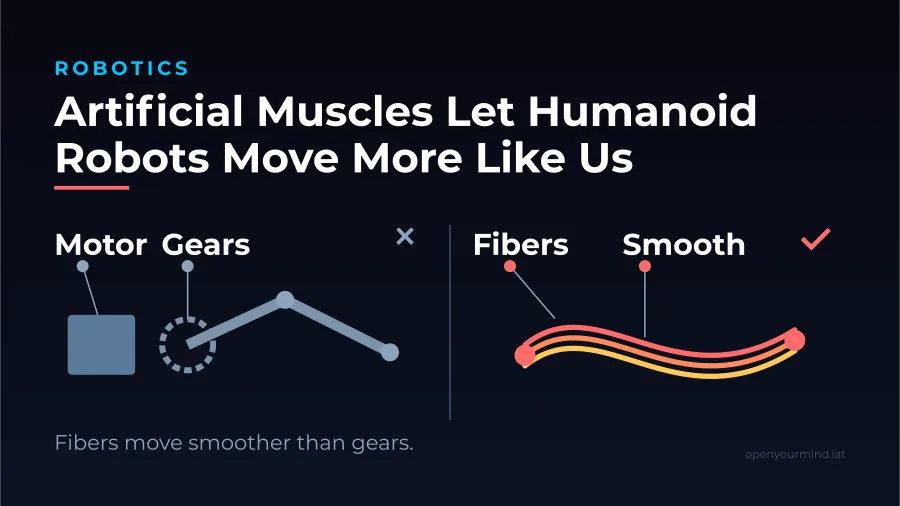
Robots have always been strangely stiff. Electric motors with gears are cheap and reliable, but they are heavy, noisy, and they fight you when something pushes back. Hydraulics give brute strength and then leak on the floor. Artificial muscles are not a new dream. Engineers have been building pneumatic ones since the 1950s, the kind that swell with air and pull shorter. Later came shape memory alloys that contract when heated, and soft polymers that bend under voltage. Each had a flaw. Too slow, too weak, too hot, or too fragile after a few thousand cycles. Meanwhile your body runs on something like 600 muscles, and none of them need a cooling fan.
🇪🇸 Décadas de intentos incompletos
Un cuerpo humano tiene unos 600 músculos, y ninguno necesita ventilador. Los robots llevan décadas intentando imitar eso con resultados mediocres. Los motores eléctricos con engranajes son baratos y confiables, pero pesan, hacen ruido y no ceden cuando algo los empuja. La hidráulica tiene fuerza bruta, aunque tiende a gotear aceite. Los músculos neumáticos, esos que se inflan con aire y se acortan, existen desde los años cincuenta. Después llegaron las aleaciones con memoria de forma, que se contraen con calor, y los polímeros blandos que reaccionan al voltaje. Todos fallaban en algo. Eran lentos, débiles, calientes o se desgastaban rápido. Esa lista de fallas es la que este trabajo intenta acortar.
Scientific diagram: Artificial Muscles Let Humanoid Robots Move More Like Us
🇺🇸 How a muscle pulls
Here is the part where I admit my limits. The general principle I understand. A fiber or sheet shortens when you feed it energy, whether that is electricity, heat, or fluid pressure. Bundle enough of them and the shortening adds up to a real pull on a tendon or a robot bone. The trick is pairing. Your biceps pulls the arm up and your triceps pulls it down, and the tension between them gives you control. Each human eye uses six muscles arranged in pairs. I am not certain which exact material this team used, and I would rather say that than guess. The pairing logic, though, is probably what lets the eyes snap and stop.
🇪🇸 Cómo jala un músculo que no es de carne
Te explico lo que sí entiendo. Un músculo artificial se acorta cuando le das energía, sea electricidad, calor o presión de fluido. Si juntas muchas fibras, ese acortamiento se suma y jala un tendón o un hueso de robot. Lo importante es el trabajo en pares. El bíceps sube el brazo y el tríceps lo baja, y la tensión entre los dos da control fino. Cada ojo humano usa seis músculos así. Lo que no sé es qué material exacto usó este equipo, y prefiero decirlo antes que adivinar. Mi sospecha es que esa lógica de pares explica por qué los ojos arrancan y frenan tan limpio.
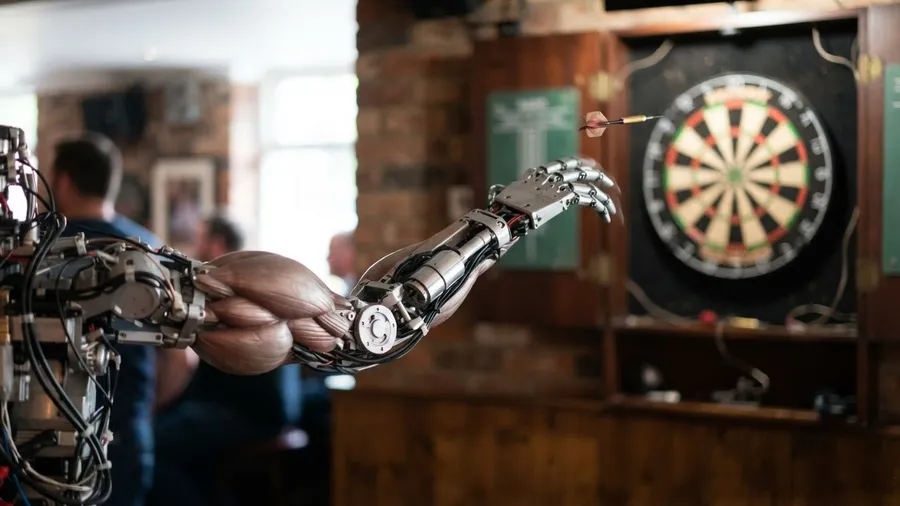
A humano
🇺🇸 What changes outside the lab
Nobody is getting a piano playing robot butler next year. Let me say that plainly. The nearer consequence is quieter and less glamorous. A robot arm built from muscle like parts gives way when you bump it, instead of snapping a wrist, yours or its own. That matters in nursing homes, in warehouses, anywhere a machine shares a floor with people. Lighter limbs mean smaller batteries, so a humanoid might work longer between charges. Prosthetics are the other obvious place, since an artificial hand that moves like a real one is worth more to a person than any demo. Cost is the catch. A lab piece is not a product, and I have seen plenty die in that gap.
🇪🇸 Lo que cambia fuera del laboratorio
Nadie va a tener un robot mayordomo pianista el año que viene. Mejor aclararlo. La consecuencia cercana es más callada. Un brazo robótico con músculos artificiales cede cuando lo golpeas, en vez de romperte la muñeca o romperse la suya. Eso importa en asilos, almacenes y cualquier lugar donde una máquina comparta piso con gente. Extremidades más livianas piden baterías más chicas, y un humanoide podría trabajar más tiempo sin cargar. Las prótesis son el otro caso claro, porque una mano artificial que se mueve como una real vale más para una persona que cualquier demostración. El problema es el costo. Una pieza de laboratorio no es un producto, y he visto morir muchas en ese hueco.
Scientific diagram: Artificial Muscles Let Humanoid Robots Move More Like Us
🇺🇸 What nobody has measured yet
The team has not made public, as far as I could find, how many contraction cycles the muscles survive before they weaken. A piano piece is thousands, a factory shift is millions. Nobody knows how much weight one muscle can lift at the speed the eyes showed. And the cost per unit is unpublished, so a price below a few hundred dollars is only a hope.
🇪🇸 Lo que falta medir
No encontré cuántos ciclos de contracción aguantan estos músculos antes de debilitarse. Una pieza de piano son miles, un turno de fábrica son millones. Tampoco se sabe cuánto peso levanta un solo músculo a la velocidad que mostraron los ojos. Y el costo por unidad no está publicado, así que un precio de unos cientos de dólares es solo una esperanza.
Artificial Muscles Let Humanoid Robots Move More Like Us
🔗 Related Articles | Artículos Relacionados
Nuestro canal transmite datos curiosos de ciencia, IA, espacio y tecnología las 24 horas. | Our channel streams science facts, AI, space and technology around the clock.
▶ Ver transmisión | Watch liveOPEN YOUR MIND
Source: Source
Join the conversation