What Brain Implant Volunteers Now Want From Clinical Trials
What Brain Implant Volunteers Now Want From Clinical Trials
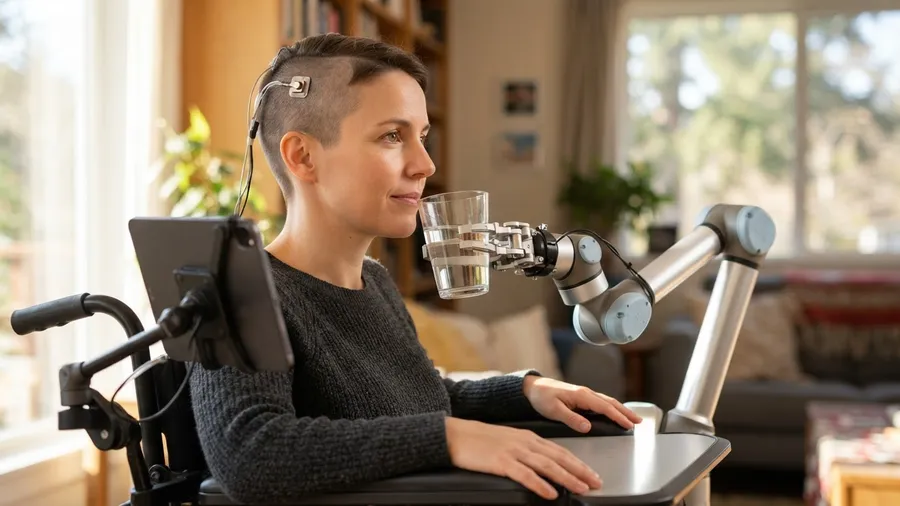
A brain implant volunteer looks toward a tablet at home in a sunlit living room
🇺🇸 What the volunteers are asking for
Ask the volunteers. That is what a few research teams finally did, and the answers were not about money. People with spinal cord injuries, ALS, and stroke who have had electrodes placed in their brains say they want to be named. They want a voice in what gets tested next. And they want to keep the device when the study ends, which is strange, if you think about it, because for years that sat in a footnote of the consent form. Some of them now appear as coauthors on papers. Others give talks beside the engineers who programmed their implants. I kept rereading one point. The ask is for partnership, not gratitude.
🇪🇸 Lo que piden los voluntarios
Lo primero que sorprende es lo poco que se habla de dinero. Algunos equipos empezaron a preguntarles directamente a los voluntarios qué esperaban del estudio, y las respuestas se repiten. Quieren que su nombre aparezca. Quieren opinar sobre qué se prueba después. Y quieren quedarse con el dispositivo cuando el ensayo termine, algo que durante años quedó enterrado en la letra pequeña del consentimiento informado. Hay participantes que ya firman artículos como coautores y que dan charlas junto a los ingenieros que programaron sus implantes. Yo lo leí dos veces para estar seguro. Lo que piden es ser socios de la investigación, no solo recibir un agradecimiento educado.
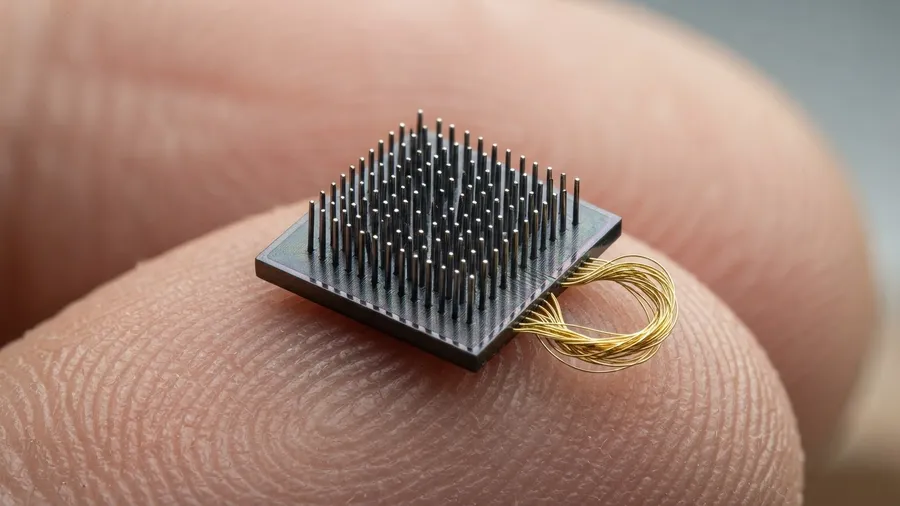
A microelectrode array with 100 needle-like electrodes rests on a fingertip for scale
🇺🇸 A short history with a dark chapter
The history here is short but crowded. Early in the 2000s, a man named Matthew Nagle moved a cursor on a screen using a small array of electrodes in his motor cortex. Since then, participants have steered robotic arms, typed with their intentions, and in 2023 two women with severe paralysis produced speech through decoders at Stanford and UCSF, at 62 and 78 words per minute. Each result rests on a person who showed up week after week for years. Then there is the darker part. When the company Second Sight ran short of money around 2020, people with its retinal implants were left with hardware nobody would repair. That memory still shapes what volunteers ask for.
🇪🇸 Una historia corta con un capítulo oscuro
Para entender la presión de ahora hay que mirar atrás. En 2004 Matthew Nagle movió un cursor con un pequeño arreglo de electrodos en la corteza motora. Después vinieron brazos robóticos, escritura mental y, en 2023, dos mujeres con parálisis severa que lograron hablar a través de decodificadores, a 62 y 78 palabras por minuto. Detrás de cada cifra hay alguien que fue al laboratorio semana tras semana durante años. Y está la parte incómoda. Cuando la empresa Second Sight se quedó sin dinero hacia 2020, quienes llevaban sus implantes de retina quedaron con aparatos que nadie quería reparar. Esa historia pesa en cada conversación sobre contratos.
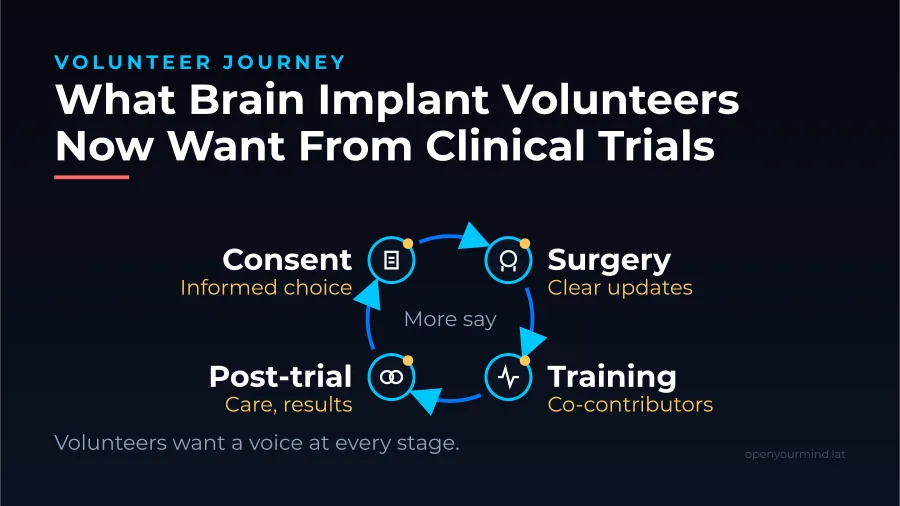
The volunteer's journey through a brain-implant trial, from consent to years of training sessions
🇺🇸 What the implant actually does
Here is the mechanical part, as best I follow it. A Utah array is about 4 millimeters wide, with 96 tiny needles that sit in the cortex and pick up the electrical spikes of nearby neurons. A wire carries that signal out through the skull to a computer. The person does not think a word and watch it appear. They try to move a hand or try to speak, and the motor cortex fires in patterns that a decoder, usually a neural network, learns to match to a movement or a sound. Training takes hours. The patterns also drift from day to day, and how the software compensates is over my head. What I do understand is that the volunteer does the teaching.
🇪🇸 Cómo funciona por dentro
Por dentro funciona así, hasta donde yo lo entiendo. El arreglo tipo Utah mide unos cuatro milímetros por lado y tiene 96 agujas diminutas que se clavan en la corteza y captan los impulsos eléctricos de las neuronas cercanas. Un cable saca esa señal por el cráneo hasta una computadora. Nadie piensa una palabra y la ve aparecer. La persona intenta mover la mano o intenta hablar, y la corteza motora dispara patrones que una red neuronal aprende a asociar con un gesto o un sonido. Entrenarla toma horas. Y las señales cambian de un día a otro, y cómo lo corrige el software se me escapa. Lo que sí entiendo es que el voluntario es quien le enseña al sistema.
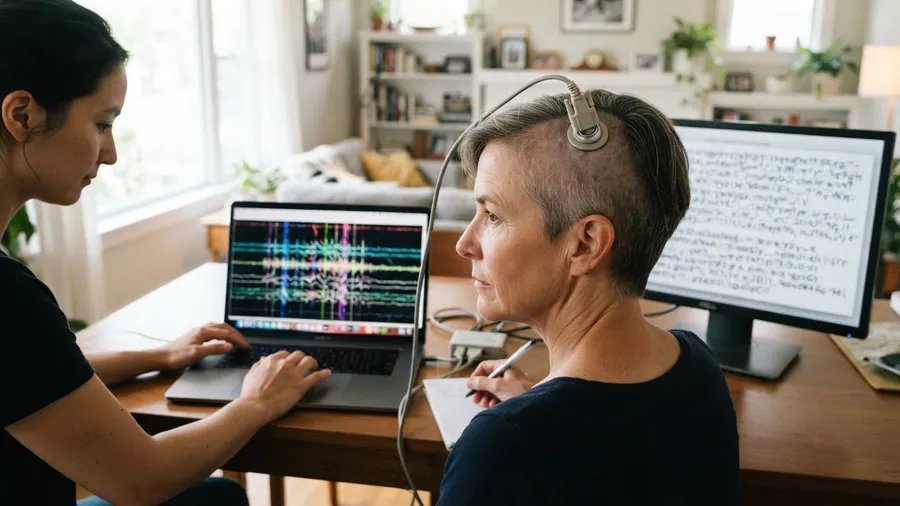
A participant attempts to imagine handwriting letters during a home research session
🇺🇸 Contracts, not headlines
Consequences come down to contracts. A person who learns to speak through a decoder for two years and then loses it when funding ends has lost something far bigger than a study visit. So volunteers are asking for follow up care, repairs, and surgery covered if the device has to come out. They want their own data returned to them. They want travel and caregiver costs paid, since a trip to a lab can take a family a whole day. A few teams have started writing long term support into consent forms. Most have not. For anyone considering a trial today, that difference is worth asking about before signing.
🇺🇸 Contratos, no titulares
En la práctica, todo se reduce a contratos. Imagina a alguien que pasó dos años aprendiendo a comunicarse con un decodificador y que lo pierde cuando se acaba el dinero del estudio. Eso es mucho más que una visita cancelada. Por eso los voluntarios piden seguimiento médico, reparaciones y cirugía pagada si hay que retirar el implante. Piden recibir sus propios datos. Piden que cubran el transporte y al cuidador, porque ir al laboratorio puede costarle a una familia un día entero. Algunos equipos ya escriben apoyo a largo plazo en el consentimiento. La mayoría todavía no. Hoy, quien piense entrar a un ensayo debería preguntar eso antes de firmar.
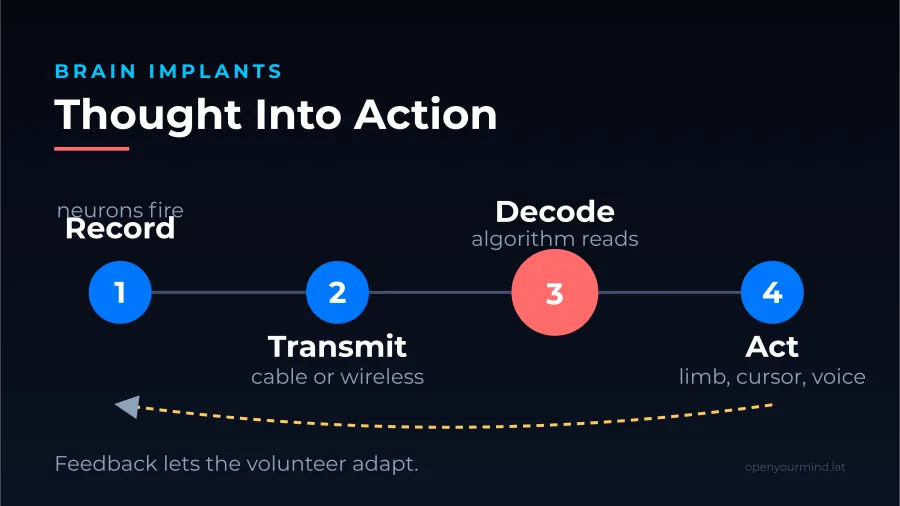
How a brain implant turns neural signals into action, from cortex firing to device output
🇺🇸 Questions with numbers attached
Nobody knows how long a Utah array keeps giving usable signals. Some have worked past five years, but recording quality tends to decline. Nobody knows who pays for upkeep once a trial closes, and no standard exists. Nobody knows whether a decoder trained today will work for the same person in ten years without retraining. Teams are tracking signal quality in long term participants, though I found no agreed timeline.
🇪🇸 Preguntas con números
Nadie sabe cuánto tiempo un arreglo Utah da señales útiles. Algunos pasaron de cinco años, pero la calidad suele bajar. Tampoco está claro quién paga el mantenimiento cuando el ensayo cierra, porque no hay un estándar. Y falta saber si un decodificador entrenado hoy servirá dentro de diez años sin reentrenarlo. Hay equipos midiendo la calidad de la señal en participantes de largo plazo, pero no encontré un calendario acordado.
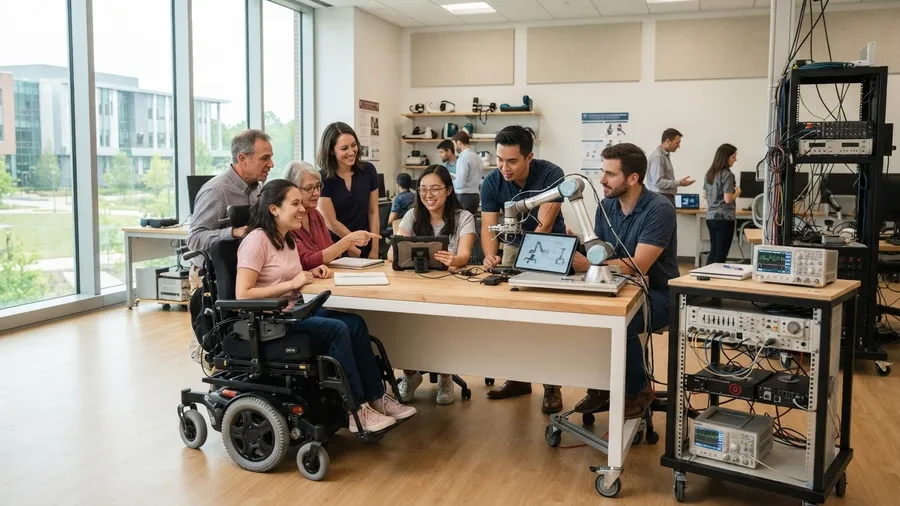
A participant in a power wheelchair joins researchers at a bright rehabilitation research suite
🔗 Related Articles | Artículos Relacionados
Nuestro canal transmite datos curiosos de ciencia, IA, espacio y tecnología las 24 horas. | Our channel streams science facts, AI, space and technology around the clock.
▶ Ver transmisión | Watch liveOPEN YOUR MIND
Source: Source
Join the conversation