Do Scientists Really Lose Their Edge With Age? New Data Says No
Do Scientists Really Lose Their Edge With Age? New Data Says No

Main visual for Do Scientists Really Lose Their Edge With Age? New Data Says No
🇺🇸 The Fade That Did Not Show Up
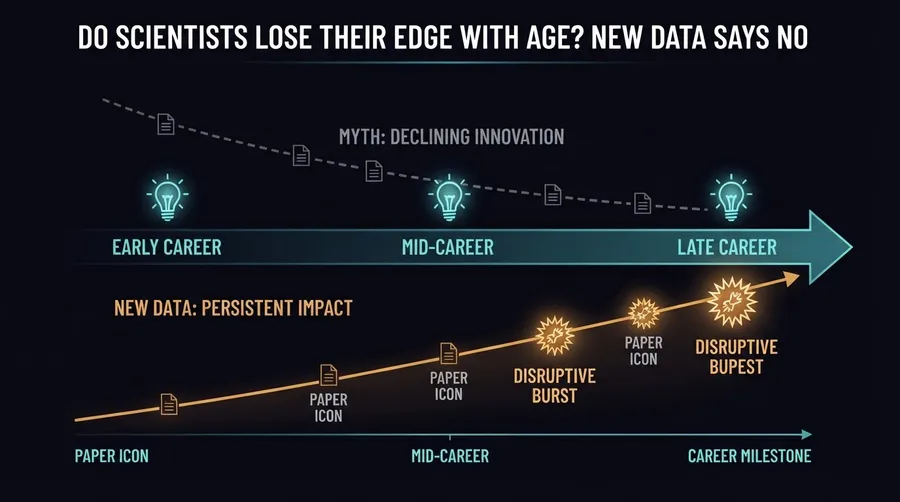
A new report says experienced scientists keep producing disruptive research, and they keep doing it for a long time. Not a burst in their thirties and then a slow slide. Persistence is the word the authors lean on. I only have the summary that Physics World ran, so I can't tell you the sample size or which fields dominate the data. That bothers me a little. Still, the direction of the result is clear enough. Researchers deep into their careers were not drifting toward safe, incremental work, which is strange, if you think about it, because almost everyone assumes they were. Even scientists assume it about themselves.
🇪🇸 Lo que nunca apareció: el declive
Un informe nuevo dice que los científicos con muchos años de carrera siguen haciendo investigación disruptiva, y no por un rato sino de forma sostenida. Nada de un pico a los treinta y luego una caída lenta. Yo solo leí el resumen de Physics World, así que no sé cuántos investigadores entraron en el análisis ni qué campos pesan más. Eso me molesta un poco. Aun así, la dirección del resultado se entiende. Los veteranos no se refugiaban en trabajo seguro y repetitivo. Casi todo el mundo daba eso por hecho, incluidos los propios científicos, y ahí está lo raro.

Detail view related to Do Scientists Really Lose Their Edge With Age? New Data Says No
🇺🇸 The Myth Had Good Marketing
Everybody knows the story. Einstein was twenty six in 1905. Dirac even wrote a little verse suggesting physics belongs to the young, and the line has been repeated at conferences ever since. Then in 2023 a Nature paper by Park, Leahey and Funk showed that papers and patents overall have become less disruptive across recent decades. That is a different claim, about the whole system and not about individual careers, but people blurred the two. Older scientists got blamed for a trend that may have other causes entirely. Benjamin Jones had already found that the age of great achievement crept upward through the twentieth century, so the picture was never as tidy as the legend.
🇪🇸 Un mito con buena publicidad
Todos conocemos la historia del genio joven. Einstein tenía veintiséis años en 1905. Dirac escribió hasta un versito sobre cómo la física es cosa de jóvenes, y esa idea se repite en congresos desde entonces. Luego, en 2023, un artículo en Nature de Park, Leahey y Funk mostró que los artículos y las patentes son cada vez menos disruptivos en las últimas décadas. Eso es otra afirmación, sobre el sistema completo y no sobre carreras individuales, pero la gente mezcló las dos. A los veteranos les echaron la culpa de una tendencia que quizás tiene otras causas. Además, Benjamin Jones ya había visto que la edad del gran logro subió durante el siglo veinte.
Scientific diagram illustrating key concepts of Do Scientists Really Lose Their Edge With Age? New Data Says No
🇺🇸 What Disruptive Actually Measures
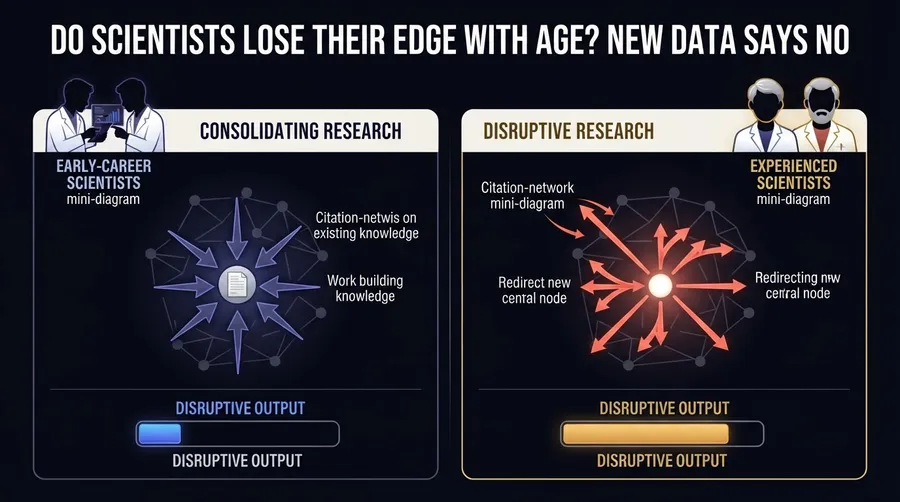
The tool behind these studies is the disruption index. It looks at who cites a paper later. If those later papers cite the original but ignore the references it was built on, the work has replaced something, and it scores as disruptive. If they cite both, the paper has consolidated what was already there. Simple on paper. I kept rereading how the index handles a paper cited by only a handful of others, because small counts make the score jumpy. Why would experience keep the score high? The authors may have ideas, but I will only guess. Maybe senior people read across more fields, hold tenure, and can afford to be wrong for a few years.
🇪🇸 Qué mide realmente lo disruptivo
La herramienta detrás de estos estudios es el índice de disrupción. Mira quién cita un artículo después. Si los trabajos posteriores citan el original pero ignoran las referencias sobre las que se construyó, ese trabajo reemplazó algo y puntúa como disruptivo. Si citan ambos, el artículo consolidó lo que ya existía. En papel suena sencillo. Yo releí varias veces cómo trata el índice a un artículo que solo tienen citado unos pocos, porque con números pequeños la puntuación salta mucho. Por qué la experiencia mantendría alto ese valor es otra cosa, y ahí solo especulo. Quizás los veteranos leen más campos distintos, tienen plaza fija y pueden equivocarse varios años sin consecuencias.
The process described in Do Scientists Really Lose Their Edge With Age? New Data Says No
🇺🇸 Who Gets Money, Who Gets Hired
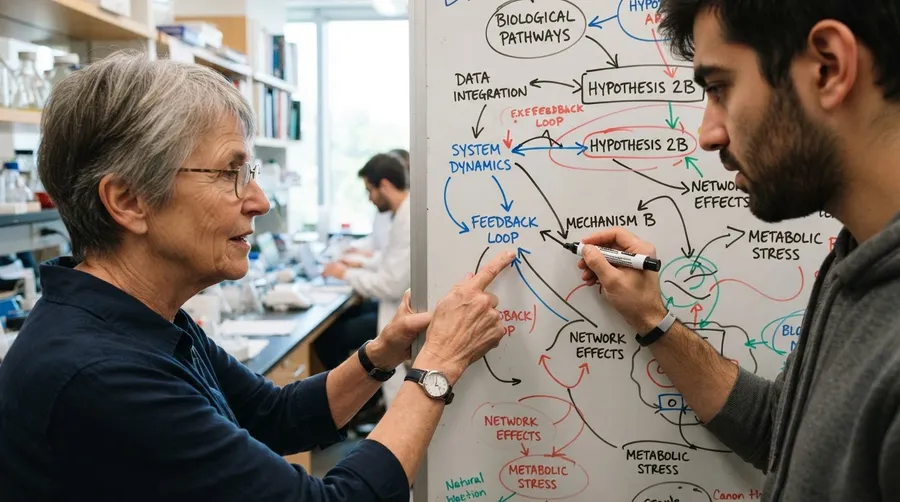
Grant systems quietly act on the youth myth. Many early career awards come with age or years since PhD limits, and review panels often treat a young applicant as the safer bet for bold ideas. If the new result holds, that logic gets shaky. A fifty five year old physicist proposing something strange deserves the same hearing as a postdoc. It also matters for labs. Senior people might be pushed toward administration when they could be doing the work that actually changes a field. For a student choosing an advisor, the practical lesson is plain. A long publication record does not mean the person stopped taking risks.
🇪🇸 Quién recibe fondos y quién consigue plaza
Los sistemas de becas actúan en silencio según el mito de la juventud. Muchos premios para investigadores jóvenes tienen límites de edad o de años desde el doctorado, y los comités suelen ver al solicitante joven como la apuesta más segura para ideas audaces. Si este resultado se sostiene, esa lógica se tambalea. Un físico de cincuenta y cinco años que propone algo raro merece la misma audiencia que un posdoctorado. También cambia cosas dentro de los laboratorios. A los veteranos se les empuja hacia la administración justo cuando podrían estar haciendo el trabajo que mueve un campo. Para un estudiante que escoge tutor, la lección es directa. Muchos años de publicaciones no significan que esa persona dejó de arriesgar.
Data visualization for Do Scientists Really Lose Their Edge With Age? New Data Says No
🇺🇸 Three Gaps in the Data
Nobody has shown whether the pattern survives past age sixty five, when many researchers lose lab funding and their output changes shape. Nobody knows if measuring citations at five years instead of ten reorders who counts as disruptive. And survivorship is unresolved. Scientists who stay for thirty years may simply be the ones who were disruptive early, so the effect might belong to the filter and not to experience.
🇪🇸 Tres huecos en los datos
Nadie ha demostrado si el patrón sigue después de los sesenta y cinco años, cuando muchos investigadores pierden fondos de laboratorio y su producción cambia de forma. Nadie sabe si medir las citas a cinco años en lugar de diez cambia quién cuenta como disruptivo. Y falta resolver el sesgo de supervivencia. Quienes se quedan treinta años en la ciencia quizás ya eran disruptivos al principio, así que el efecto podría venir del filtro y no de la experiencia.

Real world context for Do Scientists Really Lose Their Edge With Age? New Data Says No
🔗 Related Articles | Artículos Relacionados
Nuestro canal transmite datos curiosos de ciencia, IA, espacio y tecnología las 24 horas. | Our channel streams science facts, AI, space and technology around the clock.
▶ Ver transmisión | Watch liveOPEN YOUR MIND
Source: Source
Join the conversation