How AI Taught a Tiny MIT Robot to Flip Like an Insect
How AI Taught a Tiny MIT Robot to Flip Like an Insect

Main visual for How AI Taught a Tiny MIT Robot to Flip Like an Insect
🇺🇸 Ten flips, eleven seconds
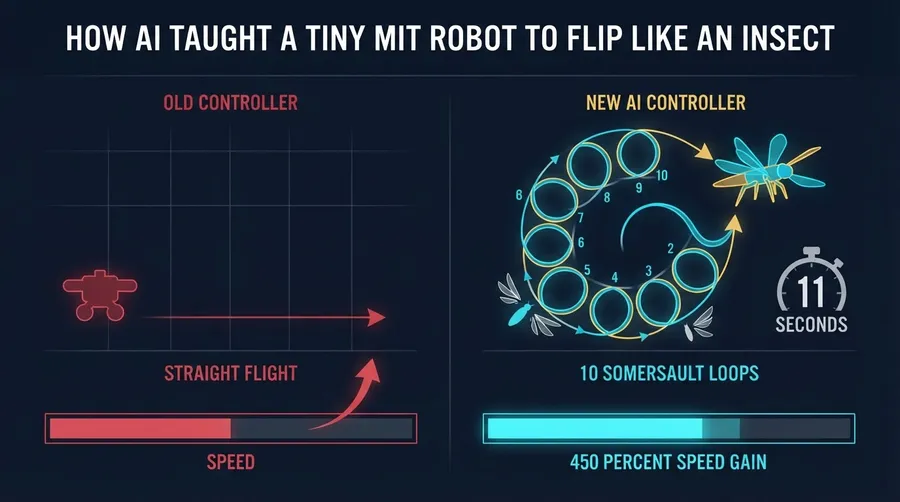
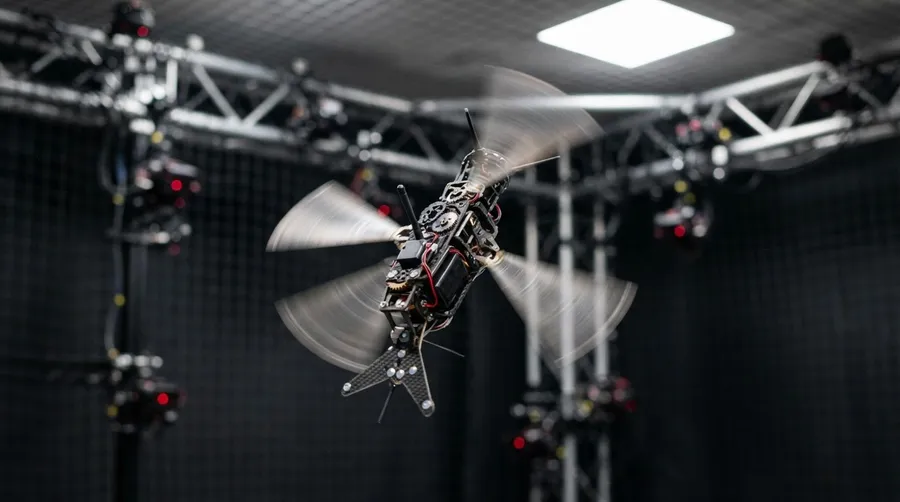
10 somersaults in 11 seconds. That is what the MIT robot did, and I kept rereading the number because it sounds like a gymnast, not a machine lighter than a paperclip. The new controller also raised the speed of the robot by about 450 percent compared with what the same hardware managed before. Same wings. Same tiny artificial muscles. The change lives in the software that decides how hard each wing should beat, moment to moment. Before, the robot could hover and drift along gentle paths. Now it tilts, spins, and snaps through a full loop, then does it again before you finish counting. Which is strange, if you think about it, because the body did not change at all.
🇪🇸 Diez volteretas sin cambiar el cuerpo
Lo primero que me llamó la atención fue que el hardware es el mismo. El robot de MIT pesa menos que un clip, y aun así ahora da 10 volteretas en 11 segundos. Su velocidad subió cerca de 450 por ciento frente a lo que lograba antes con ese mismo cuerpo. Cambió el cerebro, no las alas. Un controlador nuevo, entrenado con inteligencia artificial, decide cuánta fuerza pedirle a cada ala en cada instante. Antes el robot flotaba y se movía con calma. Ahora gira, se inclina y completa el giro sin perder el rumbo. Uno lo ve y piensa en una mosca, no en un aparato de laboratorio.
Detail view related to How AI Taught a Tiny MIT Robot to Flip Like an Insect
🇺🇸 Why small robots stayed clumsy
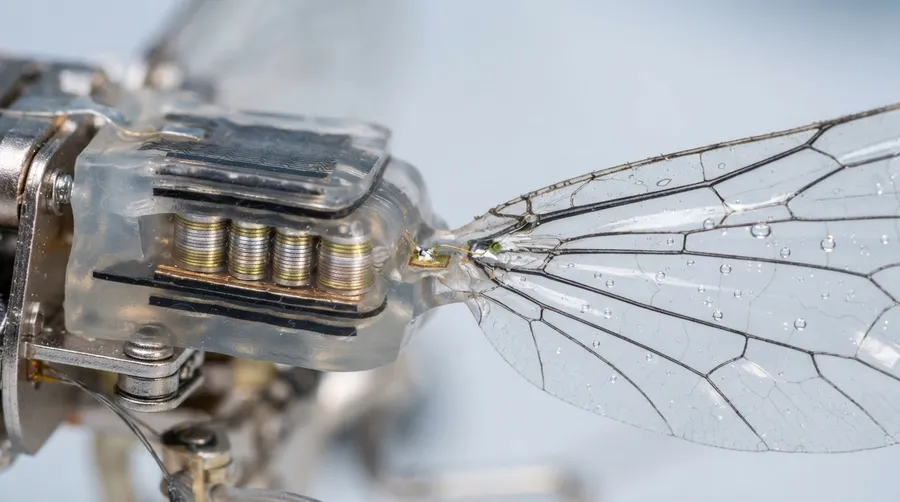
Insects are absurdly good at this. A fly beats its wings hundreds of times each second and still dodges a rolled up newspaper. Engineers have chased that skill for years. The MIT robot gets close on the wingbeat part, flapping roughly 400 times per second with soft artificial muscles. Close on hardware, far on control. The old controllers were written by hand from physics equations, and people tuned them for hours. They worked, but cautiously, because a model of something this small is never perfect. One tiny error in wing force and the robot tumbles. So the earlier flights were gentle. Hovering, drifting, the occasional flip.
🇪🇸 Por qué los robots pequeños eran torpes
Durante años el problema no fue el cuerpo sino el control. Una mosca esquiva un periódico enrollado sin pensarlo, y copiar eso con una máquina más liviana que un clip es dificilísimo. El robot de MIT aletea unas 400 veces por segundo gracias a músculos artificiales blandos. Eso se parece bastante a un insecto. Lo que no se parecía era la forma de manejarlo. Los controladores viejos salían de ecuaciones de física escritas a mano, y los ingenieros pasaban horas ajustándolos. Un error pequeño en la fuerza de un ala y el robot se desplomaba. Por eso volaba con cuidado, casi con miedo.
Scientific diagram illustrating key concepts of How AI Taught a Tiny MIT Robot to Flip Like an Insect
🇺🇸 A slow planner teaches a fast student
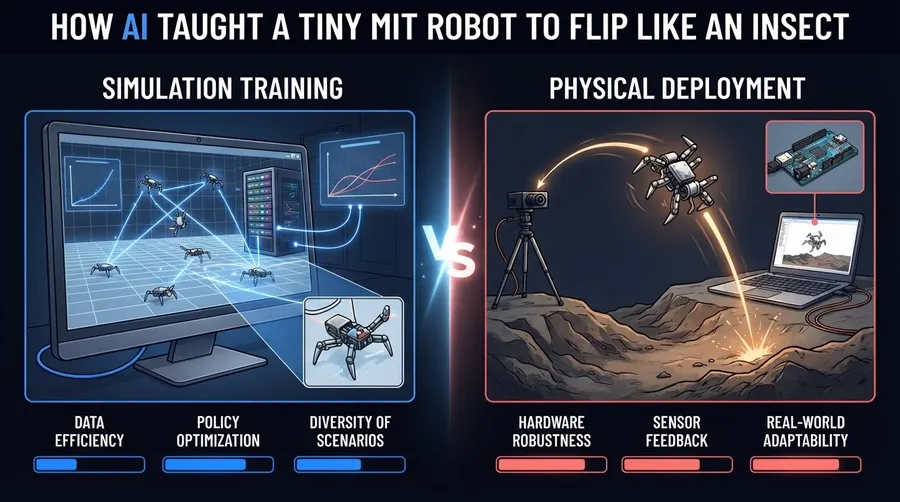
Here is where I get a little out of my depth, so take my version as a sketch. As I understand it, the team started with a model predictive controller. That is a planner. It looks a short distance into the future, tests many wing commands against a physics model, and picks the best one. It can plan a flip. It is also slow, far too slow for a robot with no room for a computer. So they trained a neural network to copy the planner, flight after simulated flight, until it could produce similar wing commands almost instantly. Imitation, basically. The student runs fast enough to steer in real time. Whether it copies the planner perfectly, I cannot say.
🇪🇸 El alumno rápido y el maestro lento
Piensa en un maestro que calcula muy bien pero tarda demasiado. Ese maestro es un controlador predictivo, que mira unos instantes hacia adelante y prueba muchas órdenes de aleteo contra un modelo de física. Sirve para planear un giro completo. El robot, sin embargo, no puede cargar una computadora encima. Entonces el equipo entrenó una red neuronal para imitarlo durante una cantidad enorme de vuelos simulados, según entiendo. La red aprende a producir casi la misma orden, pero en una fracción del tiempo. Al final es el alumno quien pilotea, y lo hace a la velocidad que exige un cuerpo que se mueve tan rápido. Los detalles del entrenamiento se me escapan un poco.
The process described in How AI Taught a Tiny MIT Robot to Flip Like an Insect
🇺🇸 What changes outside the lab
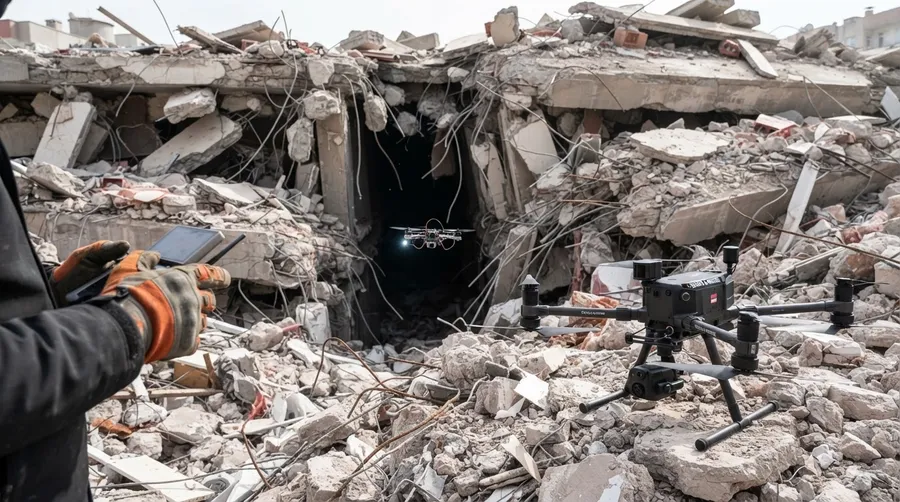
Nothing changes this year for a rescue worker. I want to be honest about that. The robot still lives in a lab, and as far as I can tell it flies on a thin tether for power. But the direction matters. A conventional drone has spinning rotors, a battery pack, and a body too wide for a gap in broken concrete. An insect scale robot is small enough to enter that gap, and light enough to survive bumping a wall. Add a controller that recovers fast and turns sharply, and the picture gets practical. Earthquake rubble, a collapsed stairwell, the inside of a jet engine that needs inspection. Real places where a person cannot fit.
🇪🇸 Qué cambia fuera del laboratorio
Un rescatista no verá este robot en un terremoto el año que viene. Mejor decirlo claro. Hoy sigue en el laboratorio y, hasta donde pude leer, recibe energía por un cable muy fino. Aun así, la dirección importa. Un dron normal tiene hélices grandes y un cuerpo que no cabe entre bloques de concreto rotos. Este robot sí cabe, y pesa tan poco que un golpe contra la pared no lo destruye. Si además se recupera rápido y gira con precisión, sirve para buscar entre escombros, revisar el interior de una turbina o entrar a un edificio inestable. Son lugares donde una persona no cabe.
Data visualization for How AI Taught a Tiny MIT Robot to Flip Like an Insect
🇺🇸 What nobody has measured yet
Nobody knows if the controller works without the tether, because a battery heavy enough for flight may outweigh the robot. Nobody has tested it against wind gusts stronger than those from a lab fan. And the team has not reported how many minutes the artificial muscles last before they wear out. I do not know that failure point either. Those three numbers decide whether this leaves the bench.
🇪🇸 Lo que todavía nadie ha medido
Nadie sabe si el controlador funciona sin cable, porque una batería capaz de sostener el vuelo podría pesar más que el robot. Tampoco hay pruebas con ráfagas más fuertes que las de un ventilador de laboratorio. Y el equipo no ha dicho cuántos minutos duran los músculos artificiales antes de desgastarse. Yo tampoco conozco ese límite. De esas tres cifras depende que el robot salga del banco de pruebas.
Real world context for How AI Taught a Tiny MIT Robot to Flip Like an Insect
🔗 Related Articles | Artículos Relacionados
Nuestro canal transmite datos curiosos de ciencia, IA, espacio y tecnología las 24 horas. | Our channel streams science facts, AI, space and technology around the clock.
▶ Ver transmisión | Watch liveOPEN YOUR MIND
Source: Source
Join the conversation