Clinical Lycanthropy When the Mind Believes It's a Werewolf
Clinical Lycanthropy When the Mind Believes It's a Werewolf
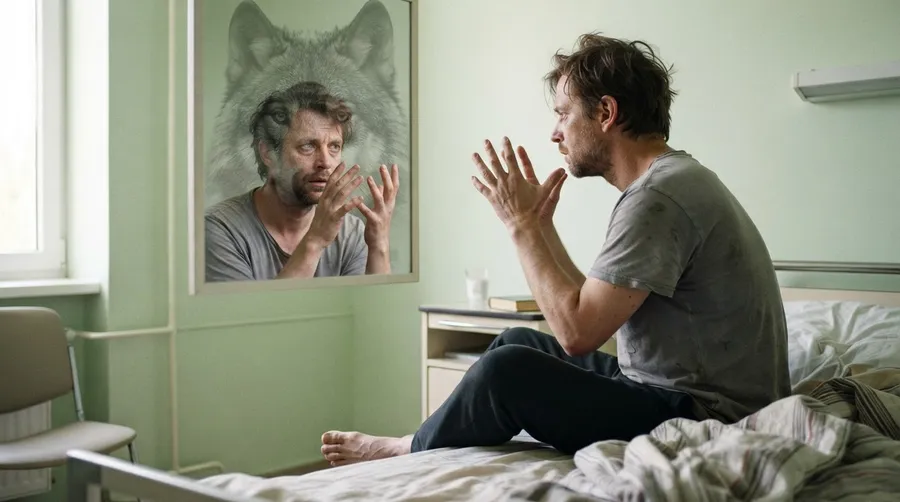
Main visual for Clinical Lycanthropy When the Mind Believes It's a Werewolf
🇺🇸 Fifty Cases and One Strange Pattern
A psychiatrist named Jan Dirk Blom once went hunting for every published case of clinical lycanthropy. He found about fifty. That is not many, which is the first surprise. The second is how little the animal matters. Wolves show up, sure. So do dogs, tigers, hyenas, frogs, even birds. What stays the same is the conviction, and it is not a costume or a game. Patients describe fur pushing through skin, jaws lengthening, bones rearranging themselves. I kept rereading that part of his review. These people are not pretending. They are reporting a body that feels wrong in a way most of us cannot picture.
🇪🇸 Cincuenta casos y un patrón raro
Lo curioso del lobo es que casi no importa. Cuando Blom revisó la literatura médica, en un trabajo publicado en History of Psychiatry en 2014, encontró unos cincuenta casos. Los animales variaban mucho: perros, tigres, hienas, ranas, hasta pájaros. Lo que no variaba era la certeza de estar cambiando. Los pacientes hablan de pelo que brota, de mandíbulas que se alargan, de huesos que se mueven por dentro. Un número tan pequeño dice algo por sí solo. O es rarísimo, o muchos nunca llegan a una consulta. Y nadie finge algo así durante meses, eso es lo que más me cuesta quitarme de la cabeza.
Detail view related to Clinical Lycanthropy When the Mind Believes It's a Werewolf
🇺🇸 An Old Name for an Older Fear
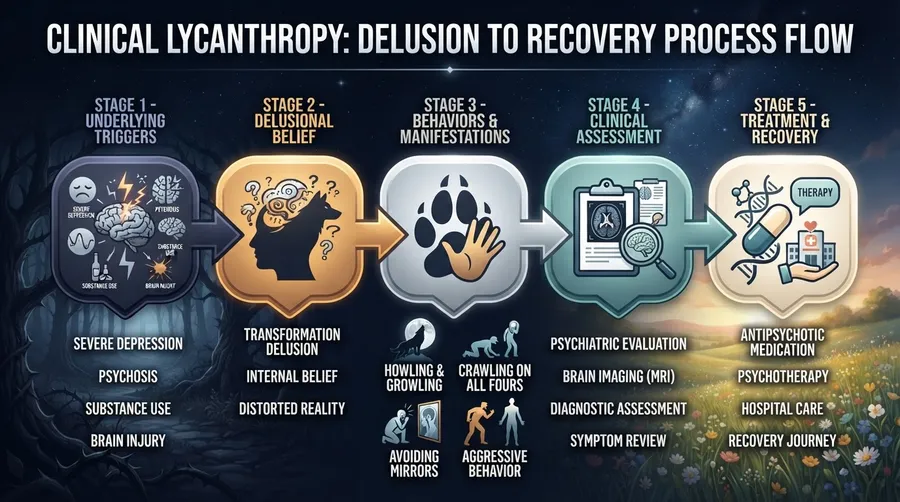
The idea is old. Greek gives us lykos for wolf and anthropos for man, and physicians in antiquity already wrote about a melancholy that sent men wandering at night and acting like beasts. Nobody back then called it psychiatry, obviously. Today the condition is not a diagnosis on its own in the major manuals. It rides along with something else, usually schizophrenia, bipolar disorder with psychosis, or severe depression with delusions. Which is strange, if you think about it, because the belief feels so specific and so vivid. Clinicians still treat it as a symptom, a passenger. The driver is the underlying illness, and the werewolf is how it shows up.
🇪🇸 Un nombre viejo para un miedo más viejo
Los griegos ya tenían nombre para esto, o casi. Lykos es lobo y anthropos es hombre, y los médicos de la antigüedad describían una melancolía que sacaba a los hombres de noche a comportarse como fieras. Hoy los manuales principales no lo tratan como enfermedad aparte. Es un síntoma que viaja con otra cosa, casi siempre esquizofrenia, trastorno bipolar con psicosis o depresión grave con delirios. Y eso me resulta raro, porque la creencia es tan concreta que uno esperaría un diagnóstico propio. No lo hay. El conductor es la enfermedad de fondo, y el hombre lobo es apenas un pasajero.
Scientific diagram illustrating key concepts of Clinical Lycanthropy When the Mind Believes It's a Werewolf
🇺🇸 How a Brain Loses Its Own Body
Your sense of owning a body is something the brain builds, constantly, from vision, touch and the position of your limbs. It can be fooled. In the rubber hand illusion, a fake hand starts to feel like yours after a minute of synchronized stroking. Now imagine the machinery misfiring with no trick at all. Regions like the parietal cortex and the insula help stitch those signals together, and in psychosis the stitching may go wrong. The mind then demands an explanation, and a culture soaked in werewolf stories hands one over ready made. Some case reports describe odd activity in frontal and temporal areas. They are tiny and inconsistent. I cannot tell you this is the mechanism, and I do not think anyone can.
🇪🇸 Cómo un cerebro pierde su propio cuerpo
Piensa en cómo sabes que tu mano es tuya. No lo piensas, el cerebro lo resuelve solo, mezclando vista, tacto y posición. Con la ilusión de la mano de goma basta un minuto para que una mano falsa se sienta propia. En la psicosis, esa mezcla puede fallar sin truco alguno, y áreas como la corteza parietal y la ínsula podrían estar metidas en el problema. Luego la mente busca una explicación, y si creciste rodeado de historias de lobos, la encuentras servida. Los escáneres de unos pocos casos muestran cambios en regiones frontales y temporales, pero son pocos y no coinciden entre sí. Yo no sé si eso explica algo todavía.

The process described in Clinical Lycanthropy When the Mind Believes It's a Werewolf
🇺🇸 What Changes in the Hospital Room
Here is what changes for an actual patient. Someone who says their hands are turning into paws can be treated as a curiosity, a story to tell on the ward. Or they can hide the belief from clinicians out of shame. In many reported cases the belief faded with antipsychotic medication, sometimes alongside therapy. So the practical shift is small and human. Doctors ask about body sensations directly, not only about voices and fear. Families learn that crawling, howling or avoiding mirrors is a symptom, not a performance. And journalists, myself included, have to resist the werewolf grin. There is a person inside that headline, and she is scared.
🇪🇸 Lo que cambia en la sala de urgencias
Imagina a una mujer que jura que le crecen garras y llega a urgencias con la familia asustada. Si el médico se ríe, o solo anota que es raro, ella no vuelve a tocar el tema. Si pregunta con calma, aparece la historia completa. En muchos casos publicados, los antipsicóticos hicieron que la creencia se fuera apagando, a veces junto con terapia. Por eso el cambio práctico es modesto pero concreto. Preguntar directamente por las sensaciones del cuerpo, y no solo por voces o miedo. Y evitar el titular de película de terror, porque detrás hay alguien sufriendo de verdad.
🇺🇸 What Nobody Has Measured Yet
Nobody knows how many people have this and never reach a clinic, because the roughly fifty published cases are only the ones someone wrote up. Nobody knows whether a scan study of twenty or more patients would show the same change in the parietal cortex. And nobody knows how long the belief lasts untreated, whether weeks or years, since almost every report follows people only after medication starts.
🇪🇸 Lo que nadie ha medido todavía
Nadie sabe cuántas personas viven así sin llegar nunca a una consulta, porque los cincuenta casos publicados son solo los que alguien escribió. Nadie sabe si un estudio de imágenes con veinte pacientes o más mostraría el mismo cambio en la corteza parietal. Y nadie sabe cuánto dura la creencia sin tratamiento, semanas o años, porque casi todos los informes siguen al paciente solo después de empezar la medicación.

Real world context for Clinical Lycanthropy When the Mind Believes It's a Werewolf
🔗 Related Articles | Artículos Relacionados
Nuestro canal transmite datos curiosos de ciencia, IA, espacio y tecnología las 24 horas. | Our channel streams science facts, AI, space and technology around the clock.
▶ Ver transmisión | Watch liveOPEN YOUR MIND
Source: Source
Join the conversation