Understanding the Birthplace of Supermassive Black Holes
Understanding the Birthplace of Supermassive Black Holes
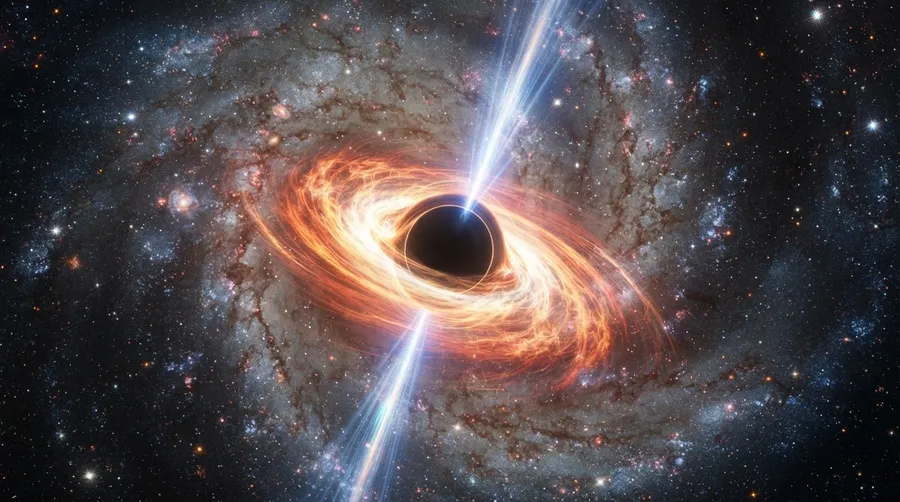
A supermassive black hole with swirling accretion disks and energy jets.
🇺🇸 Understanding the Birthplace of Supermassive Black Holes
In the vast expanse of the universe, scientists have been puzzled by the rapid appearance of supermassive black holes. Think about it. These cosmic giants showed up way too fast after the Big Bang. Recently, astronomers have stumbled upon something intriguing. They found that the environments suitable for direct-collapse black holes might be more common than previously thought. These findings suggest that such conditions could explain how these massive objects came into existence so quickly in the early universe. The study provided strong evidence that supports the direct-collapse scenario, turning what was once a wild theory into something more plausible.
As an Amazon Associate I earn from qualifying purchases.

🇪🇸 Comprendiendo el Origen de los Agujeros Negros Supermasivos
En el inmenso universo, la rápida aparición de agujeros negros supermasivos ha dejado a muchos científicos perplejos. Es curioso, ¿no? Estos gigantes cósmicos aparecieron muy rápido después del Big Bang. Investigadores han descubierto recientemente algo interesante: los entornos adecuados para el colapso directo de agujeros negros podrían ser más comunes de lo que se pensaba antes. Estos resultados sugieren que tales condiciones podrían explicar la formación tan rápida de estos objetos masivos en el universo temprano. El estudio proporciona evidencia sólida que respalda el escenario de colapso directo, convirtiendo una teoría descabellada en algo mucho más plausible.
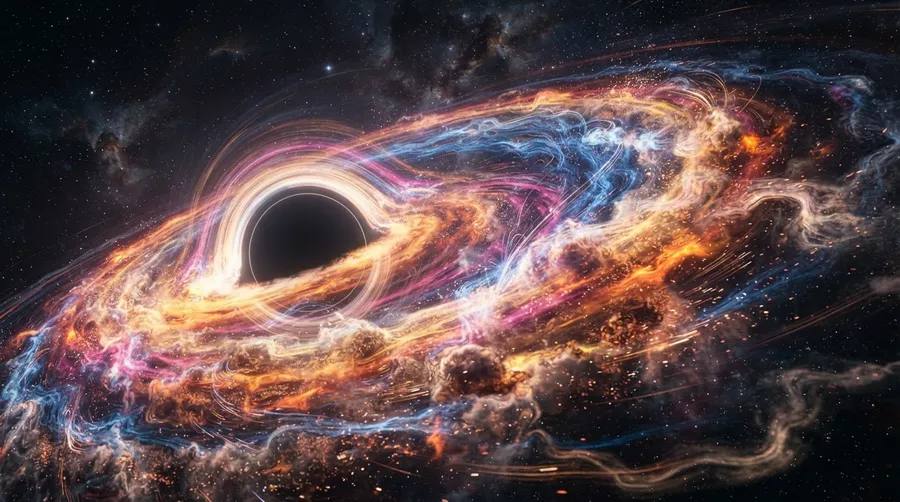
Close-up of accretion disk material spiraling into a black hole.
🇺🇸 The Puzzle Before the Discovery
Before this recent study, scientists were scratching their heads over supermassive black holes. They knew these giants existed but had no clear idea of how they formed so fast after the universe began. The leading theories just did not fit well with the timeline. Conventional theories suggested slow growth through mergers or accretion, which seemed like it would take too long to create such massive entities so soon after the Big Bang. So, there was a gap waiting to be filled. That gap pushed researchers to explore new ideas and alternatives beyond what was considered possible.

🇪🇸 El Rompecabezas Antes del Descubrimiento
Antes de este estudio reciente, los científicos no sabían cómo los agujeros negros supermasivos se formaron tan rápido en el universo primitivo. Sabían que estos gigantes existían pero no tenían idea clara sobre su formación tan acelerada tras el inicio del universo. Las teorías predominantes no encajaban bien con la línea de tiempo observada. La idea convencional era un crecimiento lento por fusiones o acreción, lo cual parecía demasiado lento para formar estos objetos masivos tan pronto tras el Big Bang. Así que había un vacío esperando ser llenado, lo que llevó a los investigadores a explorar nuevas ideas y alternativas.
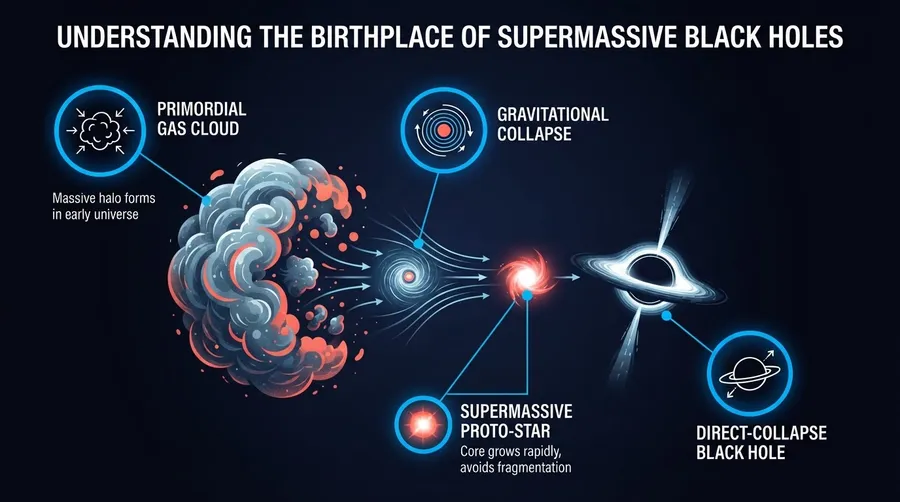
Process flow of direct-collapse black hole formation stages.
🇺🇸 How Direct-Collapse Black Holes Form
So how do direct-collapse black holes come into being? It turns out that under specific conditions, gas clouds can skip the star formation phase entirely and collapse directly into a black hole. Imagine that happening on a massive scale in the early universe. This fast-tracks the creation of supermassive black holes without needing them to grow from smaller seeds over time through accretion or mergers. These conditions include having a low metallicity environment and enough gas density to allow gravitational forces to dominate without interference from other processes like radiation pressure or stellar winds.

🇪🇸 Cómo Se Forman los Agujeros Negros por Colapso Directo
¿Cómo se forman los agujeros negros por colapso directo? Resulta que bajo ciertas condiciones específicas, nubes de gas pueden saltarse la fase de formación estelar y colapsar directamente en un agujero negro. Imagina eso ocurriendo a gran escala en el universo temprano. Esto acelera la creación de agujeros negros supermasivos sin necesidad de crecer a partir de semillas más pequeñas con el tiempo mediante acreción o fusiones. Estas condiciones incluyen un entorno de baja metalicidad y suficiente densidad de gas que permita a las fuerzas gravitacionales dominar sin interferencias de otros procesos como la presión de radiación o vientos estelares.
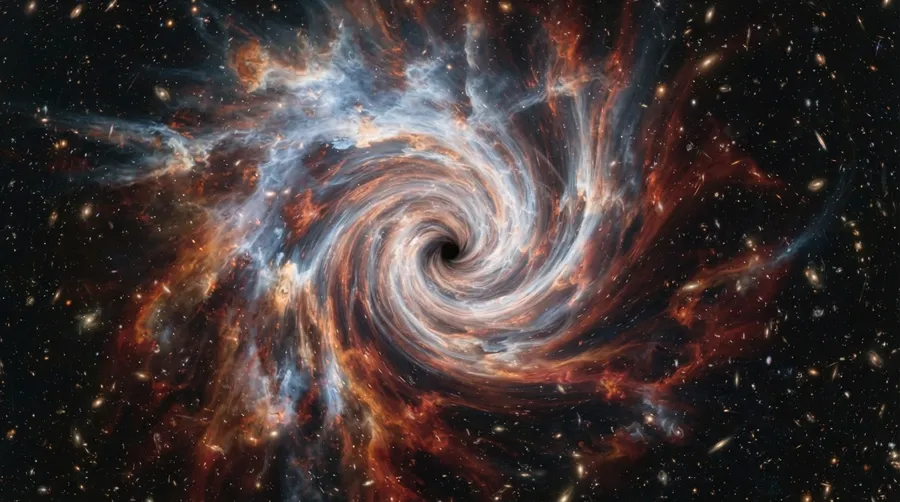
Formation of a direct-collapse black hole in the early Universe.
🇺🇸 Practical Implications and Changes
These insights could shift how we look at galaxy formation and evolution models since supermassive black holes influence their host galaxies significantly. It may lead to new methods for predicting which galaxies could harbor these giants based on their environments' characteristics early in their formation history. Such understanding might even affect future telescope designs aimed at studying galaxy formation and evolution in more detail. For those working in astrophysics, this means revisiting old data with fresh eyes and possibly reinterpreting observations under this new context.

🇪🇸 Implicaciones Prácticas y Cambios
Estos descubrimientos podrían cambiar la manera en que entendemos los modelos de formación y evolución galáctica ya que los agujeros negros supermasivos influyen significativamente en sus galaxias anfitrionas. Podría llevar a nuevas formas de predecir qué galaxias podrían albergar estos gigantes según las características ambientales tempranas en su historia formativa. Este conocimiento podría incluso afectar el diseño futuro de telescopios destinados a estudiar la formación y evolución galáctica con más detalle. Para los astrónomos esto significa reevaluar datos antiguos con nuevos ojos y tal vez reinterpretar observaciones bajo este nuevo contexto.
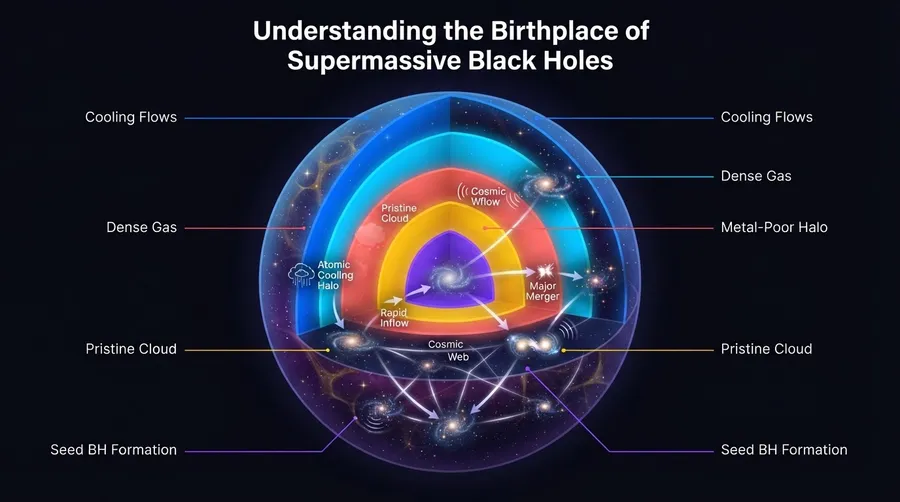
Network map of potential DCBH host environments in the early Universe.
🇺🇸 The Unanswered Questions
There are crucial unknowns still lingering about supermassive black holes' origins. No one knows precisely how common these direct-collapse events were across different cosmic epochs. Researchers also have not determined what specific conditions tip the scales toward direct collapse instead of star formation in all cases studied so far.
🇪🇸 Las Preguntas Sin Responder

Hay preguntas clave sin respuesta sobre el origen de los agujeros negros supermasivos. Nadie sabe exactamente cuán comunes fueron estos eventos de colapso directo en diferentes épocas cósmicas. Los investigadores tampoco han identificado las condiciones específicas que favorecen el colapso directo en lugar de la formación estelar en todos los casos estudiados hasta ahora.
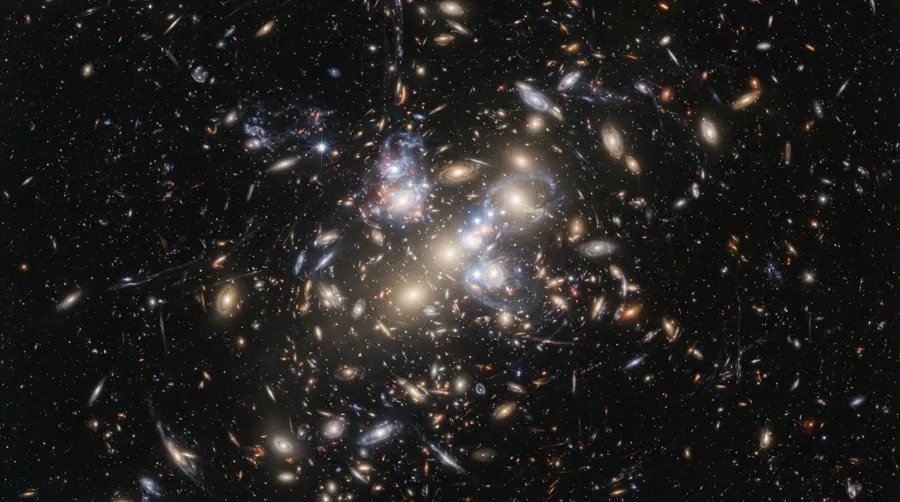
A galaxy cluster as a potential host for direct-collapse black holes.
🔗 Related Articles | Artículos Relacionados
Nuestro canal transmite datos curiosos de ciencia, IA, espacio y tecnología las 24 horas. | Our channel streams science facts, AI, space and technology around the clock.
▶ Ver transmisión | Watch liveOPEN YOUR MIND
Source: Source
Join the conversation