Millisecond Pulsar and Its Companion Caught Mid-Transformation
Millisecond Pulsar and Its Companion Caught Mid-Transformation
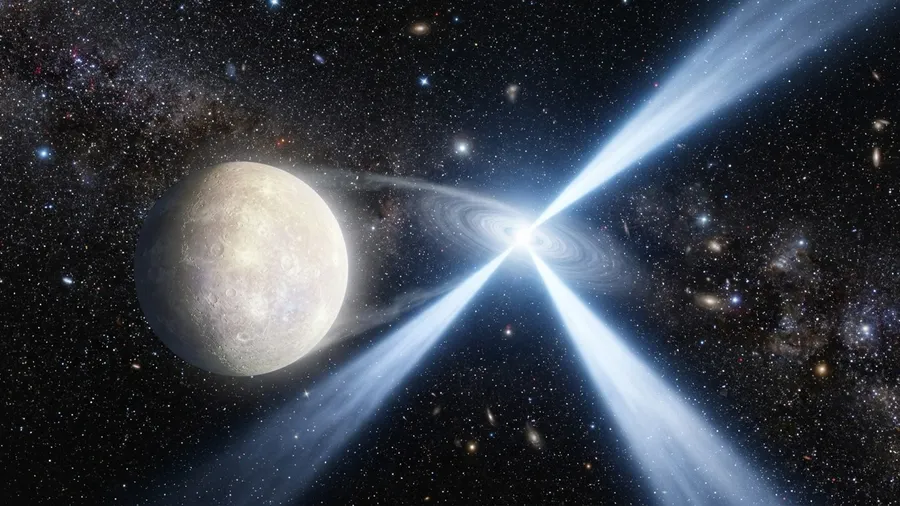
A millisecond pulsar and its newly exposed white dwarf companion orbit closely together.
🇺🇸 A Spinning Star Caught Mid Change
Here is the picture. A neutron star spins hundreds of times every second, and next to it sits a white dwarf that still looks a little unfinished. That white dwarf is the leftover core of a star that spent a long stretch feeding its partner. The surprise is the timing. Astronomers appear to have caught the pair just after the feeding stopped, with some debris still hanging around. Usually we meet these systems long after the mess is gone. I kept rereading that part, because the mess is the evidence. Without it you infer the history. With it, you get to look at the scene. I cannot judge the debris details myself.
🇪🇸 Una estrella que gira, atrapada a medio cambio
Lo que más me llama la atención es el momento. Un púlsar de milisegundos y su enana blanca, y alrededor todavía quedan restos de material. Casi siempre encontramos estos sistemas millones de años después de que terminó la comida, cuando ya no hay pruebas en la escena. Aquí parece que la transferencia de masa acaba de cerrarse. La enana blanca es lo que sobró del núcleo de una estrella que alimentó a su compañera durante mucho tiempo. Y el púlsar gira cientos de veces por segundo, lo cual es raro si uno lo piensa bien. Un objeto del tamaño de una ciudad, a veces más rápido que una licuadora. Yo no sé cuánto de ese escombro se puede medir con precisión todavía.
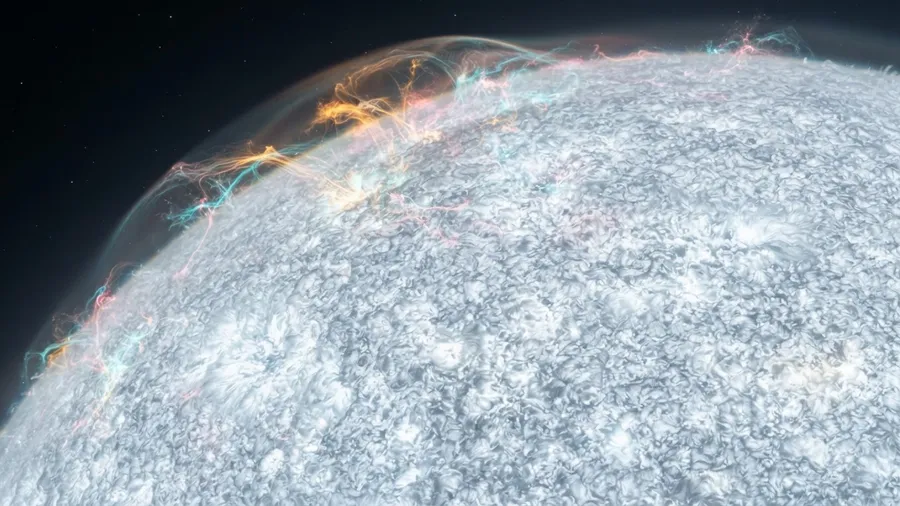
The white dwarf's glowing surface is edged by a shell of residual hydrogen gas.
🇺🇸 The Story Had a Hole in It
The recycling idea is old. Astronomers proposed decades ago that a slow, dying pulsar could be spun back up by a partner star, and the first millisecond pulsar turned up in 1982, spinning more than six hundred times a second. That fit the theory a little too well. Then came the X ray binaries, where a neutron star pulls gas off a normal star through a disk. Those looked like the middle of the story. Later came odd systems that flip between radio pulsar and accretion states, which is strange, if you think about it, because they seem caught switching jobs. What had been missing was the moment right after the feeding ends.
🇪🇸 Un hueco en la historia
Durante años la historia tuvo un vacío. Se sabía que los púlsares de milisegundos eran púlsares viejos reciclados, y el primero apareció en 1982, girando más de seiscientas veces por segundo. Las binarias de rayos X mostraban la fase en la que la estrella de neutrones se alimenta, con gas cayendo por un disco. Había también sistemas raros que alternan entre emitir en radio y acretar, como si no se decidieran. Pero casi todo lo que veíamos era el durante o el mucho después. El instante en que se acaba la comida, con la mesa todavía sin recoger, era lo que faltaba. Y eso es lo que este hallazgo parece ofrecer.
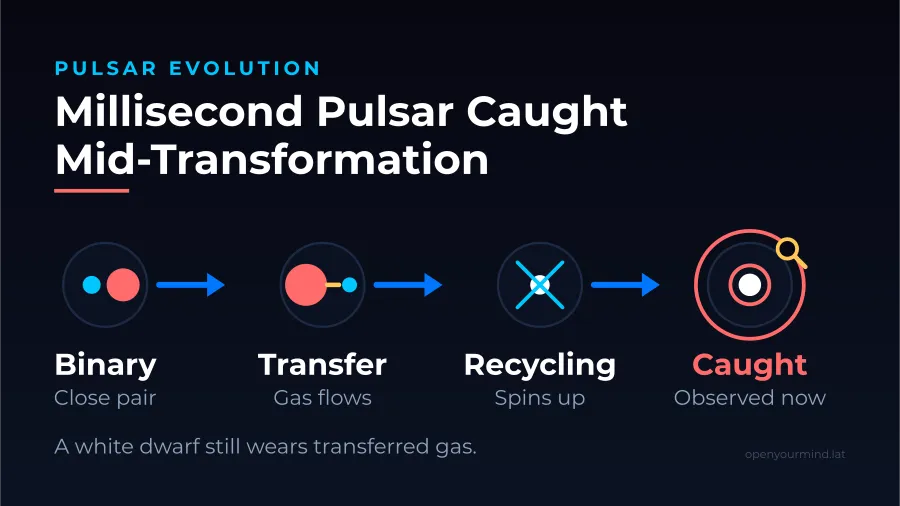
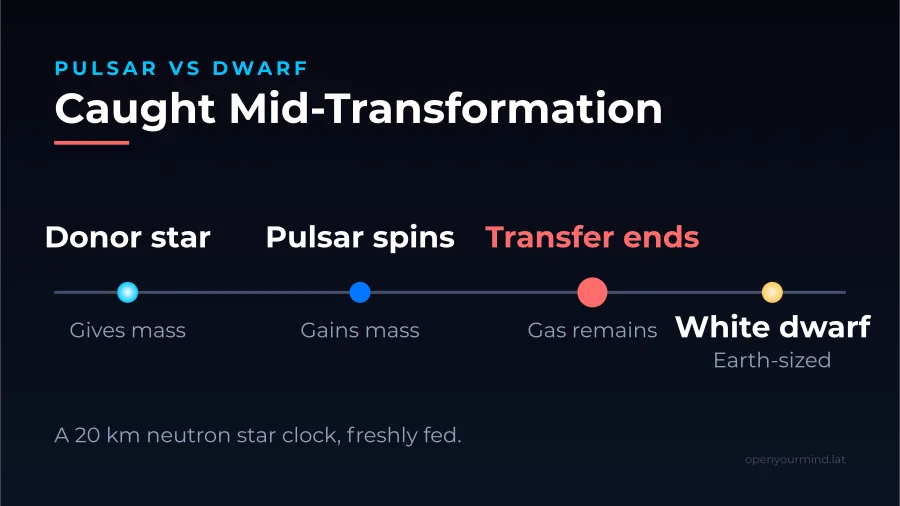
The five steps trace how a millisecond pulsar system evolves over time.
🇺🇸 How the Feeding Actually Works
Start with gravity. The companion swells as it ages, until its outer layers cross the point where the neutron star's pull wins. Gas streams through that gateway, forms a disk, and spirals inward. Each bit of gas carries angular momentum, so the pulsar spins faster as it lands, like a playground roundabout getting shoved again and again. Meanwhile the donor loses its envelope. What remains is a small helium rich core that cools into a white dwarf. That is why the process can push the companion toward its final stage so quickly. When the gas runs out, the pulsar's radiation and wind can push on what is left. How the last debris gets cleared, I am not sure anyone has nailed down.
🇪🇸 Cómo funciona la transferencia de masa
Piénsalo desde el final. Lo que queda de la compañera es un núcleo pequeño de helio que se enfría despacio y se vuelve enana blanca. Para llegar ahí, la estrella tuvo que hincharse hasta que su capa exterior pasó el punto donde manda la gravedad de la estrella de neutrones. El gas sale por esa puerta, forma un disco y cae en espiral. Cada gramo trae momento angular, y el púlsar acelera su giro como un tiovivo al que le dan empujones una y otra vez. La donante pierde casi toda su envoltura en el proceso. Cuando el gas se acaba, la radiación y el viento del púlsar empujan lo que sobra. Si ese viento barre los restos o se agotan solos, no lo tengo claro.
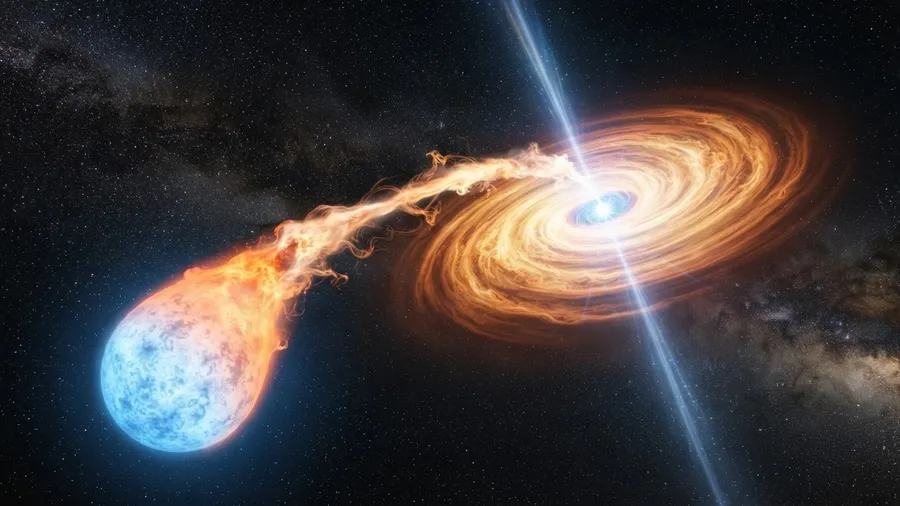
Hydrogen gas streams from the stripped companion, feeding a glowing disk around the pulsar.
🇺🇸 Who Actually Notices
Nobody's daily life changes because of one white dwarf. Let me be straight about that. The payoff is for people who use these pulsars as clocks. Teams around the world time dozens of millisecond pulsars to hunt for slow gravitational waves, and every timing error matters. Knowing how these stars form tells them which ones to trust and why some behave better than others. There is also the matter of mass. Orbital timing can weigh a neutron star, and the heaviest ones limit what dense nuclear matter can be made of. That is a question nuclear physicists care about, and it starts with systems like this one.
🇪🇸 Quién lo nota de verdad
Para la gente de a pie, de momento, casi nada cambia. Mejor decirlo claro. Quienes sí lo notan son los equipos que usan púlsares como relojes para buscar ondas gravitacionales de frecuencia muy baja. Si entienden cómo nacen estos astros, saben cuáles son más estables y por qué otros se portan peor. Hay otro asunto, la masa. Cuando un púlsar tiene compañera, el movimiento orbital permite pesarlo, y las estrellas de neutrones más pesadas ponen límites a de qué puede estar hecha la materia a densidades extremas. Eso les importa a los físicos nucleares, que en la Tierra no pueden fabricar nada parecido en un laboratorio.
The pulsar and white dwarf companion differ sharply in role and physical properties.
🇺🇸 What Nobody Has Measured Yet
The debris lifetime is unknown. A measured number would show how fast the pulsar wind clears it. The white dwarf mass is also loose, and several years of orbital timing would tighten it. Then there is the spin period. Someone has to track it for years to see whether it is still creeping up. Until then, the transformation is a snapshot, not a movie.
🇪🇸 Lo que nadie ha medido todavía
Falta saber cuánto dura el escombro. Con una cifra medida sabríamos qué tan rápido lo barre el viento del púlsar. La masa de la enana blanca también está floja, y varios años de cronometraje orbital la afinarían. Y queda el periodo de giro, que habría que seguir durante años para ver si todavía cambia. Hoy tenemos una foto, no una película.

The pulsar and white dwarf pair appears as a bright point of light in the Milky Way.
🔗 Related Articles | Artículos Relacionados
Nuestro canal transmite datos curiosos de ciencia, IA, espacio y tecnología las 24 horas. | Our channel streams science facts, AI, space and technology around the clock.
▶ Ver transmisión | Watch liveOPEN YOUR MIND
Source: Source
Join the conversation