Unusual Black Hole Pairs Challenge Formation Theories
Unusual Black Hole Pairs Challenge Formation Theories
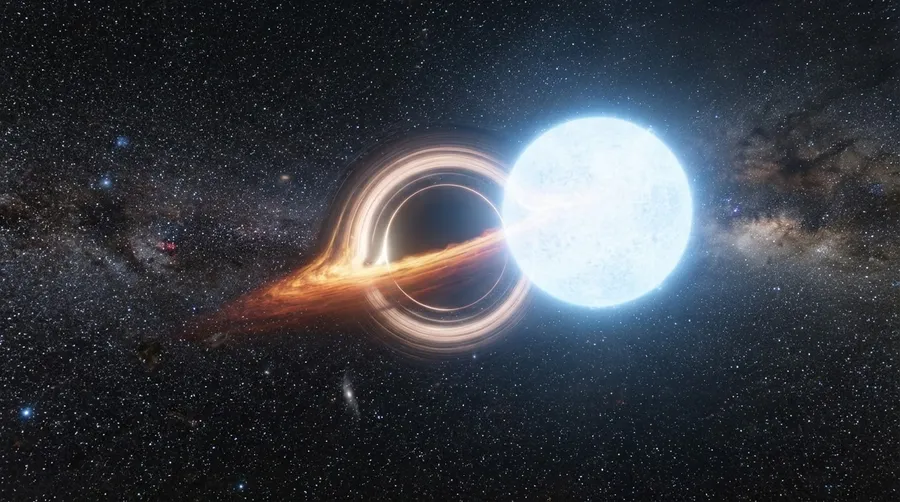
A black hole pair with its companion star against a starry backdrop.
🇺🇸 Gaia's Surprising Discovery
The Gaia satellite has spotted something unexpected. Three black holes, each with a tiny star companion, almost like a cosmic dance. This is exciting because usually, we expect black holes to hang out alone or in pairs with other heavyweight stars. But here, they're hanging out with stars that are way smaller. Imagine the surprise of seeing them orbit closer than expected. For two of these systems, the distance between the black hole and its partner is unusually small. Astronomers are scratching their heads. What exactly caused these pairs to form this way?
Como Afiliado de Amazon, obtengo ingresos por las compras adscritas que cumplen los requisitos aplicables.

🇪🇸 El Asombroso Hallazgo de Gaia
El satélite Gaia ha hecho un descubrimiento que nadie esperaba. Ha encontrado tres agujeros negros, cada uno con una pequeña estrella como compañía, como si estuvieran bailando en el cosmos. Normalmente, pensamos que los agujeros negros están solos o acompañados de otras estrellas masivas. Pero aquí están con estrellas mucho más pequeñas y orbitan más cerca de lo que esperaríamos en dos de estos sistemas. Los astrónomos no se lo explican muy bien. ¿Cómo se formaron estas parejas tan peculiares?

Close-up of the stellar companion star's surface texture.
🇺🇸 What We Thought We Knew
In the past, black hole pairs were thought to form from massive stars that evolved together. Those pairs would usually fall into each other over time, spiraling inward until both stars collapsed into black holes or one swallowed the other. This process seemed straightforward enough for larger stars. But these new findings suggest there might be another path to forming black hole pairs. Maybe smaller stars play a role we didn't fully appreciate before. Or maybe there's some unknown factor at work here that challenges the old model.

🇪🇸 Lo Que Creíamos Saber
Antes se pensaba que las parejas de agujeros negros se formaban a partir de estrellas masivas que evolucionaban juntas en el espacio-tiempo. Estas estrellas solían orbitar cada vez más cerca hasta que una o ambas colapsaban y se convertían en agujeros negros. Algo sencillo cuando hablamos de estrellas grandes. Pero con estos nuevos hallazgos parece que debe haber un camino diferente para formar pares de agujeros negros. Quizás las estrellas más pequeñas juegan un papel más importante del que creíamos o tal vez hay un factor desconocido cambiando el modelo.
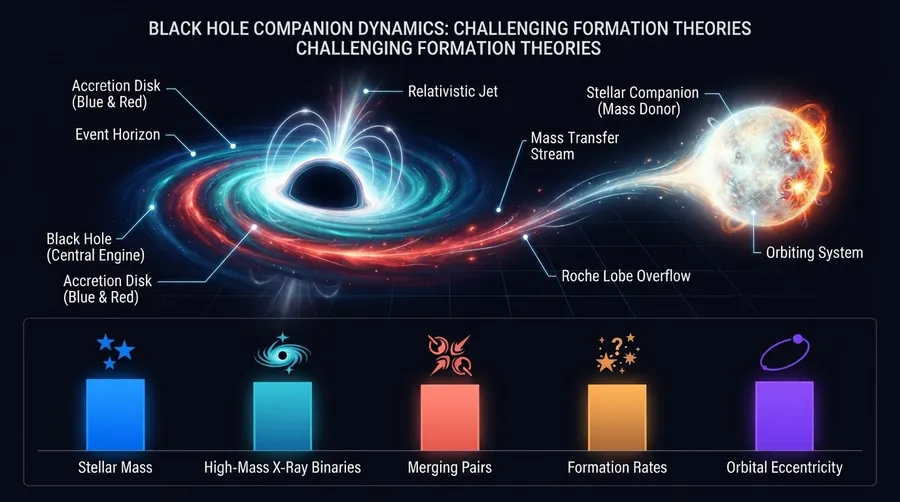
Diagram showing interaction between black hole and its companion.
🇺🇸 Mechanics of Black Hole Pair Formation
Black holes typically form when massive stars die and collapse under gravity's pull. If two stars orbit each other closely enough before this happens, they can become a pair of black holes circling one another in a tight dance. What's tricky is when you have small star companions involved. How did they survive the intense gravitational forces near the black hole? Did they get caught in their orbits afterward? Was it some kind of cosmic coincidence? Or did another mechanism bring these unlikely partners together in such close quarters?

🇪🇸 Mecánica de la Formación de Pares de Agujeros Negros
Los agujeros negros normalmente se forman cuando estrellas masivas mueren y colapsan bajo la fuerza de la gravedad. Si dos estrellas están lo suficientemente cerca antes de esto, pueden convertirse en un par de agujeros negros que giran en una danza apretada. Lo complicado es cuando hay pequeñas estrellas involucradas como compañeras. ¿Cómo sobrevivieron a las fuerzas gravitatorias intensas cerca del agujero negro? ¿Fueron atrapadas en sus órbitas después? ¿Fue pura casualidad cósmica o algún otro mecanismo hizo que estas parejas improbables estuvieran tan cerca?

The stellar companion star influenced by the black hole's gravity.
🇺🇸 Why This Matters for Real People
Alright, so why should anyone care about distant black holes and their dance partners? It could change how we understand star evolution and death in general, which is cool for astrophysicists but maybe not important when you're trying to pay bills on Earth. But wait—there's more! These insights could help improve our understanding of gravitational waves and how they ripple through space-time, affecting everything around us on a cosmic scale. Who knows what we'll learn next?

🇪🇸 Por Qué Esto Importa para la Gente Común
Entonces, ¿por qué a alguien le importarían los agujeros negros lejanos y sus compañeros danzantes? Podría cambiar nuestra comprensión sobre la evolución y muerte estelar general, lo cual es genial para los astrofísicos pero no tan relevante cuando intentas pagar tus cuentas aquí en la Tierra. Sin embargo hay algo más que considerar; estos descubrimientos podrían mejorar nuestra comprensión sobre las ondas gravitacionales y cómo afectan todo a su alrededor en una escala cósmica.
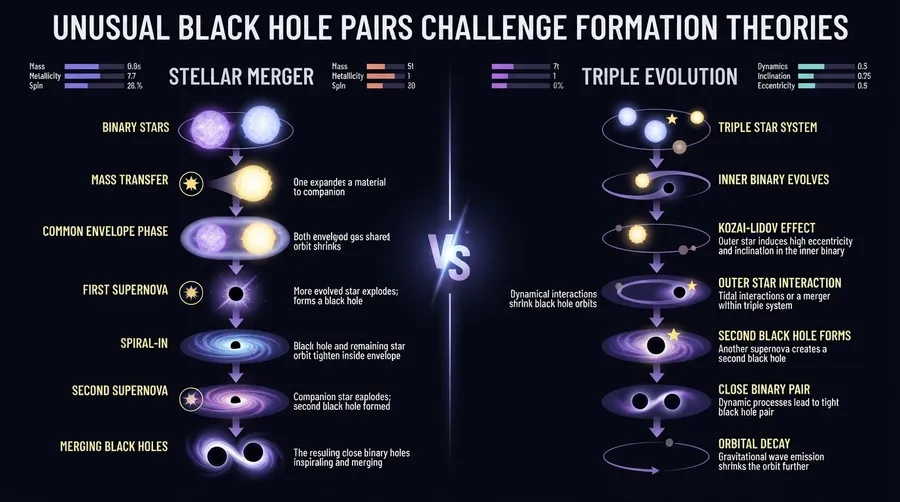
Flowchart of theories on how unusual black hole pairs form.
🇺🇸 What's Still Unsolved
Mystery remains around several questions. What specific processes allow smaller stars to end up partnered with black holes? Another puzzle: How stable are these unusual orbits over time? Finally, what does all this mean for our models of stellar evolution?
🇪🇸 Lo Que Queda por Resolver
Aún quedan muchos misterios por resolver respecto a este tema tan fascinante. Como saber qué procesos específicos permiten que las pequeñas estrellas terminen junto a agujeros negros o cuán estables resultan ser las órbitas inusuales con el paso del tiempo.
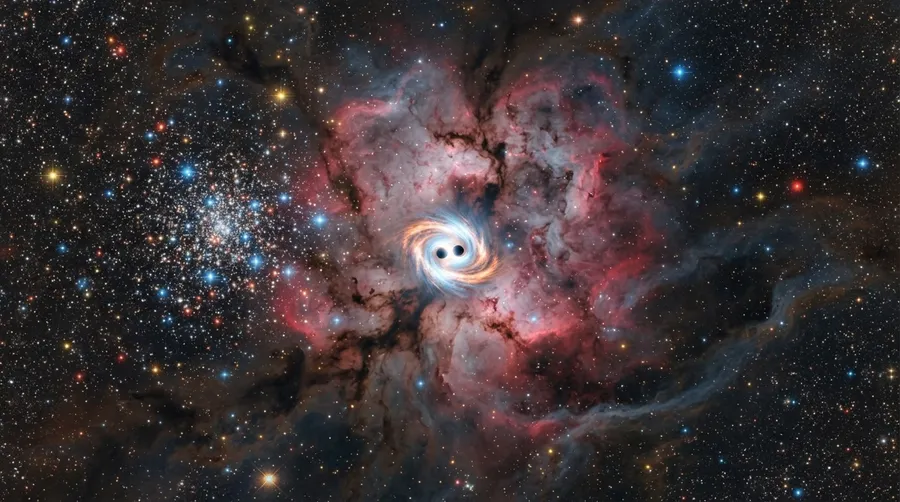
Wide view of space showing black hole pairs and nearby celestial bodies.
🔗 Related Articles | Artículos Relacionados
Nuestro canal transmite datos curiosos de ciencia, IA, espacio y tecnología las 24 horas. | Our channel streams science facts, AI, space and technology around the clock.
▶ Ver transmisión | Watch liveOPEN YOUR MIND
Source: Source
Join the conversation