Robotic Fish Show How Zebrafish Brains Navigate Currents
Robotic Fish Show How Zebrafish Brains Navigate Currents
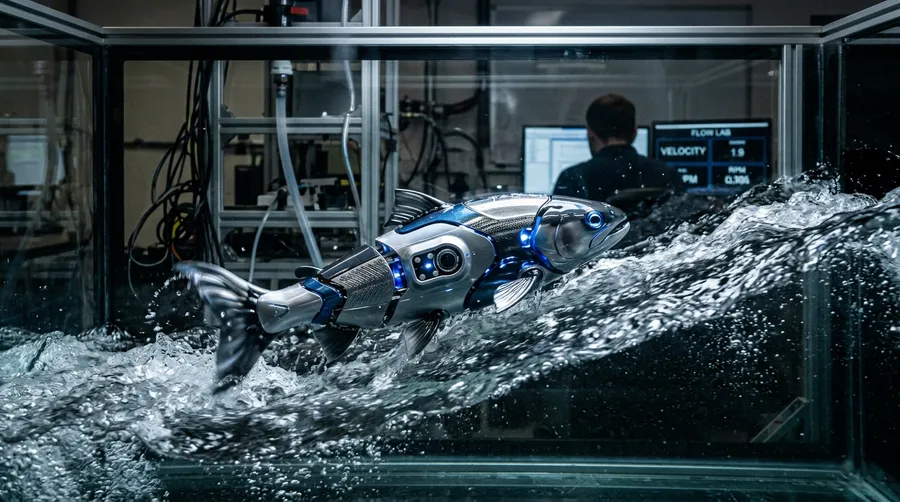
A robotic fish swims against a strong current in the lab.
🇺🇸 Robotic Fish Mimic Zebrafish in Currents
A team has managed to develop a robotic fish that swims like zebrafish when faced with water currents. They put these robots in tanks and observed how they attempt to hold their position, much like real zebrafish do in rivers. By simulating the water flow, researchers could analyze the role of the fish's brain in navigation. The robotic models provided insights into how zebrafish process sensory information to make quick decisions. Observations suggest that these robots accurately replicate the movements and decisions of live zebrafish. This experiment opened up new ways to study complex fish behaviors without the unpredictability of live animals. It provides a controlled environment where variables can be monitored closely.
🇪🇸 Peces robóticos imitan a los peces cebra en corrientes
Un equipo ha desarrollado peces robóticos que nadan como los peces cebra cuando enfrentan corrientes de agua. Colocaron estos robots en tanques y observaron cómo intentan mantener su posición, similar a los peces cebra reales en los ríos. Al simular el flujo de agua, los investigadores analizaron el papel del cerebro del pez en la navegación. Los modelos robóticos brindaron información sobre cómo los peces cebra procesan la información sensorial para tomar decisiones rápidas. Las observaciones sugieren que estos robots replican con precisión los movimientos y decisiones de los peces cebra vivos. Este experimento abrió nuevas formas de estudiar comportamientos complejos sin la imprevisibilidad de animales vivos.
Como Afiliado de Amazon, obtengo ingresos por las compras adscritas que cumplen los requisitos aplicables.

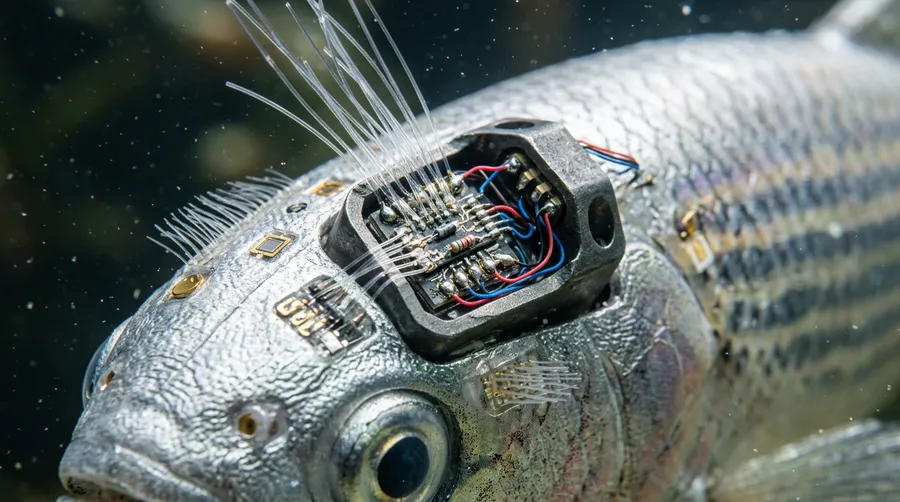
Close-up of sensors mimicking zebrafish sensory organs.
🇺🇸 Background Knowledge on Zebrafish Navigation
Zebrafish have been a focus of research due to their reliance on visual cues for navigation. These small fish use their eyes to track movement in their environment, which helps them maintain their position against currents. Scientists have long known that zebrafish depend heavily on optic flow to gauge speed and direction. This ability allows them to modify swimming patterns and avoid obstacles or predators effectively. What was less clear until recently is how exactly they integrate various sensory inputs to produce coherent movement responses. Many believed that vision was just part of the equation, but precise mechanisms remained elusive until this robotic breakthrough.
🇪🇸 Conocimiento previo sobre la navegación del pez cebra
Los peces cebra han sido objeto de investigación por su dependencia en las señales visuales para navegar. Estos pequeños peces usan sus ojos para rastrear el movimiento en su entorno, lo cual ayuda a mantener su posición contra las corrientes. Los científicos sabían desde hace tiempo que los peces cebra dependen mucho del flujo óptico para medir la velocidad y dirección. Esta habilidad les permite modificar sus patrones de nado y evitar obstáculos o depredadores eficazmente. Lo que no estaba tan claro hasta hace poco era cómo integraban exactamente varias entradas sensoriales para producir respuestas de movimiento coherentes.

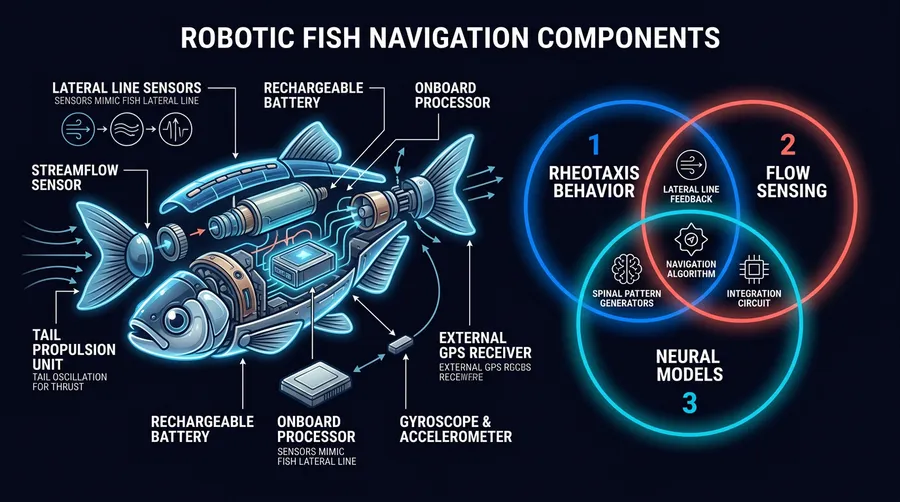
Diagram of components aiding robotic fish navigation.
🇺🇸 Mechanics Behind Robotic Fish Movement
The mechanical design of these robotic fish isn't overly complex but is highly effective at mimicking real zebrafish movements. Engineers equipped the robots with sensors that detect changes in water flow and direction, similar to how zebrafish use their eyes and lateral line systems. As water flows past, these sensors communicate with an onboard processor that calculates adjustments needed for maintaining position or changing course. The robots' fins are powered by small motors that respond quickly to sensor inputs, enabling them to adjust their swimming patterns in real time. While not perfect replicas, they offer a close approximation of natural behaviors observed in living zebrafish.
🇪🇸 Mecánica detrás del movimiento del pez robótico
El diseño mecánico de estos peces robóticos no es excesivamente complejo pero es muy efectivo imitando los movimientos reales de los peces cebra. Los ingenieros equiparon a los robots con sensores que detectan cambios en el flujo y la dirección del agua, similar a cómo los peces cebra usan sus ojos y sistemas de línea lateral. A medida que el agua fluye, estos sensores se comunican con un procesador a bordo que calcula los ajustes necesarios para mantener la posición o cambiar de rumbo. Las aletas de los robots están impulsadas por pequeños motores que responden rápidamente a las entradas de los sensores.


The robotic fish adjusts to the water current.
🇺🇸 Implications for Understanding Fish Behavior
This new approach to studying fish behavior has some interesting implications for both science and technology. For researchers, it means they can now conduct experiments that were difficult with live subjects due to ethical concerns or logistical challenges. In terms of technological applications, these robotic fish could be used in environmental monitoring or even search and rescue operations underwater. There is also potential for using this technology in designing better aquatic drones that navigate more naturally through water environments.
🇪🇸 Implicaciones para comprender el comportamiento de los peces
Esta nueva forma de estudiar el comportamiento de los peces tiene algunas implicaciones interesantes tanto para la ciencia como para la tecnología. Para los investigadores, significa que ahora pueden realizar experimentos que eran difíciles con sujetos vivos debido a preocupaciones éticas o desafíos logísticos. En términos de aplicaciones tecnológicas, estos peces robóticos podrían usarse en monitoreo ambiental o incluso en operaciones de búsqueda y rescate bajo el agua.

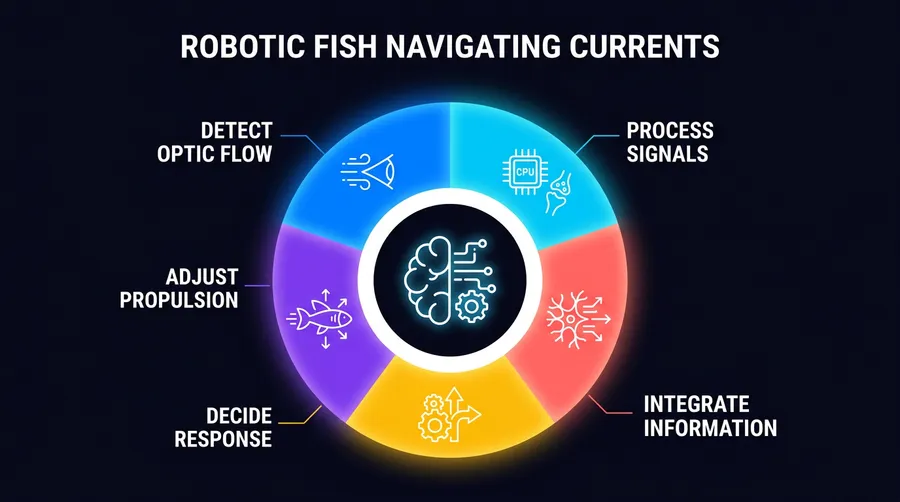
Flowchart of the robotic fish's navigation process.
🇺🇸 Lingering Questions About Zebrafish Navigation
No one knows how zebrafish process multiple sensory inputs simultaneously while swimming upstream against strong currents. How does the integration happen at the neural level How do they prioritize visual data over other types Researchers are also unsure about the role hormones play during extended periods of navigation under challenging conditions.
🇪🇸 Preguntas pendientes sobre la navegación del pez cebra
Nadie sabe cómo procesan simultáneamente múltiples entradas sensoriales mientras nadan contra fuertes corrientes aguas arriba. Cómo ocurre la integración a nivel neuronal Cómo priorizan los datos visuales sobre otros tipos El papel que juegan las hormonas durante períodos prolongados bajo condiciones desafiantes también es incierto.

Researchers monitor the robotic fish in the lab.
🔗 Related Articles | Artículos Relacionados
Nuestro canal transmite datos curiosos de ciencia, IA, espacio y tecnología las 24 horas. | Our channel streams science facts, AI, space and technology around the clock.
▶ Ver transmisión | Watch liveOPEN YOUR MIND
Source: Source
Join the conversation