Innovative Hydrogel Simplifies Creation of Living Tissue Models
Innovative Hydrogel Simplifies Creation of Living Tissue Models
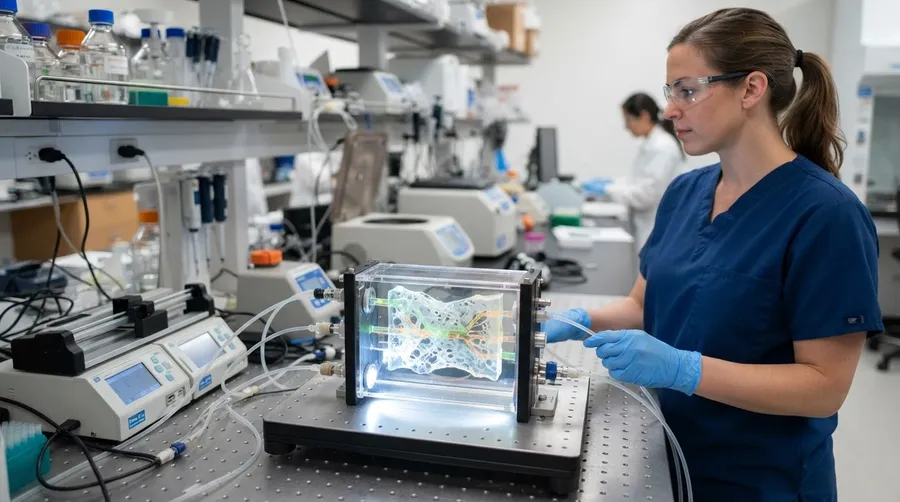
The hydrogel platform is set up in a bright, sterile lab environment.
🇺🇸 A New Hydrogel Platform Emerges
Researchers at Tampere University have come up with something pretty cool: a hydrogel platform that makes building living tissue models easier. It's not just some lab experiment never to be seen again, but a real tool you can use. They've created this plug-and-play technology that lets you mix and match different biological molecules under cell-friendly conditions. This means proteins, peptides, and nucleic acids can all join the party without stressing out the cells they're supposed to help. The goal here is to support tissue engineering, disease modeling, drug discovery, and even regenerative medicine. Published in Cell Reports Physical Science, this study could really change how scientists approach creating biomaterials for research and medical applications.
🇪🇸 Un Nuevo Hidrogel Revoluciona la Creación de Modelos de Tejido Vivo
En la Universidad de Tampere han desarrollado una plataforma de hidrogel que simplifica la creación de modelos de tejido vivo. Sí, es una herramienta útil y no solo un experimento para olvidar. Han diseñado una tecnología versátil que permite combinar diferentes moléculas biológicas en condiciones amigables para las células. Esto significa que proteínas, péptidos y ácidos nucleicos pueden integrarse sin dañar las células con las que trabajan. La finalidad es apoyar la ingeniería de tejidos, la modelación de enfermedades, el descubrimiento de fármacos y la medicina regenerativa. Este trabajo, publicado en Cell Reports Physical Science, podría cambiar radicalmente cómo se fabrican los biomateriales para investigación y aplicaciones médicas.
Como Afiliado de Amazon, obtengo ingresos por las compras adscritas que cumplen los requisitos aplicables.

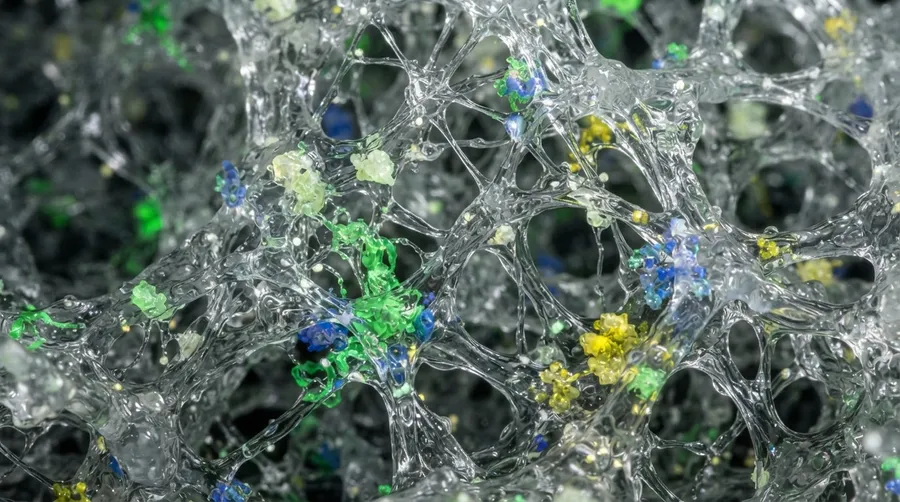
A close-up reveals the hydrogel's intricate mesh-like structure.
🇺🇸 The Background of Tissue Engineering
Before this came around, creating living tissue models was quite the ordeal. Tissue engineering has been around for a while but it often required complex processes and materials that were costly and not particularly adaptable. Scientists used to rely on rigid scaffolds or chemically harsh conditions to create these models. Approaches varied widely based on what you wanted to achieve; one size definitely did not fit all. The concept of creating a customizable and adaptable platform was more like a dream than reality until now. Just think about how many fields could benefit from models that mimic actual human tissues without all the hassle.
🇪🇸 Antecedentes en la Ingeniería de Tejidos
Antes de este avance, crear modelos de tejido vivo era complicado y agotador. La ingeniería de tejidos lleva tiempo existiendo pero a menudo requería procesos complejos y costosos que no se adaptaban bien a todos los propósitos. Los científicos solían usar estructuras rígidas o condiciones químicas duras para crear estos modelos. Cada enfoque varía según el objetivo deseado; no había un método universal efectivo. La idea de una plataforma personalizable y adaptable parecía más un sueño que una posibilidad concreta hasta ahora. Imagina cuántos campos podrían beneficiarse realmente con modelos que imiten tejidos humanos sin tantas complicaciones.

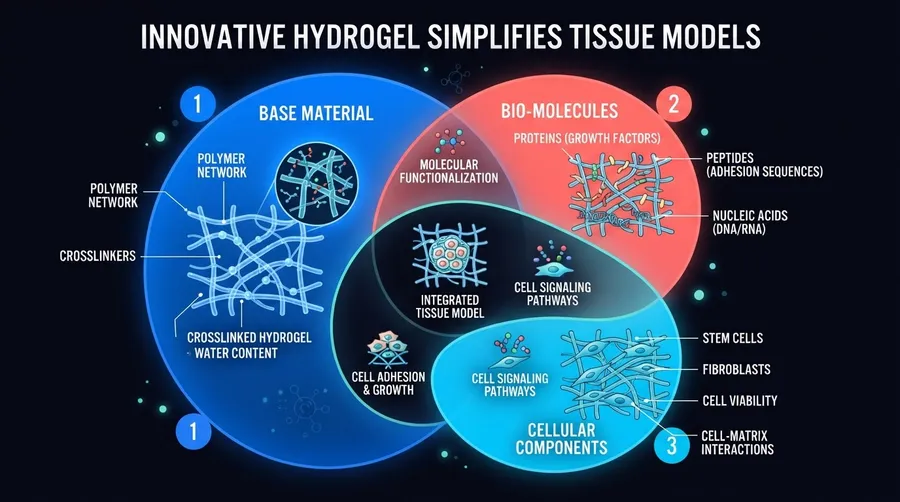
Diagram showing the composition of the innovative hydrogel.
🇺🇸 How It Works Mechanically
So let's break down what's happening inside this hydrogel platform. The researchers used a special crosslinking technique that allows the gel itself to be easily customized at the molecular level. This crosslinking happens in mild conditions so as not to harm any cells involved in the process. Picture it as snapping together pieces of a puzzle that fit perfectly without forcing them into place. Proteins, peptides, and nucleic acids can be incorporated smoothly, allowing for precise control over the material's properties and functions. This flexibility opens up new possibilities for creating materials more similar to human tissue than ever before.
🇪🇸 Cómo Funciona Mecánicamente
Vamos a ver cómo funciona esta plataforma de hidrogel por dentro. Los investigadores usaron una técnica especial de entrecruzamiento que permite personalizar el gel al nivel molecular fácilmente. Este entrecruzamiento ocurre bajo condiciones suaves para no dañar las células involucradas en el proceso. Imagínalo como juntar piezas de un rompecabezas que encajan perfectamente sin forzarlas en su lugar. Las proteínas, péptidos y ácidos nucleicos se incorporan suavemente, permitiendo un control preciso sobre las propiedades y funciones del material. Esta flexibilidad abre posibilidades nuevas para crear materiales más parecidos al tejido humano que antes.


A researcher demonstrates the hydrogel's plug-and-play crosslinking process.
🇺🇸 Impact on Real-World Applications
What does this mean outside the lab? Well, for one thing, it could make personalized medicine much more feasible by allowing for patient-specific tissue models to be created quickly and accurately. Imagine testing a drug on a small piece of your own heart tissue before taking it yourself — that’s where we’re headed with this tech. Researchers might also find better ways to study diseases as they can work with tissues closer to what is found in humans rather than animal models or 2D cultures in petri dishes.
🇪🇸 Impacto en Aplicaciones del Mundo Real
¿Qué significa esto fuera del laboratorio? Por un lado podría hacer que la medicina personalizada sea mucho más viable al permitir crear modelos específicos del paciente rápida y precisamente. Imagina probar un medicamento en una pequeña parte del tejido de tu propio corazón antes de tomarlo tú mismo — hacia eso nos dirigimos con esta tecnología. Los investigadores también podrían encontrar mejores formas de estudiar enfermedades al trabajar con tejidos más cercanos a los humanos en lugar de modelos animales o cultivos 2D en placas petri.
🇺🇸 What's Still Unknown

So what don’t we know yet? A big question is how stable these custom hydrogels are over time when used in different applications; nobody's nailed down the long-term durability yet. Another unknown is how well they replicate complex biological environments found in actual human tissues under various conditions like stress or temperature changes.
🇪🇸 Lo Que Aún Se Desconoce
¿Qué no sabemos todavía? Una gran pregunta es cuán estables son estos hidrogeles personalizados con el tiempo al usarlos en diferentes aplicaciones; aún no se ha determinado su durabilidad a largo plazo. Otra incógnita es qué tan bien replican ambientes biológicos complejos encontrados en tejidos humanos reales bajo diversas condiciones como cambios de estrés o temperatura.

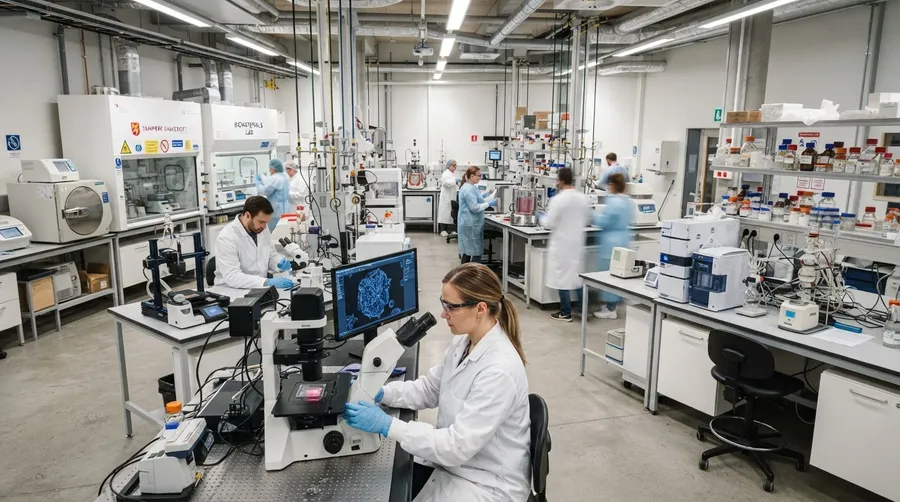
Researchers at Tampere University work with the hydrogel platform.
🔗 Related Articles | Artículos Relacionados
Nuestro canal transmite datos curiosos de ciencia, IA, espacio y tecnología las 24 horas. | Our channel streams science facts, AI, space and technology around the clock.
▶ Ver transmisión | Watch liveOPEN YOUR MIND
Source: Source
Join the conversation