How Electric Motors Copy Muscle Coordination in Robots
How Electric Motors Copy Muscle Coordination in Robots

Main visual for How Electric Motors Copy Muscle Coordination in Robots
🇺🇸 A Spring Where a Brain Should Be
Here is the odd part. In several lab setups, a robot leg driven by an electric motor started moving in a coordinated way before anyone wrote the coordination code. The trick was not in the software. The motor sat behind a spring, and the controller treated the whole package a bit like a muscle, with force that depends on stretch and speed. Joints that should have fought each other ended up sharing the load. Their timing lined up on its own. Muscle physiologists had suspected this for years, because even isolated fibres seem to organize movement just by how they push back. Seeing it in hardware is another matter. I kept rereading that part. Coordination without a coordinator, which is strange, if you think about it.
🇪🇸 Un resorte donde debería haber un cerebro
Empecemos por lo raro. Una pata robótica movida por un motor eléctrico empezó a coordinarse sola, sin que nadie programara esa coordinación. El truco no estaba en el código. Estaba en el resorte colocado entre el motor y la articulación, y en una regla de control que imita cómo responde un músculo cuando se estira o se acorta. Las articulaciones dejaron de pelearse y empezaron a repartirse la carga. Los fisiólogos sospechaban algo parecido desde hace tiempo, porque una fibra muscular aislada ya se resiste al cambio de una manera que ordena el movimiento. Verlo en un montón de metal y cables es otra cosa. A mí me costó creerlo.
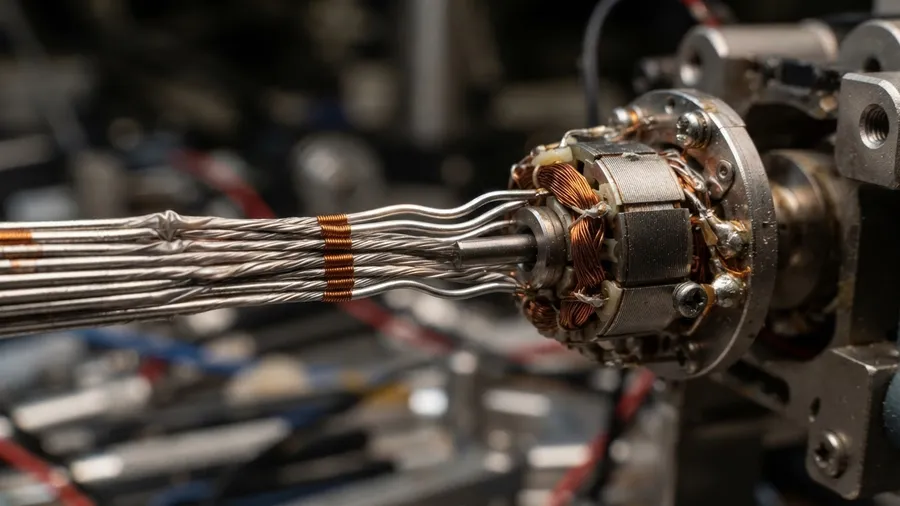
Detail view related to How Electric Motors Copy Muscle Coordination in Robots
🇺🇸 What Everyone Already Suspected
Nobody ever thought the nervous system did everything. In 1990, passive walking machines showed that a pair of legs with the right shape could stroll down a slope with no motor and no computer. Gravity did the work. Soon after, physiologists described preflexes, the instant mechanical response of a muscle before any nerve signal reaches it. Then engineers started putting a spring in line with a motor, so a robot could feel force and stop smashing into things. Those three ideas lived in different buildings for a long time. Biologists read one set of journals, roboticists read another. The overlap only became obvious later, and honestly it still feels a little accidental.
🇪🇸 Lo que ya se sabía
Hay que volver a los años noventa. Unos juguetes mecánicos que bajaban una cuesta caminando, sin motor ni batería, demostraron que la forma de las piernas hace buena parte del trabajo. Después los fisiólogos hablaron de preflexos, que son la respuesta mecánica inmediata del músculo antes de que llegue cualquier señal del nervio. Más o menos por esa época, los ingenieros empezaron a poner resortes en serie con los motores para que el robot sintiera la fuerza y no se estrellara contra todo. Tres ideas, tres comunidades, casi sin hablarse. Cada grupo leía revistas distintas. Juntarlas tardó años, y todavía hoy el encuentro parece medio casual.
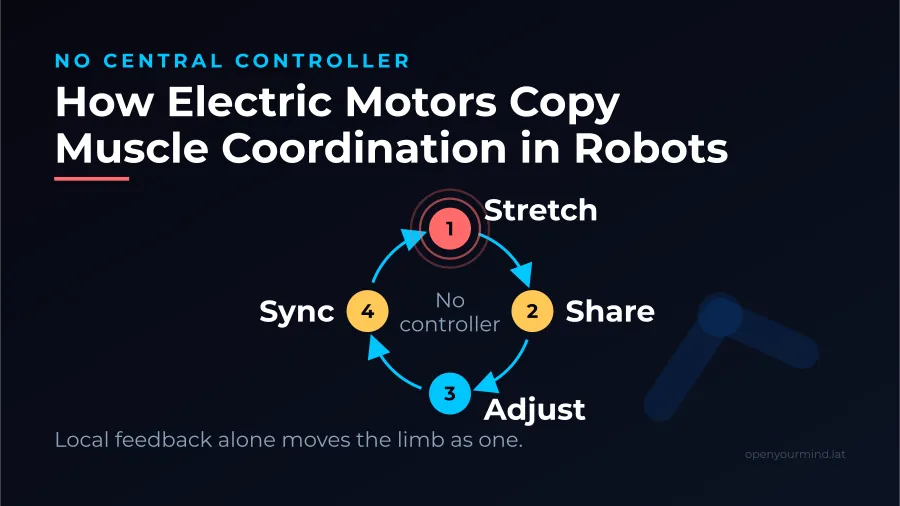
Scientific diagram illustrating key concepts of How Electric Motors Copy Muscle Coordination in Robots
🇺🇸 Where the Coordination Hides
Think of two motors pulling on the same plastic bone, each through its own spring. When one pulls harder, the spring on the other stretches, and its force rises automatically. No message gets sent. The coupling lives in the physical connection. Now add a rule that makes motor force drop as speed rises, which copies how real fibres weaken when they shorten fast. You get damping for free, no extra brake needed. Together these two ingredients make a kind of local negotiation between parts. I think that is the gist. How stable that negotiation stays during sudden movements, I could not fully follow, because the stability math lost me and I will not pretend otherwise.
🇪🇸 Dónde se esconde la coordinación
Imagina dos motores jalando el mismo hueso de plástico, cada uno a través de un resorte. Si uno aprieta más, el resorte del otro se estira y su fuerza sube sin que nadie le avise. La conversación pasa por el material, no por un cable de datos. Luego se agrega una regla: cuanto más rápido se acorta el motor, menos fuerza entrega, igual que una fibra real. Eso frena las oscilaciones sin programar ningún freno. Hasta aquí llego con seguridad. Por qué todo se mantiene estable en movimientos bruscos es otra historia, y las ecuaciones de estabilidad se me escapan. Prefiero decirlo claro que fingir.
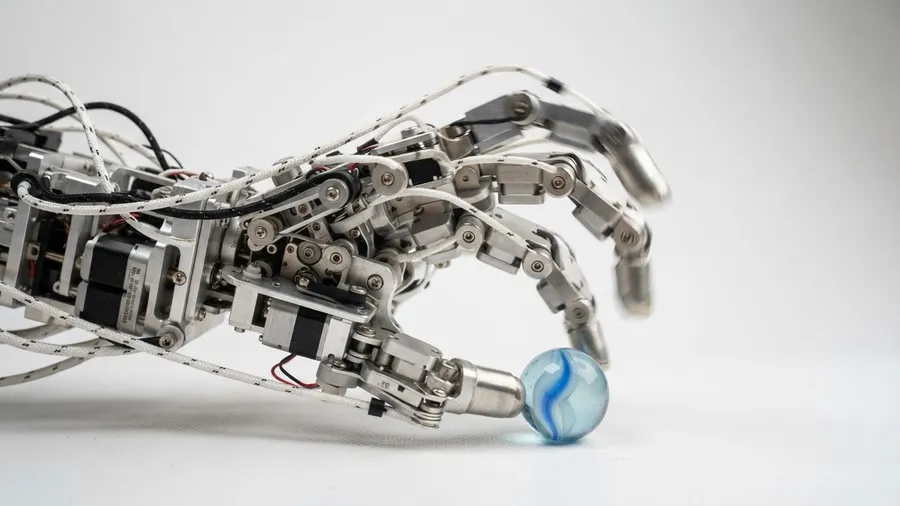
The process described in How Electric Motors Copy Muscle Coordination in Robots
🇺🇸 What Changes for Real People
A prosthetic ankle that adjusts to a curb without the user fiddling with settings. An exoskeleton for a stroke patient that yields when a muscle spasms instead of fighting it. A warehouse arm that bumps a worker and simply gives way. Those are the plausible gains, and they are modest. Springs add weight and cost money. They also wear out. I am skeptical of anyone promising a robot that moves like an athlete by next year. What changes sooner is tuning time. Engineers spend weeks adjusting gait parameters by hand, and a body that sorts out part of that on its own saves real hours for real teams.
🇪🇸 Qué cambia para la gente
Piensa en una prótesis de tobillo que se ajusta sola al subir un bordillo. O en un exoesqueleto para alguien que sufrió un derrame y que cede cuando el músculo se espasma, en vez de pelear contra él. O en un brazo de almacén que roza a un trabajador y se aparta. Son ganancias modestas. Los resortes pesan, cuestan y se desgastan. Desconfío de quien promete un robot atlético para el año que viene. Lo que sí cambia más pronto es el tiempo de ajuste. Hoy un equipo pasa semanas afinando a mano los parámetros de la marcha, y un cuerpo que resuelve parte de eso solo ahorra horas reales.

Data visualization for How Electric Motors Copy Muscle Coordination in Robots
🇺🇸 What Nobody Has Measured Yet
Three gaps stand out. How stiff the spring can be before the effect vanishes. Whether coordination holds when motor force drops by thirty percent, the way a tired muscle does. And what happens at running speed, since most demonstrations I have seen are slow walking. I found no published answers to any of them.
🇪🇸 Lo que nadie ha medido todavía
Faltan tres cosas. No se sabe qué tan rígido puede ser el resorte antes de que el efecto desaparezca. No se sabe si la coordinación aguanta cuando la fuerza del motor cae un treinta por ciento, como en un músculo cansado. Y falta ver qué pasa a velocidad de carrera, porque casi todas las demostraciones que he visto son caminatas lentas. Respuestas publicadas a esas tres, yo no he encontrado ninguna.
🔗 Related Articles | Artículos Relacionados
Nuestro canal transmite datos curiosos de ciencia, IA, espacio y tecnología las 24 horas. | Our channel streams science facts, AI, space and technology around the clock.
▶ Ver transmisión | Watch liveOPEN YOUR MIND
Source: Source
Join the conversation