Dor Minzer and the Limits of Fast Computer Problem-Solving
Dor Minzer hardness of approximation explained: why some problems resist fast solutions, and what his work reveals about computing's limits.
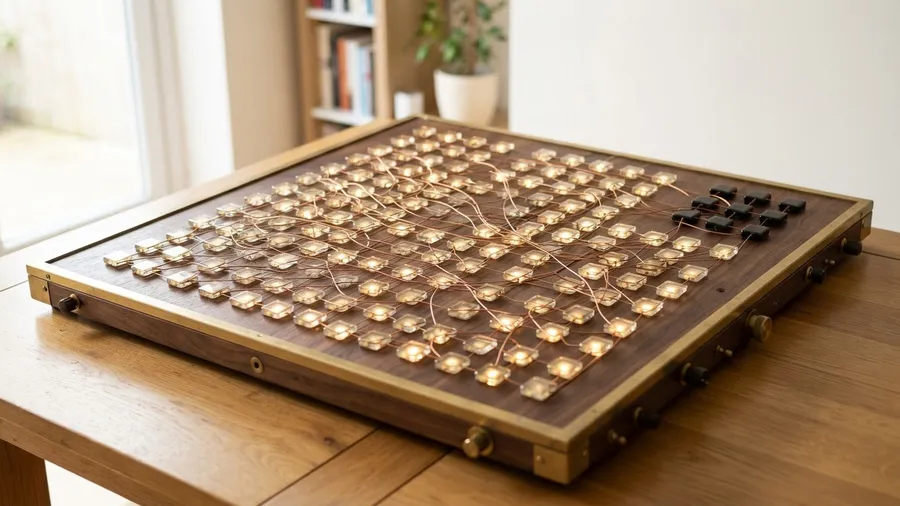
Minzer's constraint game board, where most linked rules can be satisfied at the same time.
🇺🇸 What Minzer, Khot and Safra actually proved
In 2018, Dor Minzer, Subhash Khot and Muli Safra finished a proof about a certain kind of game. Irit Dinur and Guy Kindler had helped with earlier pieces. The game is just a pile of rules, and each rule ties two choices together. Their result says no fast computer method can reliably separate two situations. In one, nearly every rule can be satisfied at once. In the other, almost none can. That holds unless P equals NP, which almost nobody believes. They called it the 2 to 2 games theorem. Minzer was still early in his career, and he later won the Abacus Medal for work in this vein. Which is strange, if you think about it, for a result most people have never heard of.
🇪🇸 Lo que de verdad demostraron
El resultado salió en 2018. Dor Minzer estudió en la Universidad de Tel Aviv con Muli Safra y hoy trabaja en MIT. Firmó la prueba junto a Safra y a Subhash Khot, y antes habían publicado piezas con Irit Dinur y Guy Kindler. La pregunta parece sencilla. Tienes un juego con montones de reglas y quieres saber si casi todas se pueden cumplir a la vez o si casi ninguna. Ellos mostraron que ningún método rápido puede responder eso de forma confiable, salvo que P sea igual a NP. Casi nadie cree que lo sea. Lo llamaron el teorema de los juegos 2 a 2. Lo leí dos veces y todavía me suena a magia.
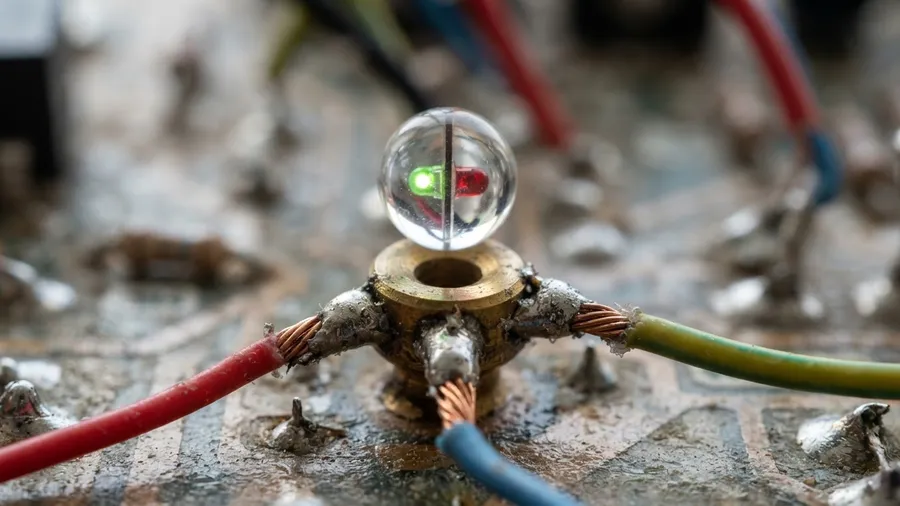
A single wire junction shows one rule satisfied while neighboring rules remain unmet.
🇺🇸 The long road to a half answer
Start in the 1990s. The PCP theorem showed that for some problems, even spotting a rough yes from a rough no is as hard as solving them exactly. That was a shock. It meant approximation could be hopeless, not just slow. Then in 2002 Subhash Khot made a bolder guess, now called the Unique Games Conjecture. It said a very specific kind of game, where each answer from one player pins down exactly one answer from the other, stays hard in that same nearly all versus almost none sense. Nobody could prove it. Nobody could kill it either. Sixteen years went by. The 2 to 2 theorem is a weaker cousin, where each answer leaves two options open instead of one.
🇪🇸 Dieciséis años de espera
Hay que volver a los años noventa. El teorema PCP mostró algo raro. Para ciertos problemas, distinguir un sí aproximado de un no aproximado es tan difícil como resolverlos de forma exacta. Aproximar podía ser imposible, no solo lento. En 2002, Subhash Khot lanzó una apuesta más atrevida, la Conjetura de los Juegos Únicos. Habla de juegos donde cada respuesta de un jugador fija una sola respuesta del otro. Según Khot, ahí también sería difícil separar casi todo de casi nada. Nadie la pudo probar y nadie la pudo tumbar. Pasaron dieciséis años. El teorema 2 a 2 es un primo más débil, porque cada respuesta deja dos opciones abiertas y no una.

Minzer contrasts games where about 99% of rules can be satisfied with ones where about 1% can.
🇺🇸 Inside the machinery
Picture a referee and two players who cannot talk. The referee picks a rule at random, asks each player one question, and checks whether the answers fit. To prove hardness, you take a problem already known to be brutal and convert it into such a game. If the original problem has a solution, the players can win almost every round. If it has none, they should lose almost every round. The trouble is cheating. A clever pair might find strategies that win more than they should. Minzer and his coauthors had to show that any such strategy carries hidden structure. They studied a graph built from subspaces of a vector space, called the Grassmann graph. I followed the outline. The details are well past me.
🇪🇸 Cómo funciona por dentro
Imagina un árbitro y dos jugadores que no pueden hablar entre sí. El árbitro escoge una regla al azar, le hace una pregunta a cada uno y revisa si las respuestas encajan. Para probar que algo es difícil, se toma un problema que ya se sabe brutal y se convierte en un juego así. Si el problema original tiene solución, los jugadores ganan casi todas las rondas. Si no la tiene, pierden casi todas. El lío es la trampa. Una pareja lista podría encontrar estrategias que ganen más de lo debido. Había que probar que toda estrategia así deja una huella ordenada. Para eso usaron el grafo de Grassmann, hecho con subespacios de un espacio vectorial. Yo sigo el esquema general. Los detalles me quedan grandes.
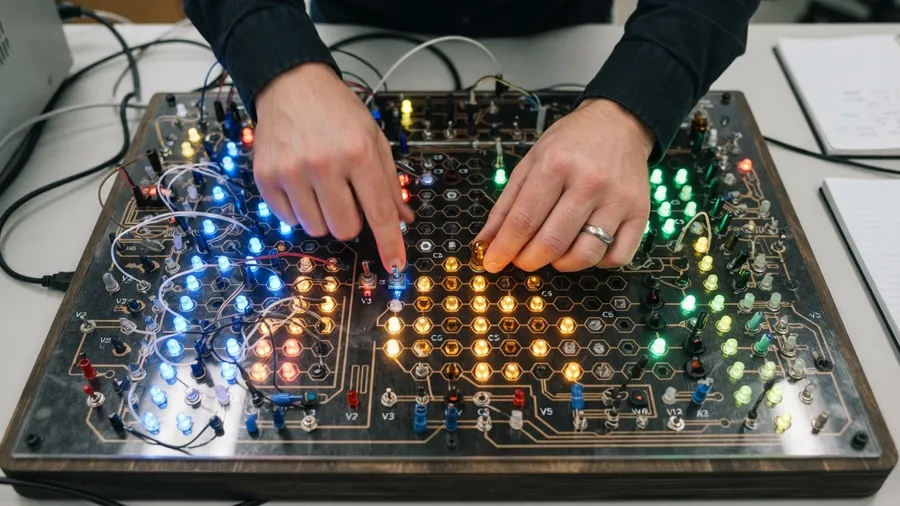
Hands flip a variable switch on the puzzle board, changing rule-lights across the network.
🇺🇸 What changes outside the blackboard
Nobody's phone works differently because of this. Be suspicious of anyone who says otherwise. What changes is what engineers and theorists can stop chasing. Take vertex cover, the problem of choosing the fewest points that touch every link in a network. Before 2018, the best known hardness barrier said no fast method could beat a factor of about 1.36. The new work pushed that to the square root of 2, roughly 1.41. So anyone designing a scheduling or network tool now knows where a promise becomes a lie. Better than 1.41 would collapse P and NP. Methods currently stuck at a factor of 2 still sit in a gap nobody has closed.
🇪🇸 Qué cambia fuera de la pizarra
A nadie le funciona distinto el teléfono por esto. Desconfía de quien te diga lo contrario. Lo que cambia es en qué dejan de perder tiempo los ingenieros y los teóricos. Piensa en el problema de cobertura de vértices, que consiste en escoger los menos puntos posibles para tocar todos los enlaces de una red. Antes de 2018, la barrera conocida decía que ningún método rápido bajaría de un factor cercano a 1.36. El trabajo nuevo subió esa barrera a la raíz de 2, más o menos 1.41. Quien diseñe una herramienta de rutas o de horarios ya sabe dónde una promesa se vuelve mentira. Bajar de 1.41 derrumbaría la frontera entre P y NP. Los métodos actuales siguen en factor 2, y ese hueco sigue abierto.

The reduction starts with a many-rule game and asks if nearly all or almost none can be met.
🇺🇸 What nobody knows yet
Nobody knows whether the full Unique Games Conjecture is true. The 2 to 2 method has not stretched to games with one option per answer. Vertex cover still sits between 1.41 and 2, and no one can say where the real barrier lies. Algorithms for unique games run in subexponential time, and whether anything much faster exists is open.
🇪🇸 Lo que todavía nadie sabe
Nadie sabe si la Conjetura de los Juegos Únicos completa es cierta. El método 2 a 2 no ha logrado extenderse a juegos con una sola opción por respuesta. La cobertura de vértices sigue entre 1.41 y 2, y nadie puede decir dónde está la barrera real. Los algoritmos para juegos únicos corren en tiempo subexponencial, y si existe algo mucho más rápido sigue abierto.
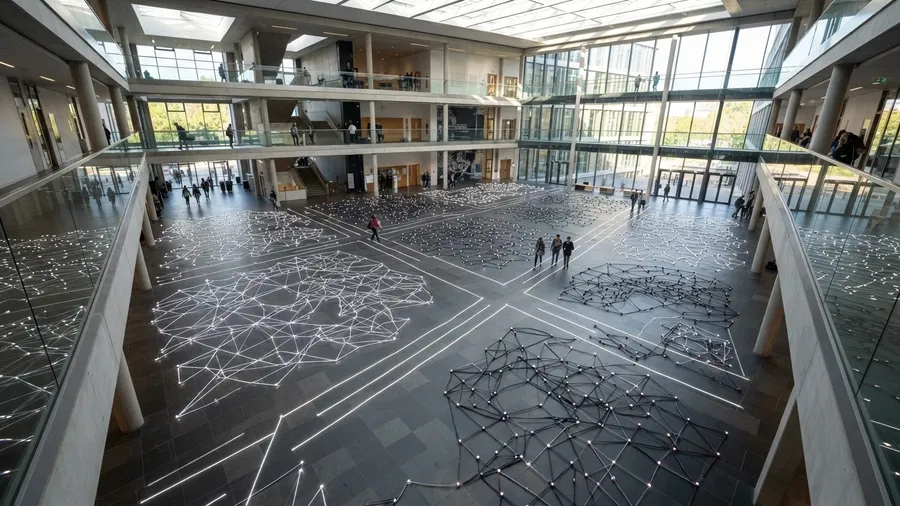
A walk-on constraint network installation shows the scale of the problems studied.
🔗 Related Articles | Artículos Relacionados
Nuestro canal transmite datos curiosos de ciencia, IA, espacio y tecnología las 24 horas. | Our channel streams science facts, AI, space and technology around the clock.
▶ Ver transmisión | Watch liveOPEN YOUR MIND
Source: Source
Join the conversation