Helium-Based Qubit Promises Major Error Reduction
Helium-Based Qubit Promises Major Error Reduction

A state-of-the-art helium-based qubit setup in the lab.
🇺🇸 Helium-Based Qubit: Reducing Errors
Researchers have proposed a qubit that uses superfluid helium to potentially reduce error rates in quantum computing by a factor of 100. This sounds like one of those crazy sci-fi ideas, right? But there's some solid theory behind it. It seems that superfluid helium might shield quantum information from electromagnetic noise. And if that works, we're talking about a huge improvement in maintaining data integrity. This could significantly impact how quantum computers perform and maybe even bring us closer to practical applications. The key is whether experiments can confirm these predictions, a question that remains open at this moment.
As an Amazon Associate I earn from qualifying purchases.

🇪🇸 Qubits de Helio: Menos Errores
Los investigadores han propuesto un qubit que usa helio superfluido para reducir los errores en la computación cuántica. Sí, suena a ciencia ficción, ¿verdad? Pero hay teoría sólida detrás de esto. El helio superfluido podría proteger la información cuántica del ruido electromagnético común. Eso significa mejoras enormes en preservar la integridad de los datos. Podría cambiar notablemente el rendimiento de los ordenadores cuánticos y hasta acercarnos a aplicaciones prácticas. Todavía falta confirmar estas predicciones con experimentos, un paso crucial que aún está pendiente.

Close-up view of superfluid helium's shimmering surface.
🇺🇸 Quantum Computing and Error Rates
Before this idea with helium came up, scientists were already grappling with error rates in quantum computing. Superconducting qubits were the main players in the field, but they had their own challenges. Electromagnetic interference was a big deal and caused errors that crippled calculations. Everyone knew reducing these errors was essential for making quantum computers useful beyond niche applications or labs. To put it simply, errors have been the Achilles' heel of quantum computing, limiting its potential to solve real-world problems efficiently.

🇪🇸 Computación Cuántica y Tasas de Error
Antes de la idea del helio, los científicos lidiaban con las tasas de error en computación cuántica. Los qubits superconductores eran protagonistas en el campo, aunque con retos propios. La interferencia electromagnética era un problema serio que causaba errores significativos en los cálculos. Todos sabían que reducir estos errores era esencial para hacer útiles los ordenadores cuánticos más allá de aplicaciones específicas o laboratorios. En resumen, los errores han sido el talón de Aquiles de la computación cuántica y han limitado su potencial.
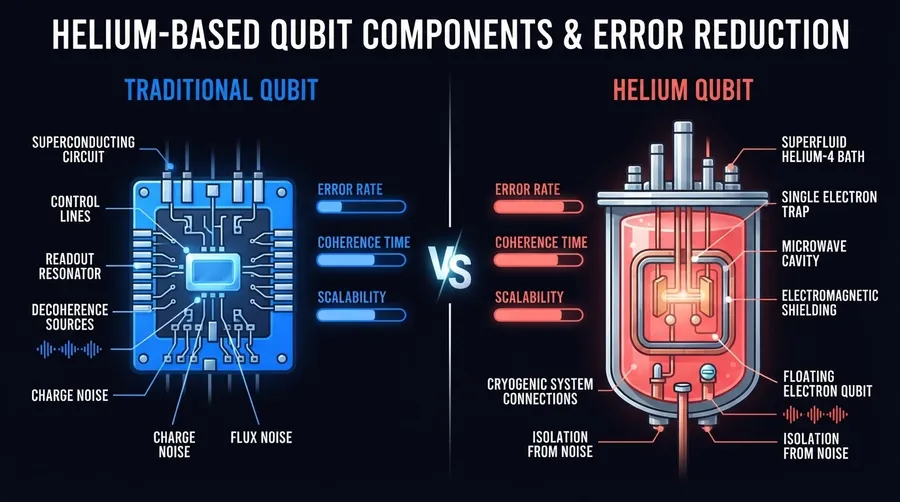
Diagram of helium-based qubit components and functions.
🇺🇸 Mechanics of the Helium Qubit
Superfluid helium has some unique properties that make it an interesting candidate for qubits. First off, it exists at near absolute zero temperatures, which is handy for reducing thermal noise—one of the pesky culprits behind errors in quantum systems. The idea is to trap atoms in this superfluid environment, where they can exist without being disturbed by outside electromagnetic fields. It creates a kind of shield around the delicate quantum states, allowing them to remain coherent longer than before. How effective this shield will be still needs testing.

🇪🇸 Mecánica del Qubit de Helio
El helio superfluido tiene propiedades únicas que lo hacen un candidato interesante para qubits. Se encuentra a temperaturas cercanas al cero absoluto, ideal para reducir el ruido térmico—uno de los culpables detrás de errores en sistemas cuánticos. La idea es atrapar átomos en este entorno superfluido para protegerlos de campos electromagnéticos externos. Esto crea una especie de escudo alrededor de los estados cuánticos delicados, permitiéndoles permanecer coherentes por más tiempo que antes. Aún falta por ver cuán efectivo será este escudo.

Researcher adjusts the helium-based qubit with precision.
🇺🇸 Impact on Quantum Computing Applications
If this helium-based qubit technology pans out, we could see more reliable quantum computers on the horizon. Researchers might finally tackle more complex problems without being constantly derailed by errors. Businesses and scientists could run algorithms faster and with fewer hiccups in fields like drug discovery or cryptography—imagine cracking codes more swiftly than before or finding new molecules at an accelerated pace. Real people might benefit from more accurate simulations or even advances in materials science sooner than expected.

🇪🇸 Impacto en Aplicaciones de Computación Cuántica
Si esta tecnología basada en helio resulta efectiva, podríamos ver ordenadores cuánticos más confiables pronto. Los investigadores podrían abordar problemas más complejos sin ser constantemente interrumpidos por errores. Empresas y científicos ejecutarían algoritmos más rápido y con menos contratiempos en campos como el descubrimiento de fármacos o criptografía—imagina descifrar códigos o encontrar nuevas moléculas más rápidamente que antes. Las personas podrían beneficiarse de simulaciones más precisas o avances en ciencia de materiales antes de lo esperado.
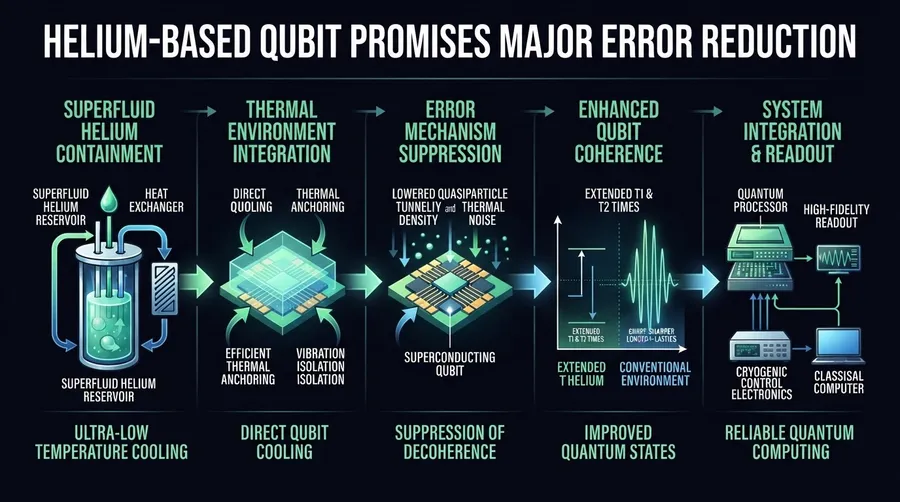
Flowchart of error reduction in helium-based qubits.
🇺🇸 Open Questions and Future Research
Much remains unknown about helium-based qubits. How exactly will they behave under different conditions? Can they be effectively integrated with existing systems? What will the long-term costs look like compared to current technologies? These are pressing questions researchers need to address in future studies to truly gauge the viability of this approach.

🇪🇸 Preguntas Abiertas e Investigación Futura
Mucho queda por saber sobre los qubits basados en helio. ¿Cómo se comportarán exactamente bajo diferentes condiciones? ¿Se integrarán eficazmente con sistemas actuales? ¿Cuál será el costo a largo plazo comparado con tecnologías actuales? Estas son preguntas urgentes que se deben abordar en futuros estudios para evaluar la viabilidad real de este enfoque.
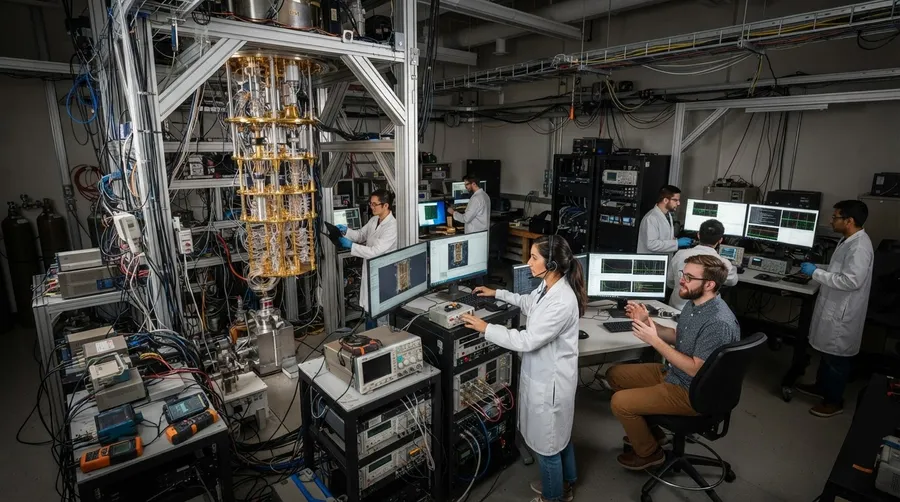
The lab showcases the scale of quantum computing research.
🔗 Related Articles | Artículos Relacionados
Nuestro canal transmite datos curiosos de ciencia, IA, espacio y tecnología las 24 horas. | Our channel streams science facts, AI, space and technology around the clock.
▶ Ver transmisión | Watch liveOPEN YOUR MIND
Source: Source
Join the conversation