Earth's Reaction to Solar Winds The Smile Mission Begins
Earth's Reaction to Solar Winds The Smile Mission Begins

The SMILE spacecraft orbits Earth under the vibrant aurora borealis.
🇺🇸 Earth's Response to Solar Winds
Recently, the European-Chinese Smile mission got the green light, and it's a big deal. The mission aims to uncover how our planet reacts to solar winds. These winds are basically streams of charged particles constantly emitted by the Sun. On 19 May, Smile launched into space. It took about a month to settle into its operational orbit by 20 June. Now, it's ready to collect data that could change our understanding of Earth's magnetic shield. What's interesting is how we often ignore these cosmic interactions when they're happening right above us. It's like knowing there's a storm but never looking outside to see the rain.
As an Amazon Associate I earn from qualifying purchases.

🇪🇸 La respuesta de la Tierra a los vientos solares
La misión Smile de Europa y China ha sido oficialmente aprobada y busca desvelar el enigma de cómo nuestro planeta reacciona ante los vientos solares. Estos vientos son flujos de partículas cargadas que el Sol lanza al espacio continuamente. Smile despegó el 19 de mayo y tardó aproximadamente un mes en alcanzar su órbita operativa el 20 de junio. Ahora está listo para recopilar datos que podrían transformar nuestra comprensión del escudo magnético de la Tierra. Lo curioso es que estos fenómenos cósmicos suelen pasar desapercibidos para nosotros, aunque estén ocurriendo sobre nuestras cabezas.

A detailed view of the SMILE spacecraft's solar panel surface.
🇺🇸 Background on Solar Winds
Solar winds have been known for a long time, affecting Earth in various ways. We knew they interact with our planet's magnetic field, causing phenomena like auroras. But details on their precise effects were fuzzy at best. Scientists have long suspected these winds don't just create pretty lights but may influence weather patterns or even technological systems on Earth. There was always this guesswork involved, kind of like assembling a puzzle with only half the pieces. The new mission hopes to fill in those gaps with hard data.

🇪🇸 Contexto sobre los vientos solares
Los vientos solares han sido conocidos desde hace tiempo por sus efectos en la Tierra. Sabíamos que interactúan con el campo magnético del planeta, provocando fenómenos como las auroras boreales. Sin embargo, los detalles sobre sus efectos exactos eran nebulosos. Los científicos siempre han sospechado que estos vientos no solo crean luces bonitas sino que podrían influir en los patrones climáticos o incluso en sistemas tecnológicos de la Tierra. Siempre hubo un grado de especulación, como armar un rompecabezas con solo la mitad de las piezas.

Key milestones of the SMILE mission from launch to present.
🇺🇸 How the Mission Works
The Smile mission operates through a satellite equipped with specialized instruments to measure solar wind activity and its interaction with Earth's magnetosphere. Think of it as a weather station in space but for cosmic storms. It uses X-ray imaging techniques to visualize these interactions in real time. This isn't easy; capturing something invisible requires precision and technology that can see beyond the normal spectrum of light. I read that part twice because imagining invisible winds interacting with an invisible shield is just wild.

🇪🇸 Cómo funciona la misión
La misión Smile emplea un satélite equipado con instrumentos especializados para medir la actividad del viento solar y su interacción con la magnetosfera terrestre. Es como tener una estación meteorológica en el espacio pero para tormentas cósmicas. Utiliza técnicas de imagen por rayos X para visualizar estas interacciones en tiempo real. Esto no es fácil; capturar algo invisible requiere precisión y tecnología capaz de ver más allá del espectro de luz normal. Pensar en vientos invisibles interactuando con un escudo invisible es simplemente asombroso.
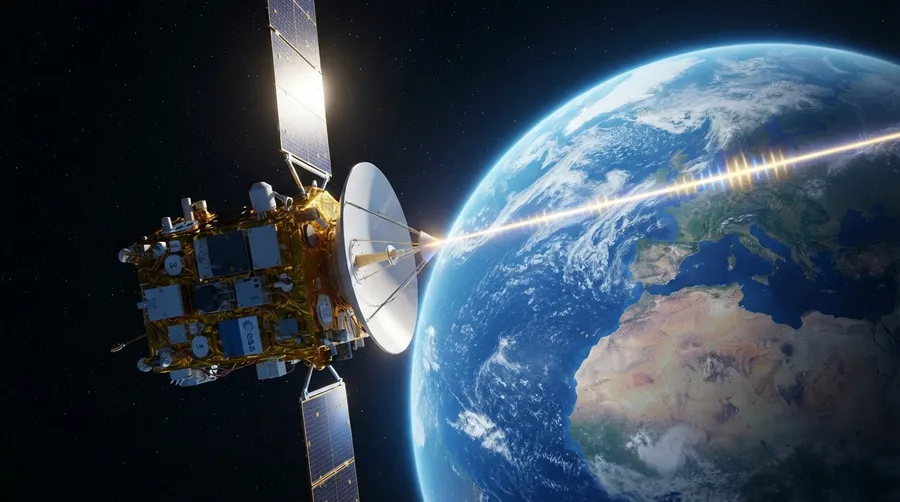
SMILE sends data back to Earth, showcasing its advanced antenna array.
🇺🇸 Impact on Day-to-Day Life
Understanding solar winds might sound esoteric at first, but it has real-world implications. Better predictions of space weather could protect power grids from unexpected surges caused by geomagnetic storms. Imagine fewer blackouts thanks to timely alerts for utility companies. This knowledge could also improve satellite operations and GPS accuracy by mitigating interference from solar activity. The everyday tech we rely on could become more reliable because of this research.

🇪🇸 Impacto en la vida cotidiana
Entender los vientos solares puede parecer esotérico al principio, pero tiene implicaciones reales para nuestro día a día. Mejores predicciones del clima espacial podrían proteger las redes eléctricas de aumentos inesperados causados por tormentas geomagnéticas. Imagina menos apagones gracias a alertas oportunas para las compañías eléctricas. Este conocimiento también podría mejorar las operaciones satelitales y la precisión del GPS al mitigar las interferencias de la actividad solar. La tecnología cotidiana podría volverse más confiable gracias a esta investigación.
🇺🇸 Unanswered Questions
Nobody knows how accurately we can predict large geomagnetic storms yet; that's still up in the air. How do smaller solar wind variations impact climate? Researchers aim to learn that soon too.

🇪🇸 Preguntas sin respuesta
Aún no se sabe cuán precisos pueden ser los pronósticos de grandes tormentas geomagnéticas; eso sigue incierto. ¿Cómo afectan las variaciones más pequeñas del viento solar al clima? Los investigadores esperan descubrirlo pronto.

Scientists monitor the SMILE mission from the control room.
🔗 Related Articles | Artículos Relacionados
Nuestro canal transmite datos curiosos de ciencia, IA, espacio y tecnología las 24 horas. | Our channel streams science facts, AI, space and technology around the clock.
▶ Ver transmisión | Watch liveOPEN YOUR MIND
Source: Source
Join the conversation