NASA's IXPE Unveils Magnetar Mysteries
NASA's IXPE Unveils Magnetar Mysteries

IXPE telescope orbits Earth, unveiling cosmic mysteries.
🇺🇸 A Surprising Find in the Cosmos
NASA's IXPE has been busy. Between March and April 2025, it spent over 140 hours observing the magnetar 1E 1547-5408. What's crazy here is that they seem to have caught empty space doing weird things. Physicists have been theorizing these effects for about 90 years. But no one's ever directly observed it until now. This isn't just about seeing something new. It’s about confirming decades of theories on how space behaves under extreme conditions. These clues could open up a whole spectrum of understanding about our universe's quirks. And it all started by staring at this cosmic oddball for a really long time.
🇪🇸 Un hallazgo inesperado en el cosmos
El IXPE de la NASA no ha parado últimamente. Entre marzo y abril de 2025, dedicó más de 140 horas a observar el magnetar 1E 1547-5408. Lo curioso es que parece haber capturado cómo el espacio vacío se comporta de maneras extrañas. Esto no es solo un hallazgo nuevo; es una confirmación de décadas de teorías sobre el comportamiento del espacio en condiciones extremas. Lo que vieron podría abrir todo un espectro de comprensión sobre las rarezas del universo. Y pensar que todo comenzó observando a este extraño objeto cósmico durante tanto tiempo.
Como Afiliado de Amazon, obtengo ingresos por las compras adscritas que cumplen los requisitos aplicables.


Detailed view of IXPE's advanced X-ray polarimeter sensor.
🇺🇸 The Science We Thought We Knew
Magnetars aren't exactly new to the science scene. We know they're a type of neutron star with insanely strong magnetic fields. People have been studying them for years, trying to figure out what makes them tick. They’re super dense, remnants of massive stars that blew up spectacularly. Their magnetic fields can be a billion times stronger than Earth's, which is wild if you think about it. Scientists knew these fields influence surrounding space, but the actual behavior remained elusive until now.
🇪🇸 La ciencia que creíamos conocer
Los magnetars no son desconocidos en el mundo científico. Han sido estudiados durante años para comprender su funcionamiento interno. Son una especie de estrella de neutrones con campos magnéticos increíblemente fuertes. Estos campos pueden ser mil millones de veces más potentes que los de la Tierra, algo realmente impresionante. Sabíamos que estos campos influían en el espacio circundante, pero el comportamiento exacto siempre fue un misterio hasta ahora.

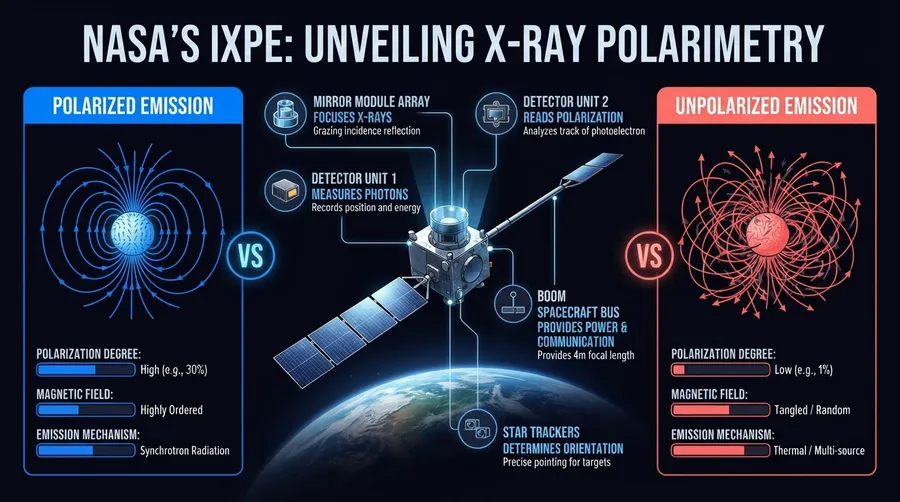
Component diagram of IXPE's X-ray polarimetry technology.
🇺🇸 Mechanics Behind the Observations
How does IXPE work its magic? It's all about X-ray polarimetry, a technique that lets scientists measure the direction of X-ray light from cosmic sources. IXPE can detect minuscule changes in these directions, helping to map out magnetic field structures as they twist and turn in space. This polarization offers a peek into what's happening around a magnetar like 1E 1547-5408 when its magnetic field interacts with nearby particles and electromagnetic waves. It’s like watching a dance in the dark.
🇪🇸 Mecánica detrás de las observaciones
¿Cómo hace su magia el IXPE? Se trata de la polarimetría de rayos X, una técnica que permite medir la dirección de la luz X proveniente de fuentes cósmicas. El IXPE puede detectar cambios minúsculos en estas direcciones para ayudar a cartografiar las estructuras del campo magnético mientras se retuercen en el espacio. Esta polarización ofrece una ventana hacia lo que sucede alrededor de un magnetar como el 1E 1547-5408 al interactuar con partículas cercanas y ondas electromagnéticas.

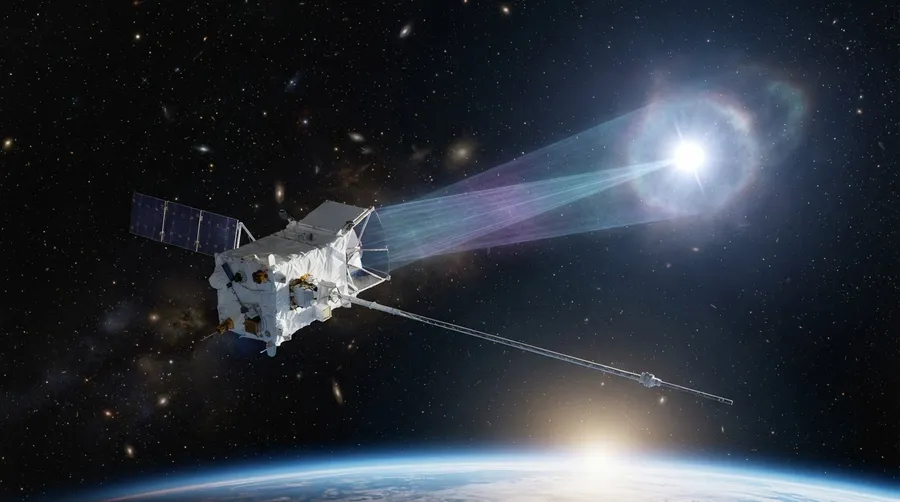
IXPE aligns to capture X-ray data from a distant magnetar.
🇺🇸 Why You Should Care
So, here's where it might hit closer to home for some folks. Understanding magnetars could refine our theories of physics itself, which influence technology indirectly over time. From GPS systems to advanced medical imaging techniques, physics discoveries have trickle-down effects everywhere. These findings might help researchers develop new models for how stars evolve and die too, shedding light on the life cycles of celestial bodies we rely on for everything from curiosity to survival.
🇪🇸 Por qué debería importarte
Comprender los magnetars podría afinar nuestras teorías físicas, lo cual influye indirectamente en la tecnología con el tiempo. Desde los sistemas GPS hasta técnicas avanzadas de imagen médica, los descubrimientos físicos tienen efectos colaterales por todas partes. Estos hallazgos podrían ayudar a los investigadores a desarrollar nuevos modelos sobre cómo las estrellas evolucionan y mueren también, arrojando luz sobre los ciclos vitales de cuerpos celestes que son fundamentales para nuestra curiosidad y supervivencia.
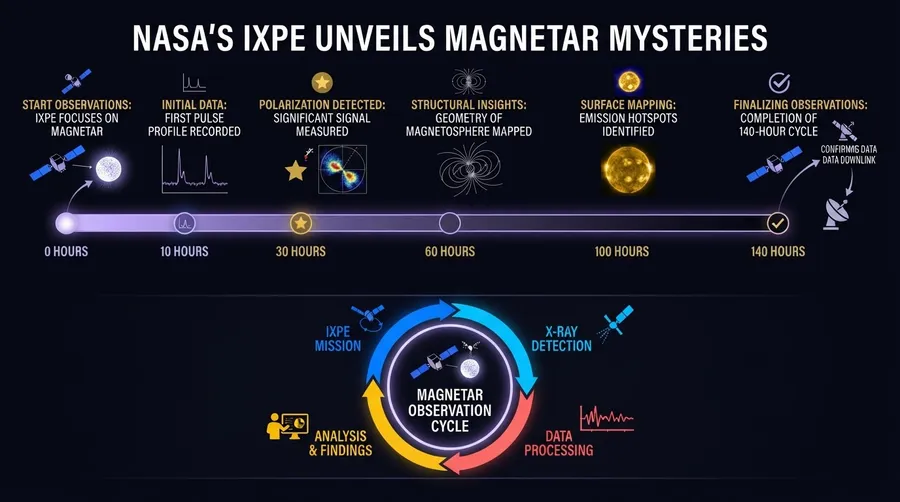
Timeline of IXPE's key findings during magnetar study.
🇺🇸 The Questions That Remain
No one knows how these magnetic fields affect particles at distances farther than currently measured by IXPE. There’s also uncertainty about whether similar behaviors occur around other types of neutron stars. Another big question is how stable these observed phenomena are over time and what triggers any changes observed at all.
🇪🇸 Las preguntas que quedan
Nadie sabe cómo estos campos magnéticos afectan a partículas más alejadas de lo que actualmente mide el IXPE. También hay incertidumbre sobre si comportamientos similares ocurren en otros tipos de estrellas de neutrones y cuánto duran estos fenómenos observados antes de cambiar o desvanecerse.


IXPE team analyzes live data from magnetar observations.
🔗 Related Articles | Artículos Relacionados
Nuestro canal transmite datos curiosos de ciencia, IA, espacio y tecnología las 24 horas. | Our channel streams science facts, AI, space and technology around the clock.
▶ Ver transmisión | Watch liveOPEN YOUR MIND
Source: Source
Join the conversation